


Last Updated: December 22nd, 2024
The university has implemented a “Zero Liquid Discharge” policy and integrates advanced technologies to minimize dependency on freshwater while maximizing reuse.
Executive Summary: 2024 Water Profile
Amrita Vishwa Vidyapeetham continued its strong alignment with UN SDG 6 (Clean Water and Sanitation). The university managed a total water consumption of 384,930 m³ across its campuses. Despite an 8.5% increase in campus population, the university successfully offset a significant portion of its demand through advanced reclamation technologies.

Key Trends Visualized:
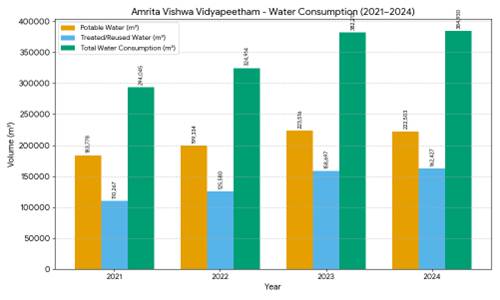
The university’s water sourcing strategy emphasizes reducing reliance on freshwater aquifers by substituting potable water with treated wastewater for non-potable applications.
| Source Category | 2024 Volume (m³) | Details |
| Potable Sources | 222,503 | Includes extraction from borewells and municipal mains7. Extraction is strictly monitored to prevent depletion. |
| Recycled Water | 162,427 | Treated wastewater reused for landscaping and flushing, reducing the need for fresh extraction888. |
| Total Consumption | 384,930 | Combined usage across all campuses9. |
The university maintains a “Zero Liquid Discharge” (ZLD) policy. In 2024, approximately 73% of the total wastewater generated was treated and reused.
Amrita employs an “Integrated Water Management Program” that combines IoT monitoring, biological treatment, and rainwater harvesting
Wastewater Treatment & Reuse (STP)
The university operates decentralized Sewage Treatment Plants (STPs) with a combined capacity of 1.4 Million Liters Per Day (MLD).
Rainwater Harvesting & Groundwater Recharge
To support the aquifers it extracts from, the university has implemented extensive recharge systems:
Smart Water Management (IoT)
The “Ecosphere” Water Sustainability Dashboard tracks consumption patterns across sectors:
Instead of extracting fresh water for all needs, the 162,427 m³ of recycled water was utilized for:
Coimbatore Campus
Amritapuri Campus
Mysore Campus
Amrita’s commitment extends beyond campus borders through the Jivamritam project and Live-in-Labs®.
Jivamritam Project
Village Adoption
In 2024, Amrita Vishwa Vidyapeetham successfully demonstrated that a large institution can decouple its growth from freshwater depletion. By treating wastewater as a resource and rainwater as a reserve, the university has created a circular water economy that protects local aquifers on and off campus.
Sources