Back close

Sustainable Water Extraction and Management Framework

At Amrita Vishwa Vidyapeetham, sustainability is deeply embedded in institutional practice, guiding innovative strategies for water conservation and management. Inspired by the Chancellor’s call to value every drop of water, the university has adopted a comprehensive water extraction policy that minimises dependence on underground freshwater sources while maximising the use of treated and reused water. In support of this approach, Amrita’s campuses are equipped with real-time monitoring systems that track the water cycle from extraction and treatment to distribution and end use. These efforts extend beyond campus boundaries to support over 30 local communities with 24/7 water supply, contributing to water-positive outcomes.
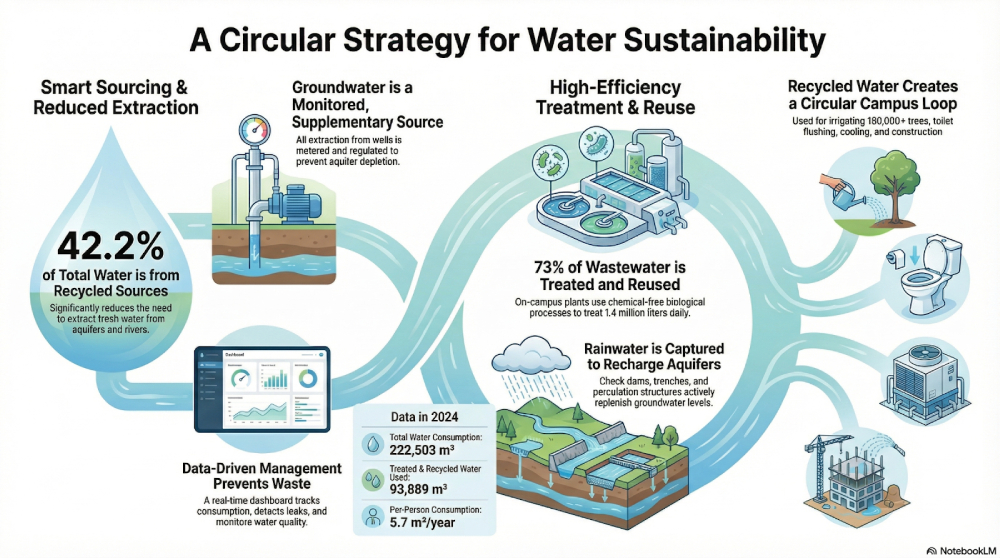
Amrita Vishwa Vidyapeetham follows a sustainable water extraction and reuse strategy that minimises dependence on freshwater aquifers, rivers, and municipal supplies. By combining controlled extractionhigh wastewater reuse, and active groundwater recharge, the university ensures long-term water security across its campuses, in alignment with SDG 6.5: Integrated Water Resource Management.

Zero Liquid Discharge (ZLD) policy is implemented across campuses, treating wastewater as a resource and rainwater as a reserve.
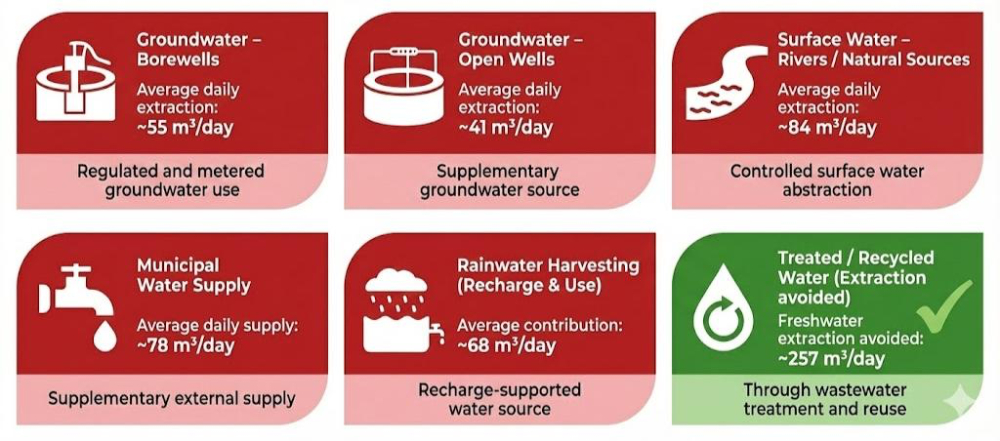
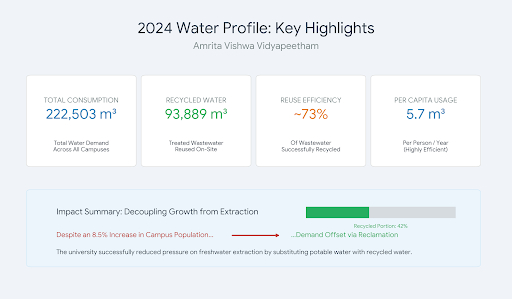
2024 Water Profile – Key Highlights

Despite an 8.5% increase in campus population, the university offset a significant share of demand through reclamation and reuse, reducing pressure on freshwater extraction.
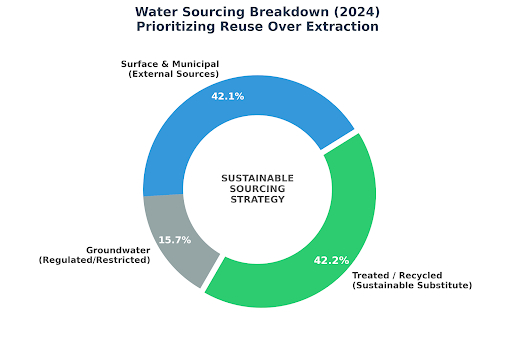
Sustainable Water Extraction Sources

  • Groundwater (borewells and wells):
    Extraction is metered, monitored, and regulated to prevent depletion and is used only as a supplementary source.
  • Surface and municipal sources:
    Used in combination with reuse systems to avoid over-dependence on any single source.
  • Treated and recycled water:
    Accounts for 42.2% of total water use, significantly reducing extraction from aquifers and rivers.

Sustainable Technologies on Campus

Wastewater Treatment and Reuse

The university operates decentralised Sewage Treatment Plants (STPs) with a combined capacity of 1.4 MLD, enabling large-scale reuse.
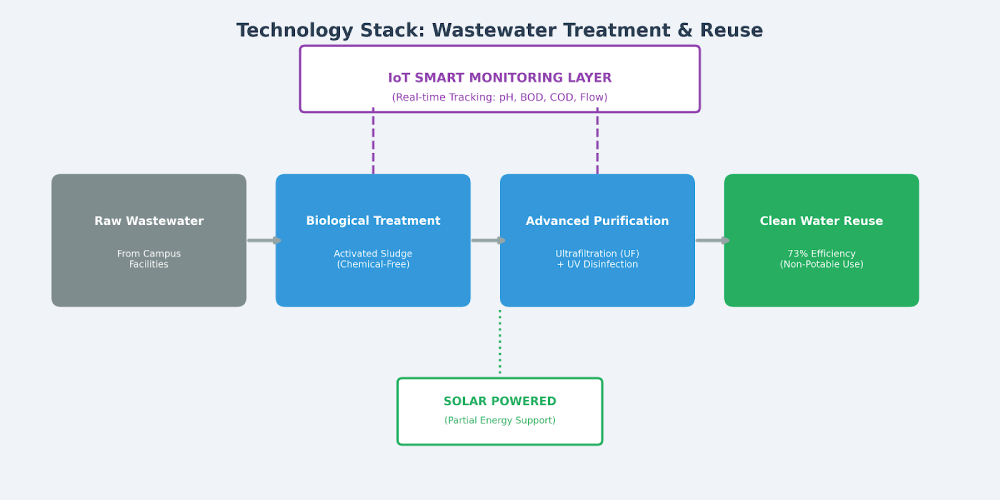
Key features include:

  • Chemical-free biological treatment (activated sludge process)
  • Ultrafiltration (UF) and UV disinfection for safe reuse
  • IoT-enabled monitoring of pH, BOD, COD, and flow parameters
  • Partial use of solar-powered systems for energy efficiency

By 2024, approximately 73% of wastewater generated was treated and reused, supporting non-potable demands across campuses.

Rainwater Harvesting and Groundwater Recharge

To balance extraction, Amrita has implemented extensive recharge mechanisms:
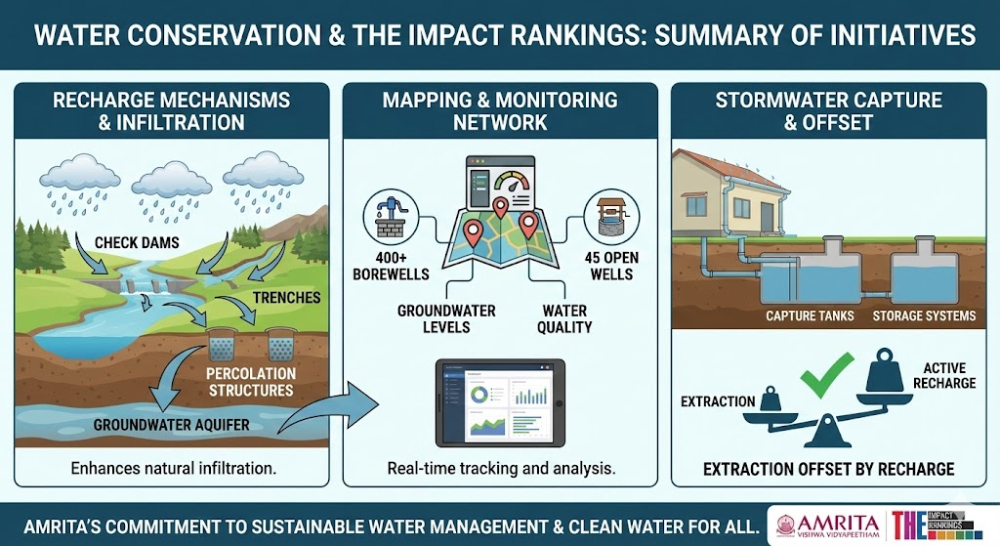
  • Check dams, trenches, and percolation structures to enhance infiltration
  • Mapping and monitoring of over 400 borewells and 45 open wells to track groundwater levels and quality
  • Stormwater capture systems to reduce runoff losses

These measures ensure that groundwater extraction is offset by active recharge.

Smart Water Management

The Ecosphere Water Sustainability Dashboard integrates real-time data on:

  • Water extraction and consumption
  • Leak detection and efficiency tracking
  • Drinking water quality parameters (pH, turbidity, dissolved solids)

This digital governance framework enables adaptive extraction management based on availability and seasonal conditions.

How Recovered Water Is Used

Instead of extracting fresh water for all needs, recycled water is used for:

  • Irrigation and landscaping (supporting over 1.8 lakh trees)
  • Toilet flushing and cooling towers
  • Construction and campus maintenance
  • Composting of nutrient-rich sludge for use as organic fertiliser

This creates a circular water and nutrient loop, reducing both extraction and waste.

Sustainable Water Extraction Beyond Campus

Amrita extends its approach off-campus through Jivamritam and Live-in-Labs® initiatives:

  • Installation of community-owned filtration systems that avoid high-rejection RO technologies
  • Promotion of low-energy, low-waste purification systems
  • Support for village water committees to manage extraction sustainably

By 2024, these initiatives continued to support thousands of rural communities, reducing groundwater stress at the community level.
Last Updated: December 22nd, 2024

Overview

The university has implemented a “Zero Liquid Discharge” policy and integrates advanced technologies to minimize dependency on freshwater while maximizing reuse.

Executive Summary: 2024 Water Profile

Amrita Vishwa Vidyapeetham continued its strong alignment with UN SDG 6 (Clean Water and Sanitation). The university managed a total water consumption of 384,930 m³ across its campuses. Despite an 8.5% increase in campus population, the university successfully offset a significant portion of its demand through advanced reclamation technologies. 

  • Total Water Consumption (2024): 384,930 m³. 
  • Total Potable Water Extracted: 222,503 m³ (Mains + Borewell). 
  • Total Recycled Water Used: 162,427 m³. 
  • Reuse Efficiency: 73% of total wastewater generated. 
  • Per-Person Consumption: 9.9 m³/person/year (decreased from 10.7 in 2023) 

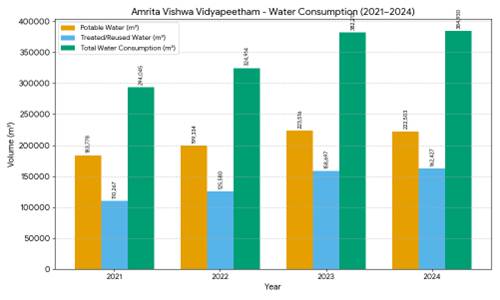
Key Trends Visualized: 

  • Total Consumption (Green): Shows a steady increase, correlating with the campus population growth. 
  • Treated/Reused Water (Blue): Demonstrates a consistent upward trend, reflecting the increasing efficiency of the STP and reuse systems (reaching 73% in 2024). 
  • Potable Water (Orange): While it increased initially, it stabilized and slightly decreased between 2023 and 2024, despite the population growth, indicating successful conservation measures. 
Visualization of the water consumption trends from 2021 to 2024 based on the report data.
Water Extraction Sources

The university’s water sourcing strategy emphasizes reducing reliance on freshwater aquifers by substituting potable water with treated wastewater for non-potable applications.

Source Category 2024 Volume (m³) Details
Potable Sources 222,503 Includes extraction from borewells and municipal mains7. Extraction is strictly monitored to prevent depletion.
Recycled Water 162,427 Treated wastewater reused for landscaping and flushing, reducing the need for fresh extraction888.
Total Consumption 384,930 Combined usage across all campuses9.

The university maintains a “Zero Liquid Discharge” (ZLD) policy. In 2024, approximately 73% of the total wastewater generated was treated and reused.

Sustainable Technologies on University Grounds (On-Campus)

Amrita employs an “Integrated Water Management Program” that combines IoT monitoring, biological treatment, and rainwater harvesting

Wastewater Treatment & Reuse (STP)

The university operates decentralized Sewage Treatment Plants (STPs) with a combined capacity of 1.4 Million Liters Per Day (MLD).

  • Technology: The STPs use a chemical-free biological process involving:
    • Aerobic Activated Sludge: Microbial degradation of organic waste.
    • Ultrafiltration (UF): Advanced filtration powered by solar panels in some units.
    • UV Disinfection: Ensures pathogen-free water for safe reuse.
  • Smart Monitoring: The entire process is IoT-enabled, monitoring parameters like pH, BOD, and COD in real-time.

Rainwater Harvesting & Groundwater Recharge

To support the aquifers it extracts from, the university has implemented extensive recharge systems:

  • Check Dams & Trenches: These structures slow runoff, allowing water to percolate and recharge the groundwater table.
  • Borewell Mapping: Over 400 borewells and 45 open wells have been mapped and monitored to track water levels and quality.

Smart Water Management (IoT)

The “Ecosphere” Water Sustainability Dashboard tracks consumption patterns across sectors:

    • Real-time Tracking: IoT smart meters and sub-meters detect leaks and track usage efficiency.
    • Quality Monitoring: Sensors monitor drinking water parameters (Turbidity, pH, Dissolved Solids) to ensure safety.
Application of Recovered Water

Instead of extracting fresh water for all needs, the 162,427 m³ of recycled water was utilized for:

  • Irrigation & Landscaping: Supporting the university’s 180,000+ trees and herbal gardens.
  • Toilet Flushing & Cooling Towers: High-volume non-potable uses.
  • Construction & Cleaning: Reducing the potable water footprint of campus maintenance.
  • Nutrient Recovery: Treated sludge rich in Nitrogen and Phosphorus is composted and used as fertilizer, creating a circular resource loop.
Community & Future Initiatives
    • Community Outreach: Through the Jivamritam and Live-in-Labs® projects, the university deploys biofiltration systems and low-energy wetlands in rural communities.
    • Future Capacity: A new 400 m³/day STP (STP IV) is planned for 2025–26 to accommodate the growing campus population.
Campus-Specific Initiatives (2024 Highlights)

Coimbatore Campus

  • Utilizes a massive network of check dams and trenches to slow rainwater runoff, allowing it to seep into the ground.
  • Achieved high operational efficiency in STPs during the summer of 2024, ensuring green cover maintenance without freshwater extraction.

Amritapuri Campus

  • Completed significant infrastructure upgrades in 2024 (Divisions A-1, A-2, and B) to enhance rainwater capture near the Engineering College and Hostels.
  • Strategically placed storage tanks behind STP units to mix treated water with rainwater for non-potable use.

Mysore Campus

  • Focuses on erosion control alongside extraction. Runoff is managed to prevent soil loss while filling storage pits that support local groundwater levels.
Off-Campus Sustainable Technologies (Community Outreach)

Amrita’s commitment extends beyond campus borders through the Jivamritam project and Live-in-Labs®.

Jivamritam Project

  • Objective: To provide clean drinking water to rural communities that rely on contaminated groundwater.
  • Technology: The university installs community-owned water filtration systems. These systems use dual-filtration technology (sediment + activated carbon + UV) to purify water from local aquifers/wells without wasting water (unlike typical RO systems which have high rejection rates).
  • 2024 Status: Continued operation and maintenance of units in over 5,000 villages, empowering local “Water Committees” to manage their own extraction sustainability.

Village Adoption

  • In adopted villages, students and faculty design low-cost water distribution networks that prevent over-extraction from single village wells by distributing load and fixing system leaks.

Conclusion

In 2024, Amrita Vishwa Vidyapeetham successfully demonstrated that a large institution can decouple its growth from freshwater depletion. By treating wastewater as a resource and rainwater as a reserve, the university has created a circular water economy that protects local aquifers on and off campus. 

Sources

Admissions Apply Now