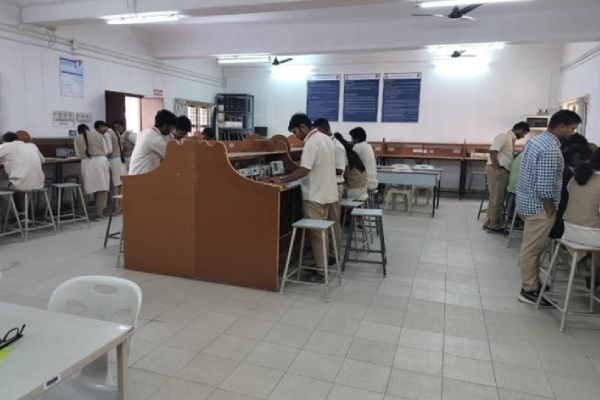
To provide the undergraduate students hands-on experience in fundamental electronic components and circuits. It helps students understand working principles, characteristics, and applications of essential electronic circuits used in engineering aligned with the Electronics and Communication Engineering (ECE) curriculum.
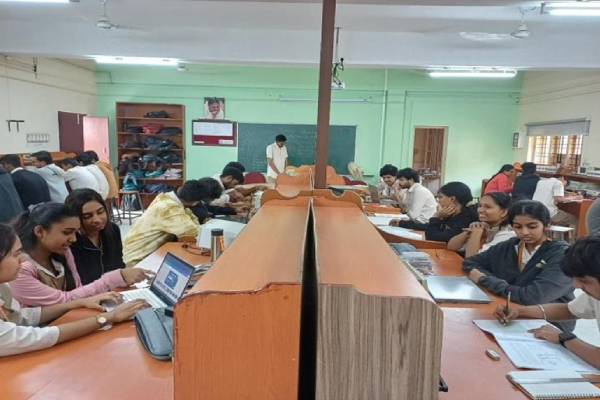
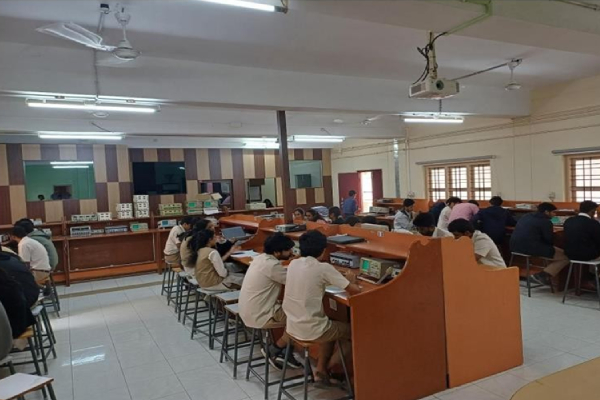
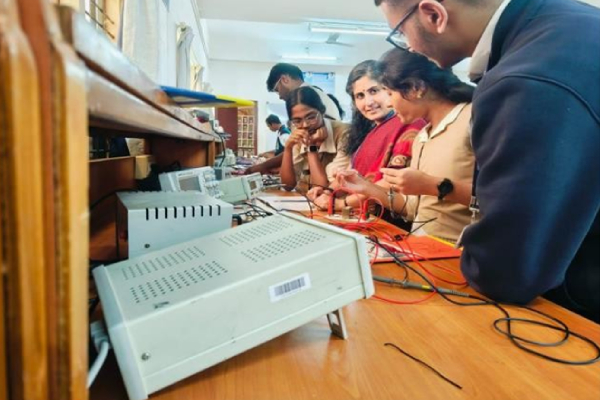
The lab familiarizes students with key electronic components such as resistors, capacitors, diodes, and transistors while developing circuit-building and troubleshooting skills. Through practical exercises, they gain deeper insights into component behaviours and circuit design, enhancingtheirproblem-solvingabilities.Inadditiontocomponent-levelanalysis, students are introduced to system-level design assessment, where they evaluate the integration of multiple circuits into functional electronic systems. This assessment helps them understand circuit interactions, optimize performance, and develop skills in designing comprehensive electronic solutions suitable for real-world applications. The lab is furnished with basic essential equipment such as Cathode Ray Oscilloscopes (CROs), DC power supplies, function generators, multimeters, voltmeters and ammeters and a variety of electronic components like Resistors, capacitors, inductors, diodes, transistors, and ICs which form the backbone of practical circuit design, enabling students to conduct experiment.
To create a value-driven learning environment that ensures the seamless execution of Communication Systems, Analog Electronics, and Linear Integrated Circuits lab courses. The lab is dedicated to providing hands-on experience with advanced equipment, fostering technical proficiency, and enhancing practical understanding in alignment with the Electronics and Communication Engineering (ECE) curriculum.
The lab serves as a vital resource for UG students, supporting their coursework in Communication Systems, Analog Electronics, and Linear Integrated Circuits. It enables students to:
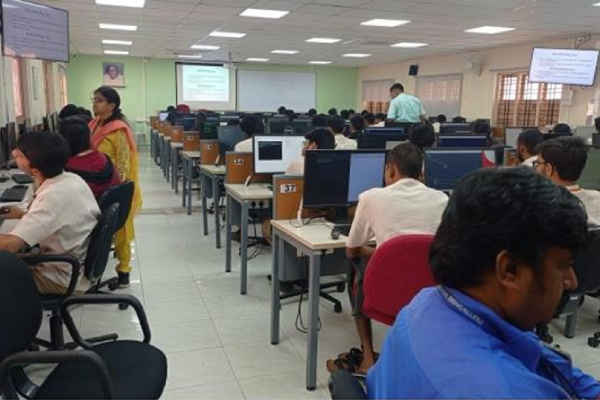
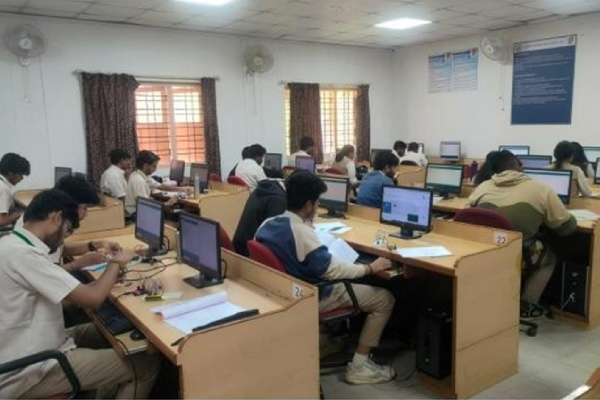
To provide adequate computing facility for the smooth conduct of lab courses per taining to the ECE curriculum that require extensive use of computer programming.
The lab has enough PCs with good hardware configuration and required software installed. Students are allocated individual machines for independent learning during the lab classes. The lab is equipped with a projector, two additional big-screen display monitors and a high quality sound system to facilitate the delivery of instruction material for hands-on learning.
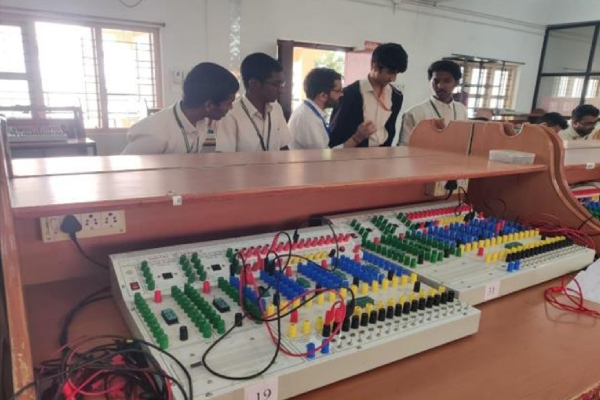
To empower innovation and technological advancement through the integration of cutting-edge digital tools and solutions, fostering a dynamic environment where creativity, collaboration, and problem-solving thrive to shape the future of industries and society.
The lab has enough digital trainer kits with good hardware and required IC’s. Students are allocated individual equipments for independent learning during the lab classes. Its uses are diverse, supporting teaching, learning, experimentation, and innovation. Undergraduate students acquire practical skill and can use the digital lab to build and test their skills in various fields. Students collaborate on group projects, using digital platforms for brainstorming, design, and project management, learning how to work in teams in real-world scenarios.
The vision of a Microcontroller Lab is to provide hands-on experience with embedded systems, fostering innovation and problem-solving through real-world projects. It aims to equip individuals with practical skills in programming and interfacing microcontrollers, preparing them for industry applications in fields like IoT, robotics, and automation.
UG/PG students can develop embedded systems for projects involving real-time data acquisition and control, bridging theory with practical applications. In a Signal Processing Lab, they can analyze and process signals using algorithms, applying concepts like filtering, Fourier transforms, and modulation to address challenges in communications, audio, and image processing. Following Software are available in the Microcontroller & Signal Processing Lab
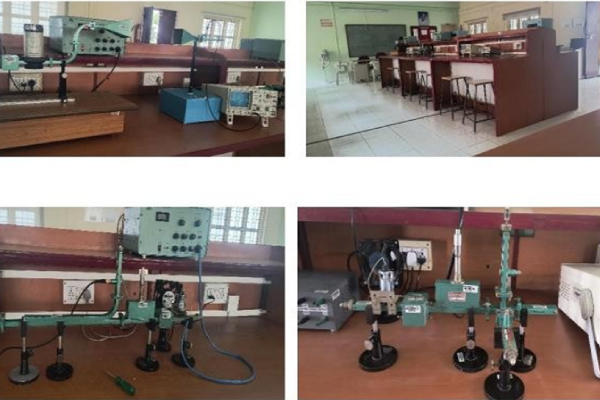
The RF (Radio Frequency) and Simulation Lab is an undergraduate lab pertaining to the ECE curriculum designed for testing and measuring devices and systems that operate using radio frequency and microwave signals in the range of 2 GHz – 12 GHz.
The lab has various RF signal generators, devices, measuring equipments, and PCs with the required software installed for the design and simulation of RF components. The lab is equipped with a projector and a big-screen display monitor to facilitate the delivery of instructional materials.
To provide adequate computing facilities for the smooth conduct of lab courses and research activities related to VLSI Design.
The lab has enough PCs with good hardware configuration and the required software installed. The lab is also equipped with a projector. Students are allocated individual machines for independent learning during lab classes.
The VLSI design laboratory is established with the aim of conducting research in various aspects of the ever-growing field of Very Large-Scale Integration(VLSI)and establishing links between industrial companies. This lab provides basic and advanced facilities for UG and PG coursework related experiments, B.Tech and M.Tech project works and research facilities in the area of device modeling, simulation and various aspects of advanced VLSI Design. This laboratory contains high-end FPGA boards like Zedboard, Virtex6 kit and Spartan-6 kit. In addition to that this lab contains EDA tools like Cadence, Mentor graphics, Synopsys and Vivado design suite. These facilities are used by the B.Tech and M.Tech VLSI design students and Research Scholars to carry out their research in the areas like Formal Verification, Static Timing analysis, Floor planning algorithms, Placement algorithms, Routing algorithms, Clock tree synthesis, Custom design, Digital Signal processing algorithm implementation and Machine learning algorithm implementation. More than 50 papers have been published by M. Tech VLSI students and research scholars in the above-mentioned areas. The VLSI lab focuses on making students industry-ready through collaborations with various industry partners for Research & Development, and training activities.