Sustainable Water Management & Pollution Prevention 2024
Home Sustainable Water Management & Pollution Prevention 2024
Preventing Water System Pollution
In line with its Sustainable Campus Policy, Amrita Vishwa Vidyapeetham is dedicated to sustainable water management, focusing on wastewater treatment, pollution prevention, and water reuse. The university is committed to re-using 80% of its water through advanced treatment mechanisms. The campus has transitioned to a zero-pit toilet system, with high-quality effluent treatment and regular groundwater testing. Additional efforts include water quality monitoring, stormwater management, rainwater harvesting, and educational programs.
Sustainable Wastewater Management & Pollution Prevention at Amrita
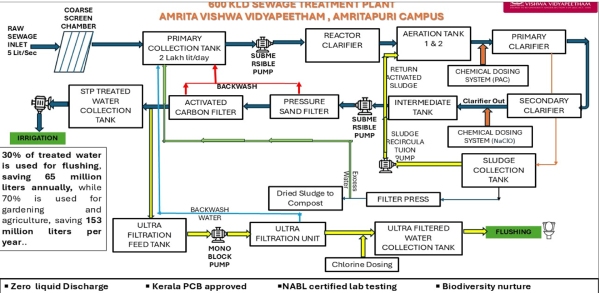
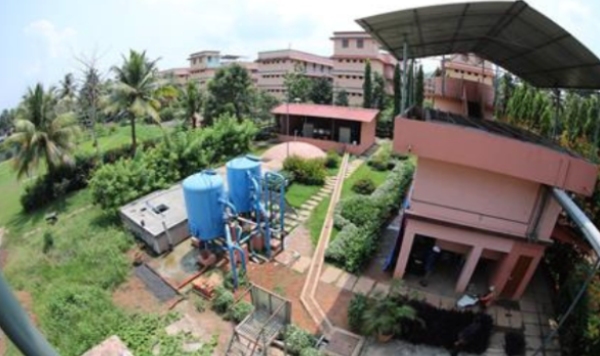
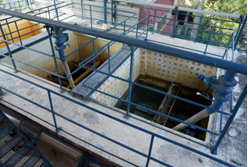
Amrita Vishwa Vidyapeetham is committed to sustainable water management, particularly in wastewater treatment and pollution prevention. The university operates several Sewage Treatment Plants (STPs) with a combined capacity of 1400 cubic meters per day, utilizing aerobic treatment methods and activated sludge mechanisms. Over the past three years, these plants have treated approximately 1,300 cubic meters of sewage water per day, which is then recycled for toilet flushing, arboriculture, and gardening, significantly contributing to freshwater conservation and maintaining a green environment on campus.
STP Plant Layout
The treated water is rich in nutrients, providing essential micronutrients and organic carbon (NPK) to promote plant and crop growth. A new, advanced 4000 cubic meter per day capacity STP (STP-IV) is planned for construction in the academic year 2025-26.
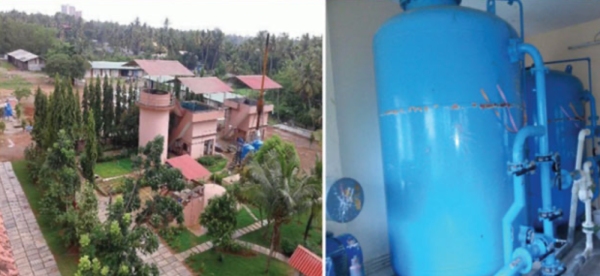
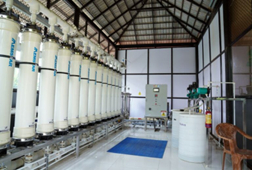
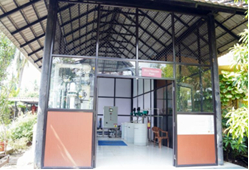
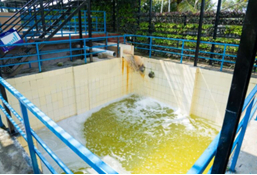
Sewage Treatment Plant
Amrita has transitioned to a zero pit toilet campus, where all the waste is now connected to a comprehensive waste treatment system. This system is designed to effectively treat wastewater, with the Biological Oxygen Demand (BOD) level of the treated water reaching as low as 3, indicating high-quality effluent.
In addition to the waste treatment improvements, the university has implemented a separate pump system for efficient wastewater management. This system ensures proper segregation and treatment of different types of waste. To guarantee that the treated water does not cause contamination, groundwater testing is regularly conducted. Both in-house and external agencies carry out these tests to ensure there is no leakage into the environment, preserving the integrity of the campus’s water supply.
To further enhance water management, a periodic inspection syste checks water pipelines, coolers, tanks, storage units, taps, and other equipment for leaks and maintenance needs. This system ensures that potential issues are identified early, minimizing disruptions in the water supply. Additionally, the Water Department has introduced a log card system to document and track these inspections, ensuring accountability and the timely completion of maintenance activities.
In addition to wastewater treatment, Amrita Vishwa Vidyapeetham has implemented several measures to prevent water pollution:
Regular Water Quality Monitoring: A dedicated team regularly tests water quality at all points of entry to the university’s water system, detecting pollutants such as bacteria, chemicals, and heavy metals.
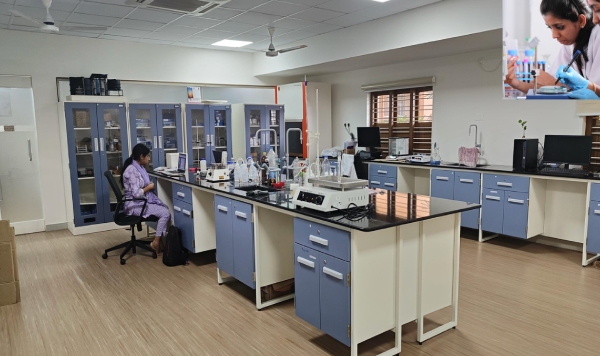
Regular Testing Lab at STP, Advanced Lab at the School of Biotechnology & Water Lab
Spill Prevention and Response: As per the guidelines of the Sustainable Campus Policy, the university has a spill prevention and response plan to deal with accidental spills of pollutants, including procedures for identifying, containing, cleaning up spills, and disposing of contaminated materials safely.
Stormwater Management Systems: Designed to collect and filter stormwater runoff before it enters the water system, these systems help remove pollutants such as oil, grease, and sediment.
Rainwater Harvesting: A system that collects rainwater from building roofs and stores it in underground tanks for use in irrigation and other non-potable purposes.
Grease Traps in Kitchens: Installed to trap grease and oil from kitchen wastewater before it enters the sewer system, preventing these pollutants from entering the water system and clogging pipes.
Educational Programs: Initiatives to educate staff and students about pollution prevention, covering proper waste disposal, water conservation, and spill prevention.
Sewage Waste Management
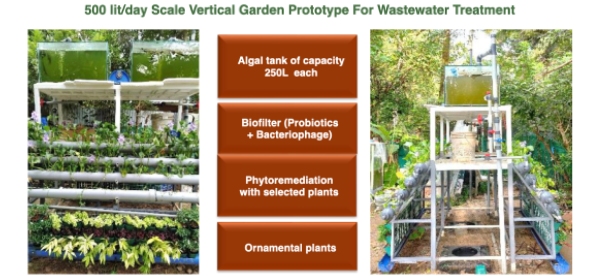
Microbiome Engineering of Waste Water (Vertical Garden)
Pollution Prevention Program at Amrita Vishwa Vidyapeetham
Amrita Vishwa Vidyapeetham has actively pursued a robust pollution prevention program aimed at protecting water quality and fostering environmental stewardship among staff and students. The program encompasses water quality monitoring, wastewater treatment, spill prevention and response, and awareness campaigns. This report highlights key activities and progress achieved in implementing pollution prevention strategies during the period in 2024.
1. Equipment Labelling and Identification
Achievements:
Successfully marked all underground services with standard-compliant marking tapes.
Installed adhesive pipe markers on above-ground pipeworks, meeting the 5-meter interval requirement. Flow direction and pipe contents are clearly indicated.
Ongoing Efforts:
Routine inspections to ensure compliance with labelling standards.
Plans for expanding coverage to newly added infrastructure.
2. Asset Labelling and Barcoding
Achievements:
All critical equipment now features asset labels and barcodes aligned with the university’s Asset Identification and Labelling Standard.
Improved inventory tracking and maintenance scheduling as a result of effective asset labelling.
Ongoing Efforts
Integration of barcode data into a centralized database is still in progress.
3. Below Ground Pipework
Achievements:
Comprehensive surveys and documentation of all subsurface utility installations conducted as per Quality Level–Classification of Subsurface Utility Information (SUI).
Implementation of the CIS Standard Permit to Dig process for all underground works.
Ongoing Efforts:
CCTV recordings of below-ground sewer and stormwater systems completed for older and newly installed infrastructure.
4. Above Ground Pipework
Achievements:
Proper insulation and expansion accommodations applied to all pipework chased into masonry walls, preventing structural damage.
Adhesive markers installed consistently across all above-ground pipelines.
Ongoing Efforts
Periodic audits to ensure ongoing compliance with installation and labelling standards.
5. Pipe Supports and Fastening
Achievements:
Compliance with spacing requirements for pipe brackets, clips, and hangers has been ensured.
Separate supports installed for valves in pipeworks of 200mm or greater diameter.
6. Core Holes and Sleeves
Achievements:
Structural engineering approval obtained for all cored holes in structural elements.
Fire-rated pipe penetrations installed to meet statutory requirements.
Copper sleeves provided for pipework passing through masonry and concrete structures.
7. Corrosion Protection and Finishes
Achievements:
All exposed surfaces and equipment have been treated with corrosion-resistant finishes, including hot-dip galvanizing for ferrous metals.
Regular maintenance programs established to monitor and address signs of corrosion.
Outcome:
Enhanced longevity of infrastructure and reduced maintenance costs.
8. Acoustic Performance of Hydraulic Pipework
Achievements:
Hydraulic systems certified to meet the acoustic requirements of the National Construction Code (NCC).
Qualified Acoustic Engineers conducted assessments and provided necessary treatments to achieve compliance.
Governance, Training & Community Engagement
Contractor & staff induction: 2024 strengthened EHS induction modules for contractors and operational staff with specific modules for spill response, stormwater protection and chemical handling.
Student & staff awareness: Campaigns and training sessions on responsible disposal, water conservation, and reporting were run across campuses; sustainable event guidance rolled out to student unions and administrative units.
Research & collaboration: Amrita’s environmental research groups collaborated with operations to trial precision erosion mapping and targeted remediation techniques.
Gaps Identified & Next Steps (Priorities for 2025)
Complete central integration of asset barcodes into the Computerised Maintenance Management System (CMMS) to enable predictive maintenance and faster incident response.
Scale ecological monitoring: expand the 2024 pilot of ecological water-body monitoring to a full programme across sensitive water bodies, with fixed monitoring locations, biological and physico-chemical parameters, and seasonal sampling protocols.
Expand stormwater treatment at scale: increase use of bioswales, constructed wetlands and infiltration basins during new landscape projects and retrofits.
Full implementation of advanced STP expansion aligned to campus growth to guarantee treatment capacity and maintain reuse targets.
Zero-plastic events target: move toward zero single-use plastic for official campus events via supplier contracts and event permitting.
Continued contractor oversight: refine contractor performance KPIs tied to environmental outcomes (sediment control, spill incidents, compliance with CSEMP commitments).
Aligning with the United Nations Sustainable Development Goal 6, “Ensure availability and sustainable management of water and sanitation for all”, in 2024, Amrita Vishwa Vidyapeetham advanced its commitment to sustainable campus water management through a comprehensive strengthening of wastewater treatment and reuse systems. The institution formalised contaminant-control procedures for construction and campus operations, expanded stormwater and erosion controls, and scaled community education and operational monitoring initiatives. Building on prior investments in Sewage Treatment Plants (STPs), zero-pit sanitation, and regular groundwater testing, Amrita implemented a suite of technical, operational, and governance measures in 2024 that together reduce freshwater demand, lower pollution risks to on- and off-campus aquatic ecosystems, and enhance resilience to accidental releases.
Key achievements in 2024
Wastewater treatment & reuse: Continued operation of multiple STPs with a combined design capacity of 1,400 m³/day, with long-term average treatment around ~1,300 m³/day. Treated effluent is routinely reused for toilet flushing, landscape irrigation and arboriculture. Amrita maintains a campus target of ≈70% potable water offset via reuse and continued progress toward that goal in 2024. Typical treated effluent quality remains high (BOD routinely ≤ 3 mg/L in upgraded units), supporting safe non-potable reuse.
Sanitation upgrade: Campus fully maintained as a zero-pit toilet system with all wastewaters directed to treatment infrastructure.
Operational inspection & maintenance: The periodic inspection programme (initiated April 2023) and a log-card system continued through 2024 — covering pipelines, tanks, coolers, pumps and taps — reducing leaks and enabling faster corrective action.
Infrastructure identification & asset control: Asset labelling and barcoding was extended across critical equipment; CCTV surveys of sewer and stormwater networks were completed for legacy and newly installed lines. Integration of barcode records into a central asset database began in 2024.
Pollution prevention systems: Grease traps, segregated pumping for different waste streams, and stormwater pre-treatment (settling, silt barriers) were installed/expanded across food service and maintenance zones. Spill response procedures and spill-kits are in place across critical operational areas.
Education & behaviour change: Campus campaigns in 2024 reinforced correct disposal practices, spill reporting, and water conservation; kitchen and catering contractors adopted grease management protocols.
Construction & contractor controls: For all major works in 2024, contractors were required to submit Environment, Health & Safety (EHS) plans / Construction Safety & Environment Management Plans describing environmental risks, control measures, monitoring arrangements and incident notification procedures; on-site EHS supervision and routine inspections were enforced.
Systems & processes
1. Wastewater & reuse management
STP operation and expansion planning: Amrita continues to optimise existing STPs (aerobic/activated sludge processes) for high removal efficiencies and nutrient management. Work carried forward in 2024 included process tuning, desludging schedules, and operator training. A larger advanced STP (planned capacity expansion) remains scheduled for upcoming years to match campus growth.
Quality assurance: Routine in-house and third-party laboratory testing of treated effluent and nearby groundwater points continued in 2024 (microbial, physico-chemical and heavy-metal panels). Test results are recorded and trended to detect deviations early.
Safe reuse practices: Treated water is used only for designated non-potable applications (toilet flushing, landscape irrigation, cooling-tower make-up where permitted). Distribution lines for recycled water are clearly labelled and physically segregated.
2. Construction, contractor and high-risk works controls
Contractor EHS requirements: All contractors performing major or high-risk works must submit an approved Construction Safety & Environment Management Plan (CSEMP) or equivalent, describing environmental risk assessments, erosion & sediment control, containment measures for temporary fuels/chemicals, monitoring, and notification procedures for any incident.
On-site supervision: Projects deploy on-site EHS officers and regular superintendent inspections; high-risk minor works require pre-work Work Method Statements and sign-off before starting.
Buried services & permit-to-dig: Subsurface utility surveys, permit-to-dig protocols, and safe excavation practices are enforced to prevent accidental damage to sewer/stormwater lines that could release contaminants.
3. Stormwater, erosion and sediment control
Treatment at source: Where possible, stormwater is treated or attenuated on-site using biologically based features (swales, constructed wetlands, sedimentation basins and infiltration features) to trap sediment and reduce pollutant loads before discharge.
Runoff management measures implemented in 2024: silt-control fences for construction areas; inlet protection for drains; sediment basins at major disturbance sites; and installation of debris separators and filters on critical drains. Permeable paving and reduced hardscape have been piloted in select zones to increase infiltration.
Erosion monitoring & rapid response: In collaboration with campus environmental researchers and external specialists, Amrita in 2024 piloted a precision erosion-mapping approach (targeted monitoring of problem slopes, gullies and drain inlets) and introduced an incident notification workflow to rapidly mobilise sediment controls after heavy rains or construction events.
4. Hazardous materials, chemical & waste management
Comprehensive hazardous materials controls: All hazardous chemicals, oils, paints and laboratory reagents on campus are managed under documented procedures for storage, containment, inventory control, handling and disposal. Purchase controls and labelled storage reduce spillage risk.
Waste segregation & regulated waste disposal: Clinical, chemical and other regulated wastes are segregated, labelled and disposed of through authorised channels per applicable regulations. 2024 saw expanded training on chemical labelling and use of secondary containment for high-risk storage areas.
Design measures to prevent cross-contamination: Fixed design choices — such as routing air-conditioner condensate and kitchen floor drains to appropriate sanitary sewers (and not to stormwater) — were formalised in project standards and enforced during 2024 retrofits and new works.
5. Spill prevention & emergency response
Spill prevention planning: Spill-response plans, standard operating procedures for containment, and dedicated spill-kits were distributed to laboratories, fuel stores, workshops, and kitchens. Staff and contractor induction in 2024 emphasised immediate containment and reporting.
Incident notification & investigation: A documented reporting chain for environmental incidents (near-miss through major spill) was used in 2024 to improve root-cause analysis and corrective actions; learnings are fed back into contractor supervision and design updates.
6. Marine & microplastic pollution reduction
Single-use plastic reduction: In 2024, Amrita extended initiatives to reduce plastics on campus: single-use cutlery/utensil bans in catering contracts, guidance for sustainable events, refill stations, and campaigns to use reusable bottles/cups.
Waste-to-resource & event planning: Sustainable Event Guidelines were promoted, and waste management plans were required for larger gatherings to avoid plastics entering drainage systems and waterways.
7. Monitoring, data & asset management
Inspection cadence & log cards: The scheduled periodic inspections (introduced April 2023) were continued and refined in 2024; inspection logs are used to prioritise repairs and replacements.
Asset labelling & central database: Asset barcoding and labelling completed for major equipment; integration into a central maintenance management system started in 2024 to enable predictive maintenance and a single source of truth for asset condition.
Diagnostics for underground networks: CCTV surveys of sewer and stormwater mains were completed for legacy and new installations to locate defects and leaks.
Reuse target maintained: ≈70% campus non-potable water offset target (progress continued in 2024).
Treated effluent quality at upgraded units: BOD ≈ 3 mg/L (typical after advanced treatment).
Number of contractors EHS plans reviewed and approved (major projects in 2024): All major projects required CSEMP submission; 100% compliance for projects above threshold.
Asset labelling: All critical equipment labelled; barcode integration to central system initiated (ongoing).
Governance, training & community engagement
Contractor & staff induction: 2024 strengthened EHS induction modules for contractors and operational staff with specific modules for spill response, stormwater protection and chemical handling.
Student & staff awareness: Campaigns and training sessions on responsible disposal, water conservation, and reporting were run across campuses; sustainable event guidance rolled out to student unions and administrative units.
Research & collaboration: Amrita’s environmental research groups collaborated with operations to trial precision erosion mapping and targeted remediation techniques.
Gaps identified & next steps (priorities for 2025)
Complete central integration of asset barcodes into the Computerised Maintenance Management System (CMMS) to enable predictive maintenance and faster incident response.
Scale ecological monitoring: expand the 2024 pilot of ecological water-body monitoring to a full programme across sensitive water bodies, with fixed monitoring locations, biological and physico-chemical parameters, and seasonal sampling protocols.
Expand stormwater treatment at scale: increase use of bioswales, constructed wetlands and infiltration basins during new landscape projects and retrofits.
Full implementation of advanced STP expansion aligned to campus growth to guarantee treatment capacity and maintain reuse targets.
Zero-plastic events target: move toward zero single-use plastic for official campus events via supplier contracts and event permitting.
Continued contractor oversight: refine contractor performance KPIs tied to environmental outcomes (sediment control, spill incidents, compliance with CSEMP commitments).