Programs
- M. Tech. in Automotive Engineering -Postgraduate
- B. Sc. (Hons.) Biotechnology and Integrated Systems Biology -Undergraduate
The eyes are no longer viewed merely as organs of vision—they are increasingly recognised as vital indicators of the body’s internal health. In a significant breakthrough, Dr. Gopal S. Pillai, Head of the Department of Ophthalmology at Amrita Hospital, Kochi, and his team has developed an artificial intelligence–based technology that can predict the risk of heart attacks, strokes, and kidney diseases by analysing retinal images.
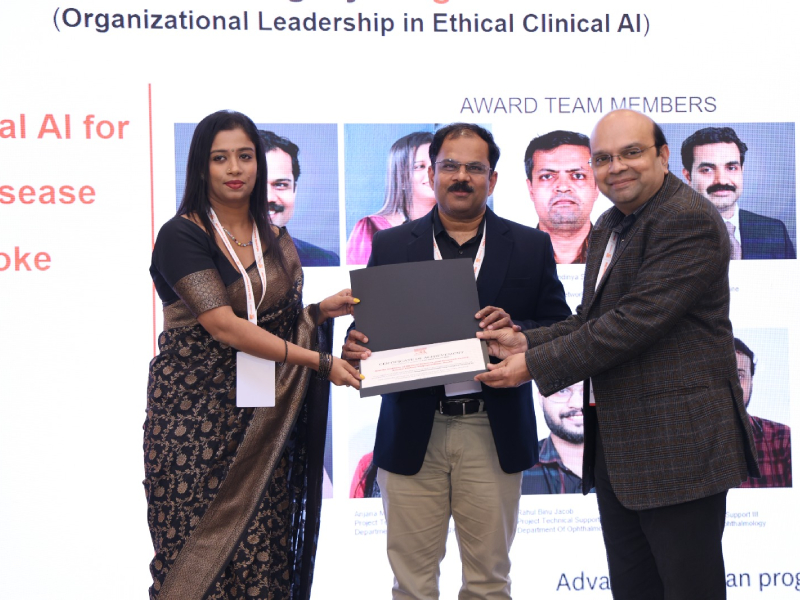
This pioneering work, jointly conducted by Amrita Hospital, Kochi and Amrita Vishwa Vidyapeetham, represents a major step forward in ethical clinical AI and organisational leadership in healthcare. In recognition of this innovation and its potential impact on preventive medicine, The team has been honoured with the Elsevier RAISE Award, a national accolade celebrating excellence in healthcare research and innovation.
The retina is the only part of the human body where blood vessels and nerves can be directly visualized without any surgical intervention. Leveraging this unique advantage, Dr. Gopal S. Pillai and his team developed an AI-powered system called “Reti AI.” By conducting a detailed analysis of retinal images, the technology can accurately estimate an individual’s risk of developing heart disease, kidney disorders, or stroke. Among numerous entries from across the country, this project secured first place in the “Ethical Clinical AI” category. The project team included Amrita Hospital doctors Dr. Rajesh T., Dr.VivekNambiar, Dr.Merin Dixon, Dr.NageshSubbanna, Aishwarya A., RahulBinu Jacob, and Anjana M J.
This technology has been entirely developed in India. It enables early identification of potential health threats even before symptoms appear, allowing timely medical intervention and preventing serious complications. More than just a technological innovation, the system’s strong commitment to ethical values is what made it deserving of this prestigious award.
Retina is the only place in the whole human body where one can see the vessels, nerves and the internal mileue where all inflammation takes place. The team have taken retinal photographs of patients with systemic diseases like diabetes, CAD, stroke and kidney diseases and integrated the clinical metadata into it. Using machine learning techniques, we have developed AI algorithms which can be used for mass screening and detect patients at risk of heart attack, stroke and kidney diseases. Retinal photography is a simple and fast, cheap and painless method for the basic test on which AI algorithm can work. Currently we have implemented the Retinal AI to our peripheral camps and patients, trying to triage the patients at the risk of systemic diseases.
Objectives
Impact and outcomes
Prevention of heart attack and stroke and detecting renal failure early can significantly reduce the healthcare spending of our country. Our indigenous AI algorithm with high sensitivity and specificity can screen population with high throughput and rapidly triage people at high and low risks for the systemic diseases.
Prevention of CAD and stroke was done by starting anti platelets, anti-hypertensive medicines and cholesterol reduction to people at risk detected through our AI algorithm. This innovative, made in India AI algorithm will positively impact the overall health economics of our country in a significant way