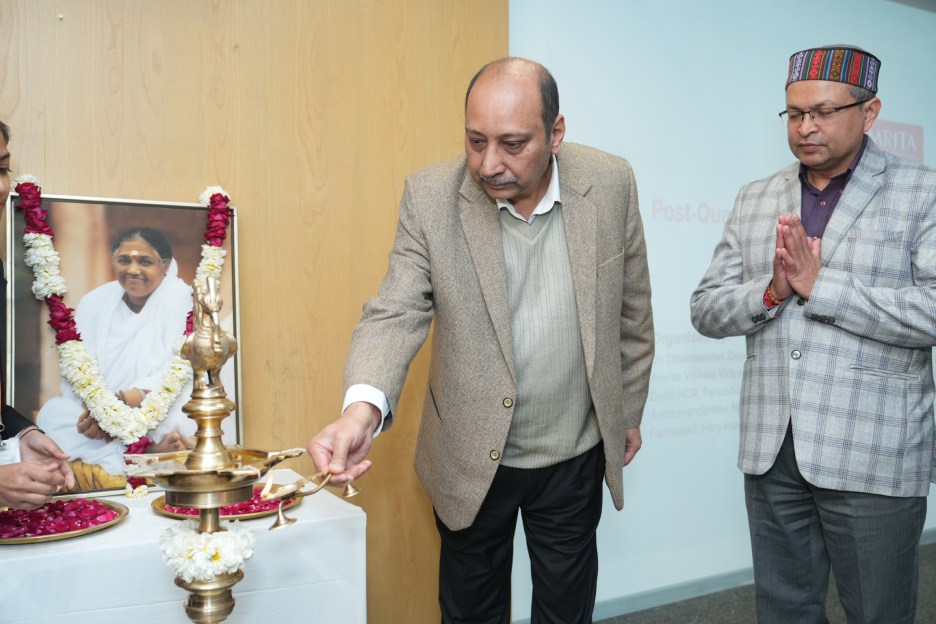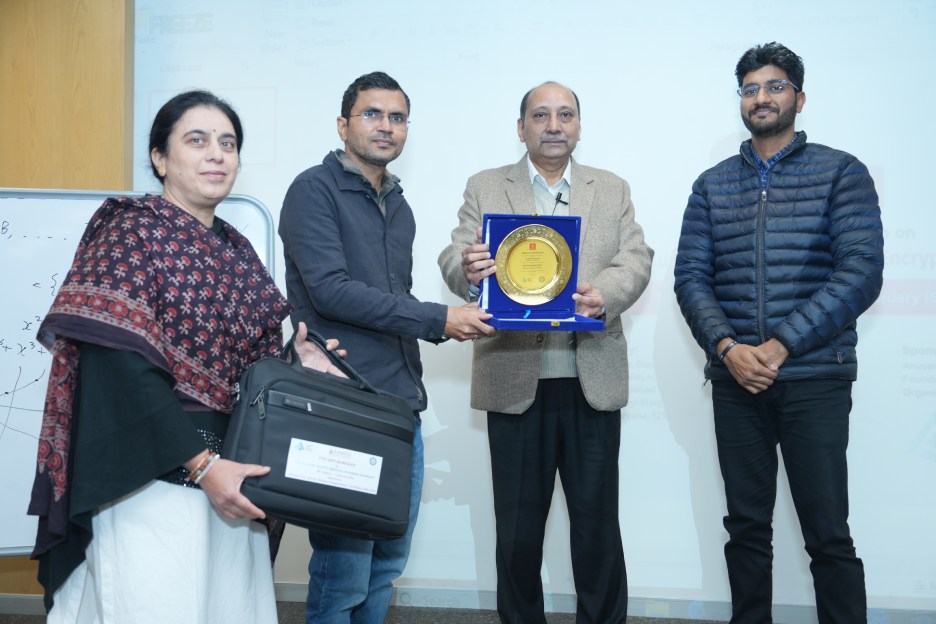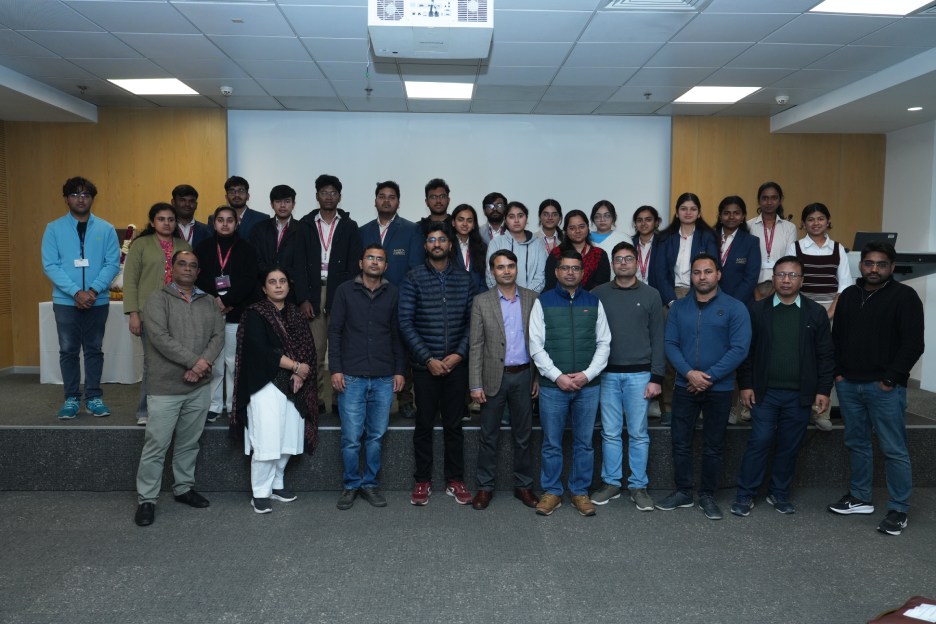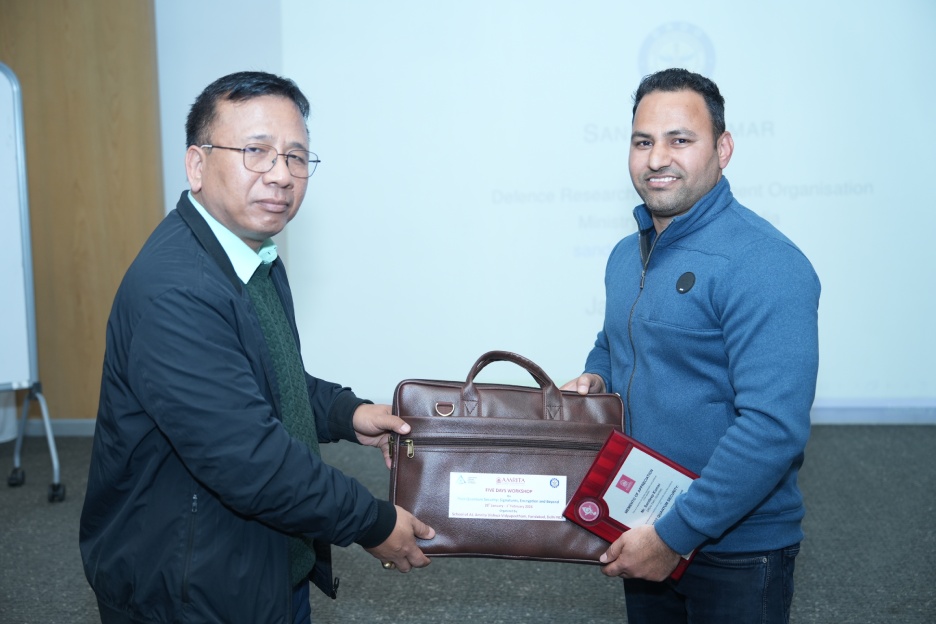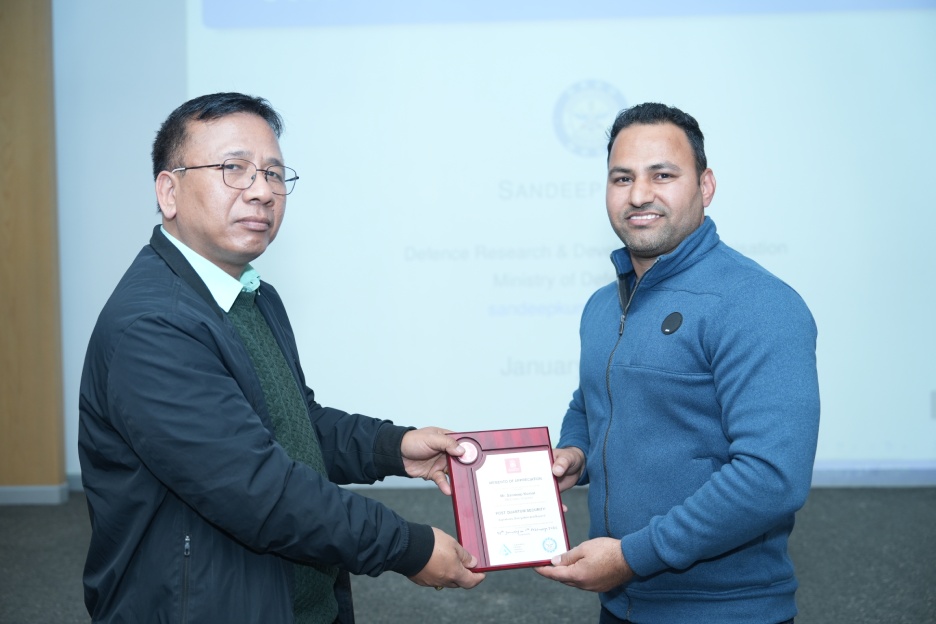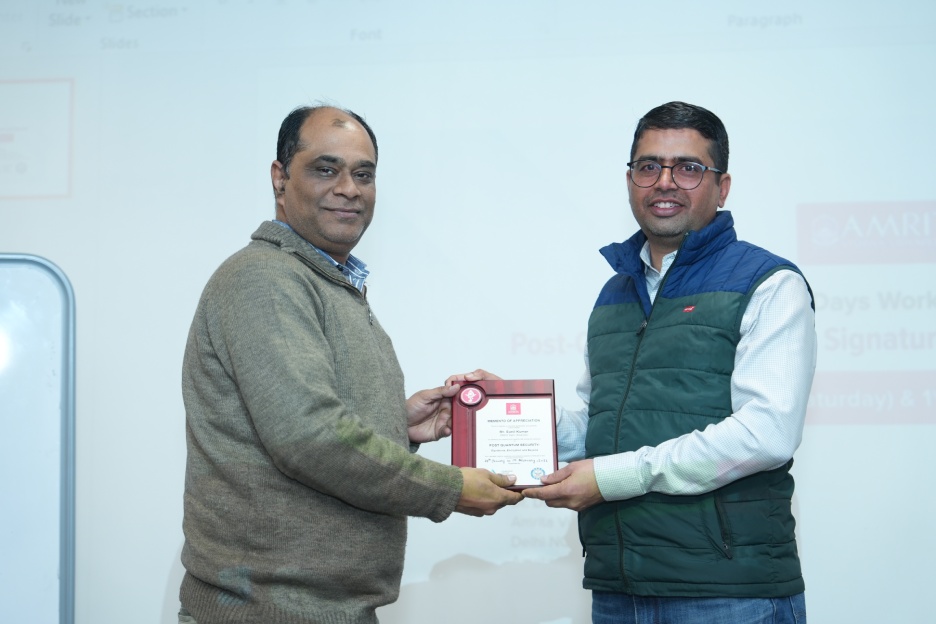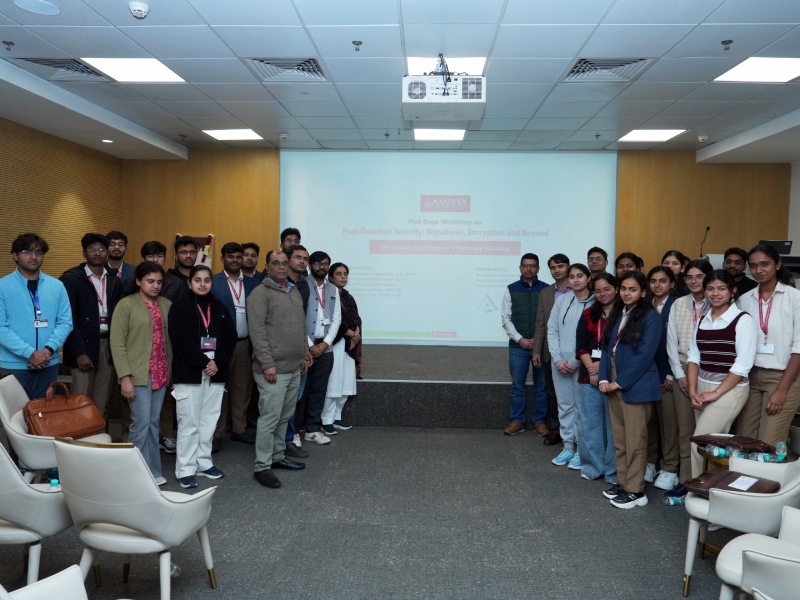
The School of Artificial Intelligence at Amrita Vishwa Vidyapeetham, Faridabad, hosted a workshop “Post Quantum Security: Signatures, Encryption and Beyond” which was sponsored by Anusandhan National Research Foundation and Defence Research and Development Organization (DRDO), Government of India.
This workshop was designed to meet the demand for post quantum secure technology on an international scale. Participants learned about post quantum cryptographic methods and how they can provide security to the next generation of communication technology from an attacker that uses quantum computing.
Researchers, experts, and academics from several of the best institutions in India and abroad attended the Workshop on Post-Quantum Security and Next Generation Cryptography. The institutions represented included IIIT Hyderabad, Bennett University, University of Delhi, MANIT Bhopal, VIT Amaravati, Lucknow University, IIIT Allahabad, King Saud University and the University of Waterloo; scientists from Institutions of Research and Development in defence, or DRDO and faculty members from Amrita Vishwa Vidyapeetham.
The workshop attracted many participants including faculty members, research scholars, postgraduate students and cyber-security professionals from all over India indicating the high level of interest to develop new standards for post-quantum security.
Dr Sandeep Shukla, Director of IIIT Hyderabad, delivered the keynote address at the inaugural meeting of the online academic program on the difficulties of transitioning legacy systems to post-quantum cryptography, such as larger key sizes, overhead in performance, and interoperability concerns in constrained IoT environments, at the beginning of the online academic program.
From the first two days, the program focused on some of the key concepts associated with post-quantum cryptography, including post-quantum assumptions and their use cases; fundamental cryptography and the OSI model; computational complexity theory; and core principles of post-quantum cryptography. Additionally, application-oriented presentations were delivered on the subject of lattice-based authentication for IoT-enabled smart payments.
The third day extended beyond just the technical aspect, as lectures on multivariate cryptography and its application to post-quantum digital signatures. Along with number theory and finite fields for post-quantum crypto as well as hash based post quantum crypto were part of the correspondence to provide the attendees with a sound mathematical foundation for establishing quantum resistant schemes.
The three sessions included securing next generation networks utilizing physical-layer security plus an invited lecture given by Prof Alfred Menezes (University of Waterloo) related to the education of practical application of cryptographic theory vs deployment in real-world applications. Also from an academic pedagogical perspective, helping attendees to create relationships between their academic research and implementing that research in practice.
The fourth day of the conference continued with in-person works at Amrita, where the Chief Guest for the day, Dr Saibal K. Pal, the Director – JCB, DRDO-Delhi. He opened the works with a talk regarding the history of cryptography and how it has evolved from classical encryption systems to the encryption systems of today and those being developed as quantum safe systems.
As part of four separate presentations from multiple DRDO experts on various aspects of post quantum security, the final day’s agenda also included an online presentation by Amrita faculty members discussing Shor’s algorithm and the implications on classical public key systems such as RSA and ECC followed by a discussion of lattice-based assumptions and key exchange techniques that can be used to implement secure communications in a post-quantum world.
The presentation at the end of the seminar included the patrons and the team that organized the event thanking everyone who spoke and participated. They also described how people will work together in future for collaborative research in quantum safe security.
This seminar improved India’s academic and research environment by giving theoretical and application-based examples of using post-quantum cryptography and the need for migration and standardization in this technology.
The seminar reinforced Amrita Vishwa Vidyapeetham’s commitment to advancing India’s cybersecurity and building a secure digital infrastructure. It also created new ways for people to collaborate on research about post-quantum security, protecting networks and developing educational programs related to cryptography.