Thematic Area: Intelligent Sustainable Power and Energy Systems
Department: Electrical and Electronics Engineering
Location: Power Systems Laboratory, Coimbatore
Project Duration: Two years
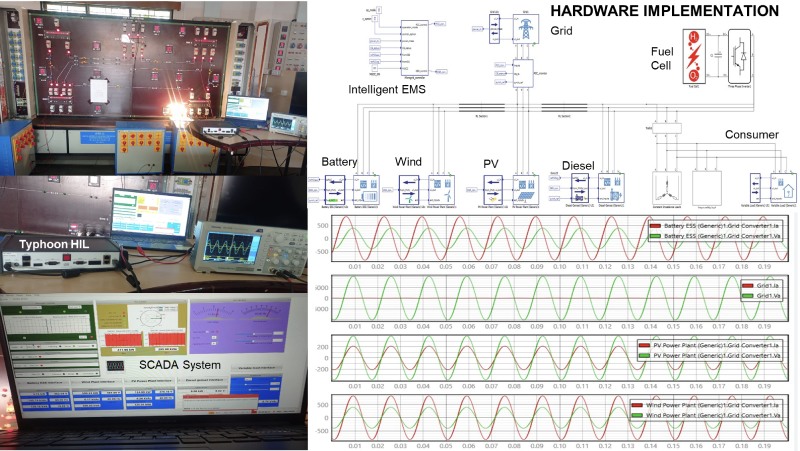
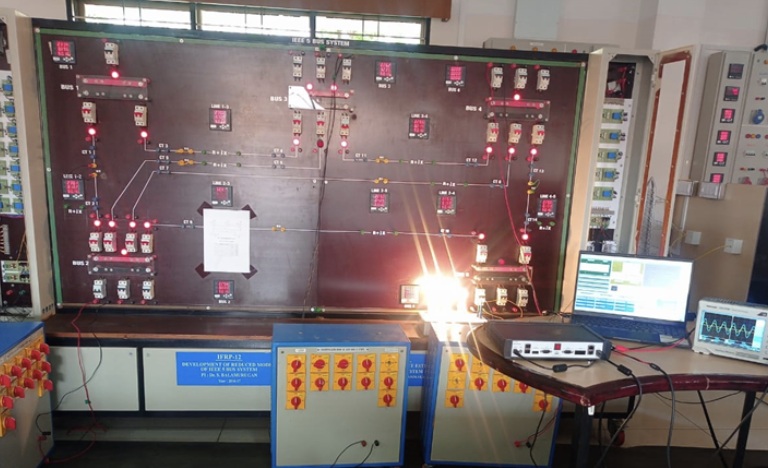
Hardware implementation and experimental validation of an intelligent hybrid microgrid energy management system [EMS] designed for reliable, efficient, and sustainable power system operation. The developed microgrid integrates multiple distributed energy resources, including photovoltaic (PV) systems, wind energy conversion systems, battery energy storage systems [BESS], diesel generators, fuel cells, and utility grid connectivity to ensure an uninterrupted power supply under varying operating conditions. The laboratory-scale setup demonstrates the practical realization of the proposed system using real-time hardware platforms, protection circuits, sensing modules, communication interfaces, and supervisory control infrastructure. The implementation is supported by the Typhoon HIL real-time hardware-in-the-loop (HIL) simulator, which enables accurate emulation of renewable energy sources, power electronic converters, and grid dynamics while allowing safe validation of advanced control strategies. A SCADA-based monitoring interface is employed for centralized supervision, visualization, fault monitoring, and real-time energy management. The SCADA system continuously monitors the operational status of the battery ESS, wind plant, PV plant, diesel generator, and consumer loads, thereby improving operational efficiency and system reliability.
The intelligent EMS coordinates the operation of renewable energy sources, storage systems, and utility grid interaction to achieve optimal power management and stable microgrid operation. Renewable energy sources are prioritized to maximize clean energy utilization, while excess power is stored in the battery system. During power deficits, the EMS controls battery discharging and provides support through diesel generator and fuel cell systems. The EMS also facilitates smooth bidirectional power exchange with the utility grid during fluctuating load and generation conditions. The waveform responses demonstrate synchronized voltage and current characteristics for the grid, battery ESS, PV, and wind systems, confirming effective converter control, proper grid synchronization, stable power sharing, and reliable dynamic performance of the integrated hybrid microgrid.