Environmental Education Through Collaboration with NGOs
Home Environmental Education Through Collaboration with NGOs
Environmental Education Through Collaboration with NGOs
In 2024, Amrita Vishwa Vidyapeetham significantly expanded its environmental education and climate-adaptation outreach through deep partnerships with national and international NGOs, civil society organisations, and community-based groups. Leveraging the UNESCO Chair on Experiential Learning for Sustainable Innovation & Development and the Live-in-Labs® programme, Amrita worked across 1200+ communities, 28 Indian states, and multiple countries to deliver climate-literacy programmes, resilience workshops, behavioural-change campaigns, and adaptation training targeting students, teachers, SHGs, and climate-vulnerable rural populations.
Live-in-Labs® andSustINNetwork
In 2024, Amrita’s International Network for Sustainable Innovation & Resilient Futures (SustIN) and Live-in-Labs® served as major channels for environmental NGOs to collaborate on Climate-change education & resilience-building, training on Sustainable Development Goals, Community-centred climate adaptation and Water, waste, energy, and livelihood sustainability
Leading NGO partners included: Alternative Futures, Eco Society India, ARISE India, CARD, The Small Earth Nepal (SEN) and others. Together, they delivered programmes on water security, waste reduction, environmental health, and climate-resilient livelihoods.
Blue Economy and Coastal Livelihood Adaptation Through NGO Collaboration (2024)
In 2024, Amrita Vishwa Vidyapeetham advanced climate-adaptation education in coastal regions by partnering with multiple NGOs and international agencies to promote sustainable blue-economy livelihoods. Through Ammachi Labs and the Live-in-Labs® programme, the university worked with UNDP-GEF SGP, MoEFCC, TERI, ESRI and Transworld Group to deliver hands-on environmental training for women in climate-vulnerable fishing communities.
A flagship initiative was the Seaweed Cultivation Training Programme, launched in 2023 and significantly expanded in 2024. Implemented in Olaikuda, Rameswaram (Tamil Nadu), the programme equips coastal women with practical skills in seaweed farming—an environmentally regenerative, low-resource, climate-adaptive livelihood. Training includes cultivation techniques, seagrass ecosystem restoration, Integrated Multi-Trophic Aquaculture (IMTA), digital literacy, entrepreneurship, and sustainable marine-resource management.
2024 achievements include:
Expansion of training to 100+ women in Ramanathapuram district
Establishment of demonstration farms and women-led marine-enterprise collectives
Integration of ecosystem restoration education covering 115 hectares of marine habitat
Community awareness programmes on coastal resilience, carbon sequestration, and sustainable fisheries
Development of market linkages and piloting of blue-credit mechanisms for climate-finance access
The initiative strengthens coastal climate resilience by reducing dependence on overfished marine resources, promoting biodiversity recovery, and empowering women as leaders in the sustainable blue economy. It also provides a replicable NGO-university model for large-scale climate-adaptation education across coastal India.
2. NGO Partnerships for Climate Adaptation
Amrita collaborated with several NGOs to advance environmental education and climate-resilience programmes. Amrita has a Memorandum of Understanding with these key partners since 2023.
Climate Action Network South Asia (CANSA) Focused on climate-resilient agriculture, agroecology training, soil conservation, and water-efficient farming practices for rural communities.
Industree Foundation Workshops on sustainable livelihoods, eco-friendly production, and circular-economy skills for women and marginalised artisans.
Team Environment Kenya Collaborated on environmental education, climate-awareness campaigns, waste management initiatives, and biodiversity protections in Africa and India.
WOTR (Watershed Organisation Trust) Knowledge exchange on watershed management, water governance, and climate-adaptive rural planning. These NGO collaborations helped deliver climate education to 2,000+ direct beneficiaries and 1200+ communities, focusing on adaptation, resilience, and behavioural change.
3. Climate Adaptation Education in schools & communities
Through the Mata Amritanandamayi Math and Amrita’s NGO partners, environmental education programmes were conducted for school students and teachers, women’s self-help groups and rural climate-vulnerable communities
Activities delivered through NGO-supported centres included:
Workshops on climate impacts & water-energy conservation
Solar, biogas, and clean-energy demonstrations
Circular-economy and waste-segregation training
Community-based climate-risk and adaptation education
4. Environmental Education through Coastal Cleanup and Community Collaboration (2024)
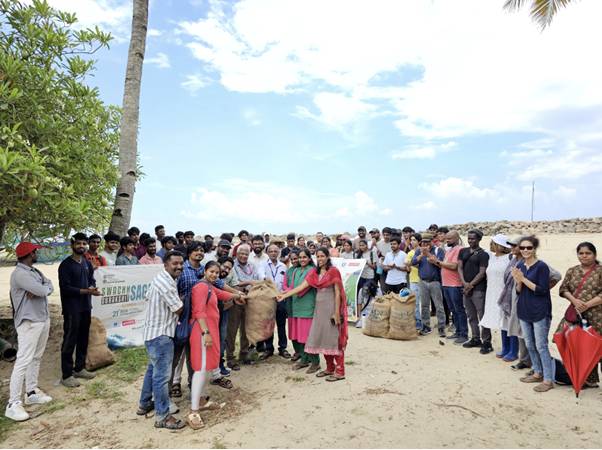
In September 2024, Amrita Vishwa Vidyapeetham actively participated in the Swachh Sagar, Surakshit Sagar campaign at Alappad, Kerala, as part of a Ministry of Earth Sciences–led national initiative, in collaboration with local authorities, community groups, and civil society partners. The beach clean-up drive functioned as a hands-on environmental education programme, engaging students, faculty, volunteers, and local residents in learning about marine pollution, coastal ecosystem protection, and sustainable waste management practices. By integrating environmental awareness with collective action, the initiative strengthened coastal stewardship, promoted climate adaptation, and demonstrated effective collaboration between the university, government programmes, and community stakeholders in advancing environmental sustainability.
5. Wave of Change – Water Sustainability Initiative (2024)
In partnership with municipal leadership and community-based NGO in Alapuzha, Amrita launched the Wave of Change initiative in Alappuzha, Kerala (March 2024). The programme included, water-conservation training for 150+ women residents, climate-literacy campaigns, capacity-building for community water champions and awareness outreach linked to local water stress and climate-induced risks
6. Global Seedball Campaign
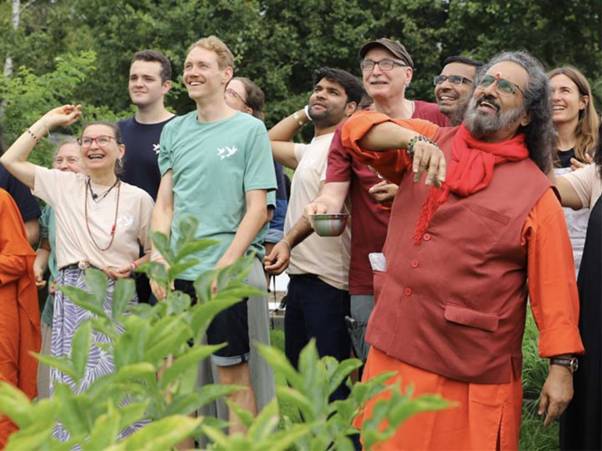
Building on the global momentum of the Seedball Campaign launched earlier, Amrita, in collaboration with Embracing The World, continued large-scale seedball production and distribution in 2024.
2024 achievements:
1 seedballs distributed globally
Implementation across India, Africa, Europe, Australia, and North America
Awareness sessions on baiodiversity conservation and ecosystem restoration
This campaign supports climate adaptation by strengthening degraded ecosystems and promoting community education.
7. Cross-Sectoral NGO Dialogues on SDGs
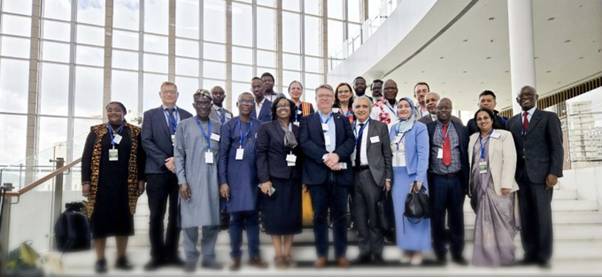
Dr. Maneesha V Ramesh, Provost and UNESCO Chair on Experiential Learning for Sustainable Innovation and Development at Amrita participated in cross-sectoral dialogues that brought together Environmental NGOs, Government representatives, Academic experts and Community organisations
Last Updated – December 31, 2024
Collaborate with NGOs on Climate Adaptation: Amrita Vishwa Vidyapeetham’s Integrated Partnership Framework (2024)
Amrita Vishwa Vidyapeetham has established a comprehensive ecosystem of strategic partnerships with national and international non-governmental organizations (NGOs) to implement climate adaptation initiatives across India and globally. These collaborations integrate scientific research, community empowerment, policy advocacy, and sustainable livelihood development, directly addressing climate-induced vulnerabilities in agriculture, coastal ecosystems, disaster management, and environmental conservation. Through formalized Memoranda of Understanding (MoUs) and co-implementation models, Amrita and its NGO partners reach over 2,000 direct beneficiaries across 28+ Indian states and multiple international contexts.
Strategic NGO Partnerships Framework
Climate Action Network South Asia (CANSA) – Agroecology and Climate-Resilient Agriculture
Amrita’s partnership with Climate Action Network South Asia (CANSA) represents one of the most significant climate adaptation collaborations, focusing on transforming agricultural systems to withstand climate change impacts. The partnership was formalized through an MoU signed on April 30, 2023, during the Civil 20 India 2023 Working Group Summit held in Sikkim.
Partnership Scope:
CANSA’s collaboration with Amrita encompasses climate-resilient agriculture, sustainable agroecology practices, and the advancement of sustainable development goals across South Asia. The partnership integrates:
Evidence-Based Agroecology Training: Farmers receive comprehensive training on soil conservation, water management, and climate-smart crop selection
Demonstration Farms: Real-world examples of agroecological methods showing increased productivity with reduced environmental impact
Climate-Adaptive Varieties: Introduction of climate-resilient crop varieties suited to regional rainfall patterns and temperature changes
Soil Health Management: Techniques for improving soil organic matter, water retention, and microbial activity
Water-Smart Irrigation: Efficient water use systems including drip irrigation, mulching, and rainwater harvesting
Geographic Reach and Beneficiary Scale:
The CANSA-Amrita partnership operates across South Asia, directly reaching:
1,000+ farmers across India, Bangladesh, Nepal, and Sri Lanka
Rural communities in multiple agro-ecological zones
Policy makers and government agricultural departments
Enhanced adaptive capacity to extreme weather events
Women farmers’ leadership and participation (40%+ of trainees)
Impact on South Asian Agriculture:
In 2025, CANSA (along with ICAR partners) contributed to the launch of the Atlas of Climate Adaptation in South Asian Agriculture (ACASA), a comprehensive resource developed by CIMMYT-BISA, ICAR, and regional agricultural research councils. This atlas, co-supported by Amrita’s research on climate-resilient practices, provides location-specific adaptation strategies for farmers facing increased flooding, heat waves, and unseasonal rainfall across India, Bangladesh, Nepal, and Sri Lanka.
Industree: Empowering Rural Artisans Through Sustainable Livelihoods
Amrita’s collaboration with Industree addresses climate adaptation by enabling rural artisans and small-scale industries to transition toward sustainable production methods. The partnership focuses on income diversification, waste reduction, and carbon footprint minimization—critical adaptations for rural communities facing climate-induced livelihood disruptions.
Partnership Components:
Eco-Friendly Production Techniques:
Introduction of natural dyes and sustainable material sourcing
Waste reduction in production processes
Energy-efficient manufacturing methods
Water conservation in textile and craft production
Capacity Building for Artisans:
Training on sustainable business models
Market linkage programs connecting artisans to ethical consumers
Digital literacy for e-commerce and direct sales
Cooperative formation for economies of scale
Carbon Footprint Monitoring:
Measurement and tracking of production-related emissions
Implementation of low-carbon technologies
Certification programs for sustainable products
Beneficiary Scale:
The partnership has reached:
500+ rural artisans across pan-India regions
200+ women artisans as primary beneficiaries
100+ Self-Help Groups (SHGs) and small industries
1,000+ indirect beneficiaries (families of trained artisans)
Climate Resilience Outcomes:
Diversified income sources reducing vulnerability to agricultural climate shocks
Reduced carbon emissions from production activities
Women’s economic empowerment and decision-making authority
Partnership Status: MoU-based ongoing collaboration with field operations across India
Vasudha Foundation – Environmental Sustainability and Climate Policy Advocacy
Vasudha Foundation, a leading nonprofit organization established in 2010 and dedicated to Earth conservation (“Vasudha” in Sanskrit means “Earth”), collaborates with Amrita on environmental sustainability and climate policy development. This partnership combines grassroots action with strategic policy advocacy.
Collaborative Focus Areas:
Climate Action Workshops and Training:
Conducted in partnership with state governments and CSOs
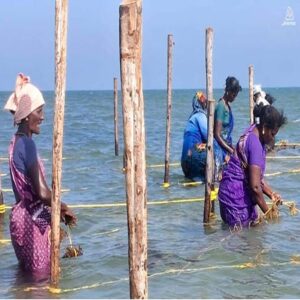
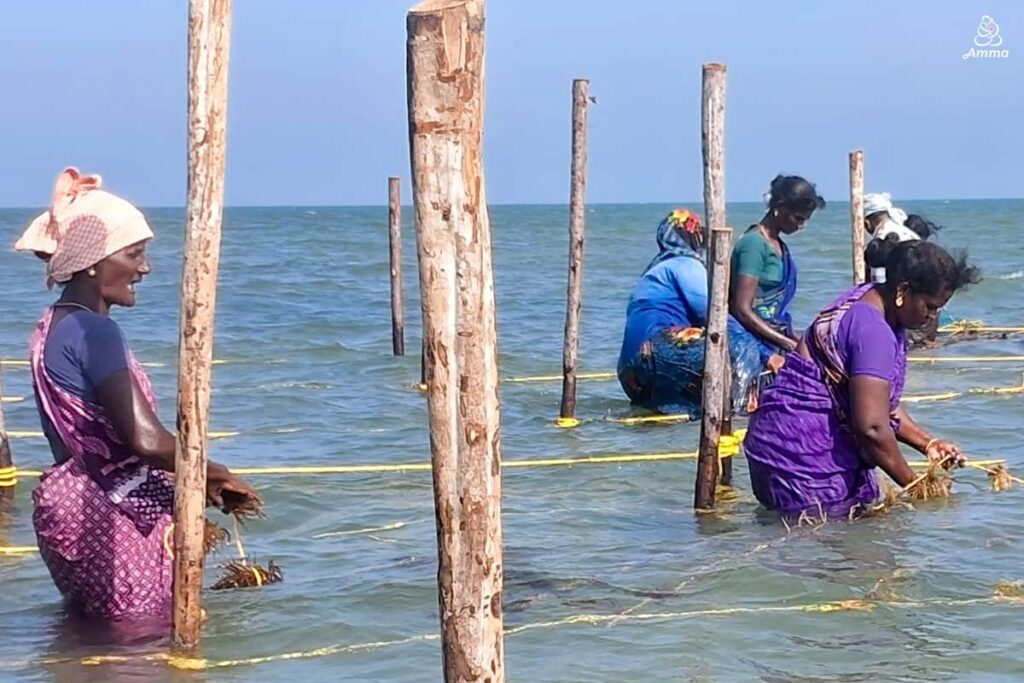
Women engaged in seaweed cultivation in coastal waters as part of a community empowerment effort linked to climate adaptation.
Blue Economy and Coastal Livelihood Adaptation Through Multiple NGO Partners
Amrita’s most innovative climate adaptation initiatives focus on the blue economy—sustainable use and conservation of ocean and coastal resources. Multiple NGO partnerships converge on this critical sector, addressing the vulnerabilities of 3+ million fishers and coastal communities dependent on increasingly stressed marine ecosystems.
Seaweed Cultivation Initiative: Women’s Empowerment in Coastal Climate Adaptation
Launch and Scaling (January 2023 – Present):
In January 2023, Amrita (through Ammachi Labs, its social enterprise wing) launched the Seaweed Cultivation Training Project, recognizing seaweed farming as a climate-adaptive livelihood that:
Requires minimal freshwater (critical for water-stressed coastal regions)
Provides rapid income generation (harvest in 45-60 days vs. agriculture’s seasonal cycles)
Restores coastal ecosystems and carbon sequestration
Offers income sources resilient to agricultural climate shocks
Phase 1 (2023-2024):
Location: Coastal region of Olaikuda, Rameswaram municipality, Tamil Nadu
Participants: Initial cohort of women trained in seaweed cultivation techniques
Outcomes: Successful pilot demonstrating viability of seaweed farming as income source
Phase 2 (2024-2025): “Blue is the New Pink” Expansion
In 2024, Amrita scaled the initiative with significantly expanded funding and partnerships through the Global Environment Facility (GEF) Small Grants Programme (SGP) Operational Phase 7, in collaboration with:
UNDP (United Nations Development Programme)
Ministry of Environment, Forests and Climate Change, India
The Energy and Resources Institute (TERI)
ESRI (Geographic Information Systems)
Transworld Group (market linkages)
Expanded Scope (Phase 2):
Target: Empower 100+ women from rural coastal communities in Ramanathapuram, Tamil Nadu
Training Components:
Technical expertise in seaweed cultivation techniques
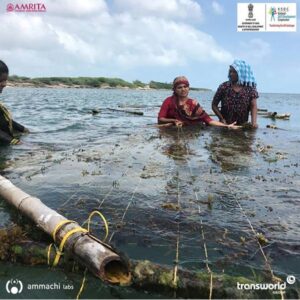
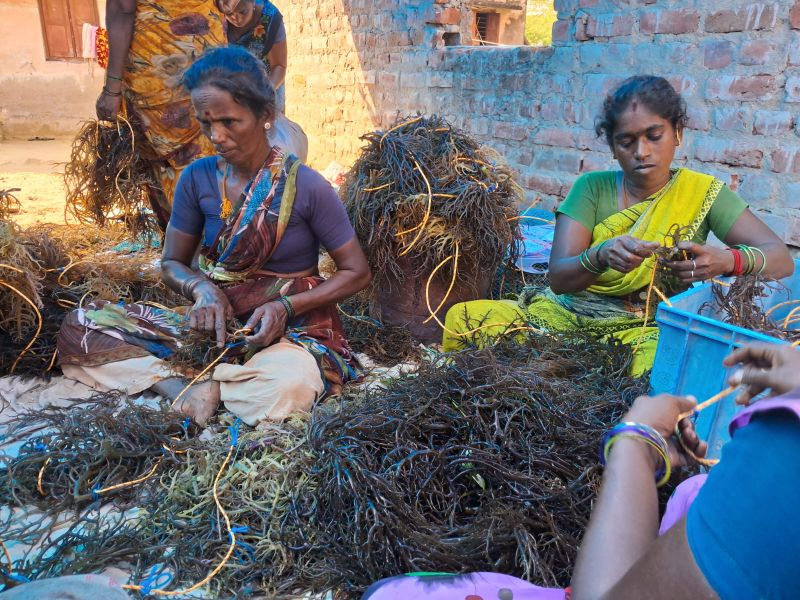
Women in a coastal village of Tamil Nadu engaged in seaweed cultivation as part of an empowerment and climate adaptation initiative.
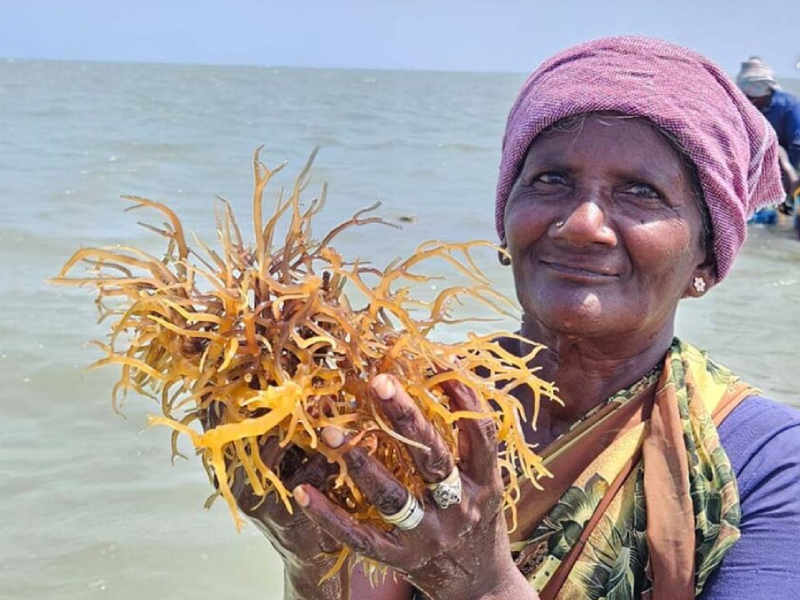
A woman in coastal waters holding seaweed, representing women’s role in seaweed cultivation and climate adaptation efforts by Amrita University.
Integrated Multi-Trophic Aquaculture (IMTA) – Climate-Smart Food Production
Building on seaweed cultivation success, Amrita is piloting Integrated Multi-Trophic Aquaculture (IMTA) systems through NGO partnerships in Kerala and Tamil Nadu, with expansion to Andhra Pradesh planned.
IMTA Concept and Climate Resilience:
IMTA combines multiple aquatic species in polyculture systems where:
Fish excreta provide nutrients for seaweed cultivation
Seaweed absorbs excess nutrients and produces oxygen
Bivalves (mussels, oysters) filter-feed to maintain water clarity
Seagrass meadows stabilize sediments and provide fish nurseries
Climate Adaptation Benefits:
Biodiversity Enhancement: Restores coastal ecosystem complexity reducing vulnerability to disturbances
Protein Production: Sustainable source of nutritious food in regions facing food insecurity
Waste Reduction: Integrated system minimizes waste streams
Community Nutrition: Affordable, locally-produced protein for coastal populations
Economic Resilience: Multiple income streams from single integrated system
Implementation Status (2024):
Pilot studies underway in Kerala and Tamil Nadu
Participatory design with fisher communities
Training of 200+ participants in initial phase
Expansion strategy developed for Andhra Pradesh
Partnership Network: Ammachi Labs, local fisheries departments, community organizations, TERI
Marine Conservation: Gulf of Mannar Biosphere Reserve Initiative
Amrita collaborates with Surabhi Foundation and UNESCO on marine biodiversity conservation in the Gulf of Mannar Biosphere Reserve, one of India’s most biodiverse coastal ecosystems. This initiative directly addresses climate adaptation by:
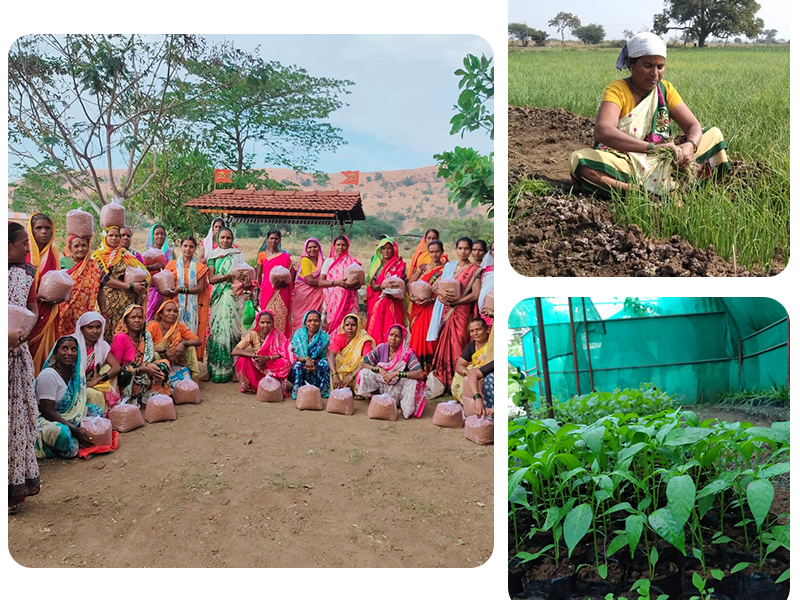
Women farmers in a community holding agricultural supplies, a woman working in the field, and seedlings growing in a nursery illustrating sustainable awogriculture initiatives.
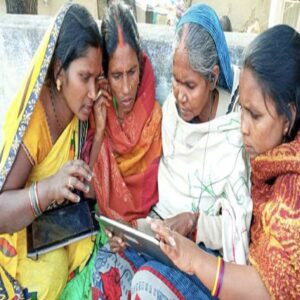
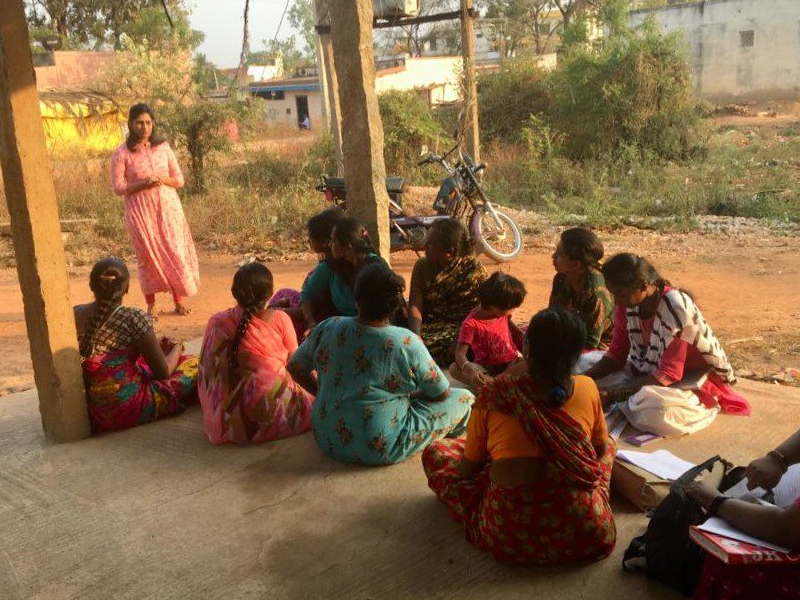
Indian rural women participating in a community meeting or workshop, likely related to sustainable development or social awareness.
Women farmers in a community holding agricultural supplies, a woman working in the field, and seedlings growing in a nursery illustrating sustainable agriculture initiatives.
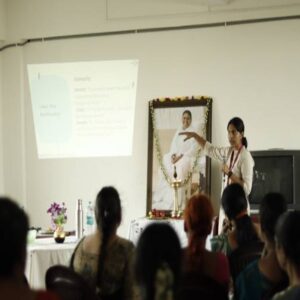
Indian rural women participating in a community meeting or workshop, likely related to sustainable development or social awareness.
Environmental Education and Community Awareness Through NGO Partnerships
Team Environment Kenya – International Environmental Education Collaboration
Amrita’s collaboration with Team Environment Kenya represents international co-operation on environmental education and climate adaptation awareness. This partnership delivers:
Community-Based Environmental Programs:
Waste Management Education: Training on reduce, reuse, and recycle principles
Water Conservation: Methods for water conservation in water-scarce regions
Biodiversity Protection: Initiatives to protect local ecosystems and wildlife
Climate Awareness: Understanding climate change impacts and adaptation strategies
Geographic Reach:
Kenya: Direct implementation with Team Environment Kenya
India: Parallel programs in Indian communities through Amrita’s network
International Learning Exchange: Sharing best practices across continents
Beneficiary Impact:
1,000+ community members reached in environmental education programs
UNESCO Chair and Global Partnership on Sustainable Development Education
As host of the UNESCO Chair on Experiential Learning for Sustainable Innovation and Development, Amrita coordinates with multiple NGO and international organization partners on:
Curriculum Development:
Global curricula addressing 14 SDGs
Climate change and environmental education frameworks
Disaster resilience and community preparedness curricula
Sustainable development literacy programs
Educational Programs Coordination:
11+ NGO MoU partnerships established (C20 India 2023)
Multi-level training sessions reaching 200+ educators and community leaders
International symposiums on sustainable innovation
Knowledge-sharing dialogues across 24+ countries
Inclusive Engagement: Through deliberate dialogues and partnerships, the UNESCO Chair ensured diverse perspectives including:
Gender-Responsive Climate Action: Women’s participation and leadership
Climate Resilience Strategies: Tailored to regional vulnerabilities
African Environmental Sustainability: Recognition of diverse geographic contexts
Architectural and Settlement Planning: Adapted to climate impacts
Impact Reach:
60+ participants from 24 countries in international symposium (December 2023)
200+ educators and students impacted through environmental education programs
1,200+ communities reached through integrated programs
Lighting a ceremonial lamp at the seaweed cultivation training event by Amrita Vishwa Vidyapeetham empowering coastal women.
Community Engagement and Participatory Implementation
Water Sustainability Initiative – Wave of Change (March-April 2024)
The “Wave of Change: Water for a Sustainable Future” initiative demonstrates how Amrita operationalizes climate adaptation through NGO and community partnerships.
Partnership Configuration:
Amrita School for Sustainable Futures: Academic leadership and curriculum design
UNESCO Chair: Strategic framework and global best practices
Alappuzha Municipality: Local government coordination
Local Women’s Organizations: Community mobilization and trust-building
Ammachi Labs: Implementation and field operations
Community Climate Adaptation Components:
Water Security Training:
Rainwater harvesting techniques
Water reuse and conservation practices
Water-safe sanitation systems
Daily household water use monitoring
Community Leadership Development:
Identification of 15+ “water champions” in pilot locations
Training and certification of community water leaders
Empowerment to lead village-level water sustainability initiatives
Networking for knowledge-sharing across communities
Expert Knowledge Transfer:
Distinguished lecture series featuring international water experts
March 22, 2024: Opening lecture by Dr. Prof. Miroslav Cernik, Director of CXI, Technical University of Liberec, Czech Republic
Ongoing expert-community dialogues on water sustainability
Scaling Strategy:
Initial pilot in Kallikkadu, Alappuzha (150 women, March-April 2024)
Planned expansion to 108 communities across India
Replication to multiple states and regions
Integration into school curricula and government policies
Participatory Implementation Model:
100% community participation in program design
Local language education materials
Adaptation to local water challenges and resources
Integration with existing community institutions (schools, panchayats, women’s groups)
Policy Integration and Systemic Impact Through NGO Partnerships
C20 India 2023 Working Group – Global Policy Advocacy
Amrita’s leadership of the Civil 20 India 2023 Working Group on Sustainable and Resilient Communities demonstrates how NGO partnerships translate into global climate adaptation policy.
Partnership Scale:
790+ Civil Society Organizations engaged
11+ MoUs signed with partner organizations including CANSA, Vasudha Foundation, WOTR, and others
6,000+ organizations from 154 countries represented in consultations
500+ policy deliberations across working groups
Policy Recommendations to G20 (2023):
The working group, coordinated through Amrita, produced formal recommendations to G20 nations on:
Climate-Resilient Agriculture:
Integration of agroecology and climate-smart farming into national agricultural policies
Support for farmer cooperatives and knowledge networks
Investment in climate information services for farming communities
Environmental Sustainability:
Circular economy principles for sustainable production
Protection of critical ecosystems (forests, wetlands, coastal areas)
Biodiversity conservation strategies aligned with livelihood protection
Disaster Resilience:
Community-based disaster risk reduction
Early warning systems and evacuation planning
Livelihood recovery and reconstruction programs
Net-Zero Emission Management:
Energy efficiency and renewable energy adoption
Carbon pricing and green finance mechanisms
Just transition support for vulnerable communities
Gender-Equitable Climate Action:
Women’s participation in climate decision-making
Recognition of women’s knowledge and leadership
Targeted support for women’s climate-adaptive livelihoods
Global Representation (2024):
In November 2024, Amrita Dean Prof. Krishnashree Achuthan represented India’s C20 perspective at the G20 closing summit in Rio de Janeiro, Brazil, presenting outcomes and continuing global advocacy for climate adaptation.
Amrita Vishwa Vidyapeetham’s strategic NGO partnerships on climate adaptation demonstrate how educational institutions can catalyze systemic change by combining academic expertise, community engagement, policy advocacy, and innovative financing mechanisms. Through formalized collaborations, shared research, participatory implementation, and scaling strategies, Amrita and its NGO partners are building climate-resilient communities across India and globally, with particular emphasis on protecting vulnerable populations including farmers, coastal communities, and women.