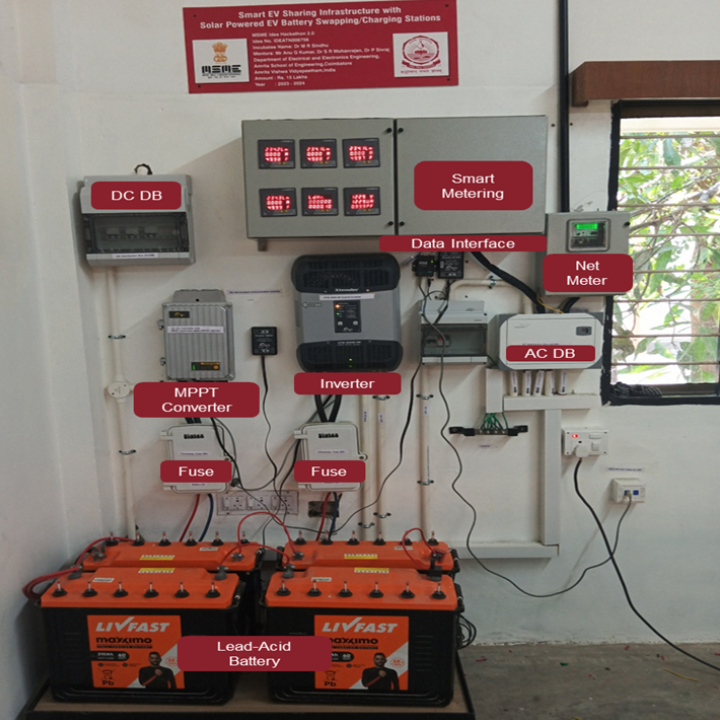
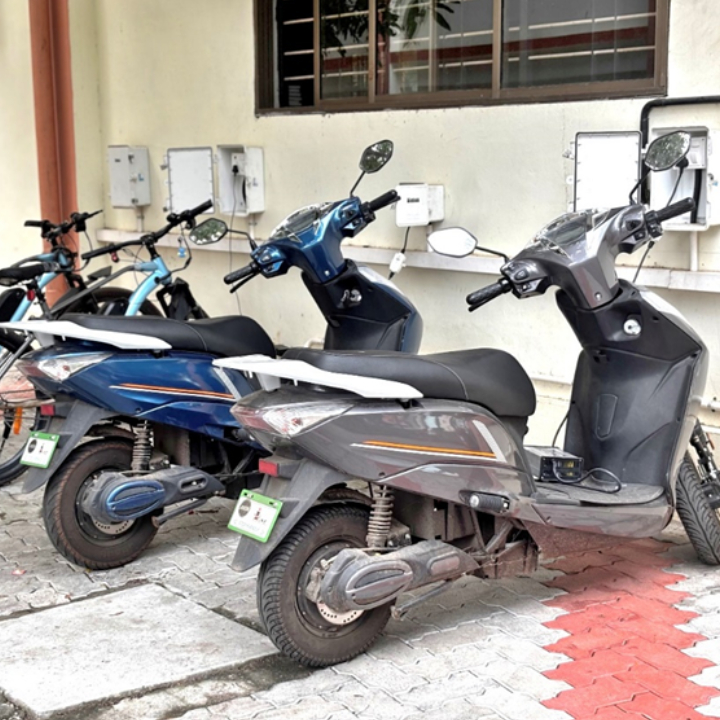
The project titled “Smart EV Sharing Infrastructure with Solar Powered EV Battery Swapping/Charging Stations,” led by investigators M. R. Sindhu, Anu G. Kumar, S. R. Mohanrajan, and Sivraj P. from the Department of Electrical and Electronics Engineering at Amrita Vishwa Vidyapeetham, is funded by the MSME, Government of India for the period 2023–2024.
Thematic Area: Net-Zero Urban Mobility Ecosystems
Amount: Rs. 15, 00, 000/-
Project Duration : One Year
Identified Challenge & Aim :
Smart EV Sharing Infrastructure with Solar Powered EV Battery Swapping/Charging Stations addresses two pressing global challenges—sustainable energy utilization and clean transportation. Electric mobility adoption is hindered by high vehicle ownership costs, limited charging infrastructure, and long charging times. This model provides EV & Charging as a Service, thereby reducing the need for capital investment in EVs while ensuring users have uninterrupted access to green energy-powered mobility. It contributes directly to SDG 7 (Clean Energy), SDG 11 (Sustainable Cities), and SDG 13 (Climate Action) by minimizing carbon emissions, reducing air pollution, and promoting shared mobility solutions.
The Study/Innovation :
The implementation of battery swapping station must consider additional factors as purchase cost of batteries, labour for battery swapping, depreciation of batteries while comparing to EV charging station. The contribution of each of the mentioned factors are specific to each location and detailed market analysis must be carried out. Battery swapping helps in increasing mobility and in reducing the total cost of ownership. These factors also will promote in growth of this segment. Cash flow is summarised in Fig.1. (C-Cost, G-Grid, H-Home, S-Solar PV, B- E2W battery)
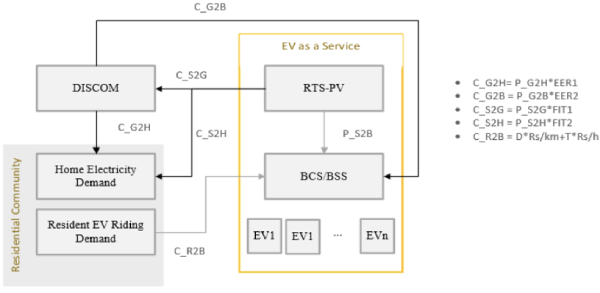
EV Service Provider. The EV service provider invests in Rooftop Solar (RTS)-PV, EVs and EV charging infrastructure.
DISCOM. The DISCOM is benefited as system sizing remains same as EV is primarily powerd by solar PV.
Residential User
Addresses Sustainable Development Goals: