Home SDG 6.5.6 – Promotion of Conscious Water Usage
Last Updated: December 30, 2024
University-Wide Commitment to Sustainable Water Usage
Amrita Vishwa Vidyapeetham has established a structured, institution-wide approach to promoting conscious water usage across all its campuses, integrating policy, infrastructure, monitoring, and community engagement. Guided by its Sustainable Campus Policy, the university is committed to reducing overall water consumption, expanding water reuse, and cultivating responsible water stewardship among students, faculty, and staff.
The policy mandates the adoption of water-efficient infrastructure, including low-flow fixtures, dual-flush toilets, aerated faucets, waterless urinals, and sensor-based tap systems to minimize wastage at source. Comprehensive water metering and automated monitoring tools enable real-time tracking of consumption patterns, early leak detection, and data-driven decision-making. Annual reduction targets and ongoing performance evaluations further reflect the university’s commitment to transparent governance and continuous improvement in sustainable water management. In 2024, all buildings/hostels implemented water-saving operating practices (e.g., timed irrigation, controlled washing stations), and were verified through monitoring logs.
Water Efficient Fixtures
Amrita strongly integrates awareness and responsibility through educational and training initiatives for students, staff, and faculty. Awareness programs, curricular integration, and workshops relating to water conservation help embed behavioral change and encourage responsible usage culture. The stakeholder engagement portion of the policy explicitly notes that the university “engages stakeholders through awareness programs, training sessions, and workshops on water conservation,” cultivating a campus-wide culture of water accountability.
The university promotes extensive water reuse and recycling, including greywater treatment, campus-wide wastewater recycling, and rainwater harvesting systems. The policy sets a reuse goal of meeting 40–50% of total water demand through recycled and harvested water, reinforcing the commitment to conscious consumption and sustainable campus operations.
Infrastructure standards extend to new buildings as well, ensuring they are equipped with dual plumbing lines, maximum reuse of STP-treated water, stormwater systems, and groundwater recharge points. This forward-looking approach integrates water conservation into structural planning and campus design.
Beyond systems and infrastructure, Amrita actively cultivates awareness through student involvement, such as green student programs, sustainability campaigns, and hands-on biodiversity and stewardship learning experiences. These initiatives encourage student participation in environmental decision-making and foster internalization of water-conscious behavior at a personal level.
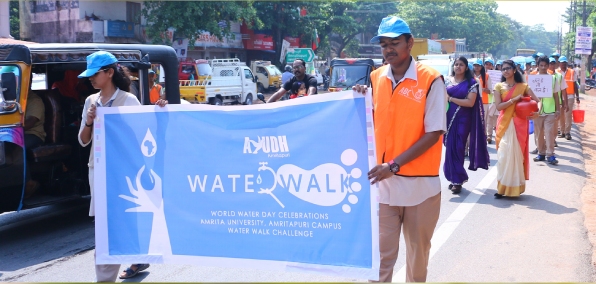
University students attending a rally to spread awareness about conscious water usage
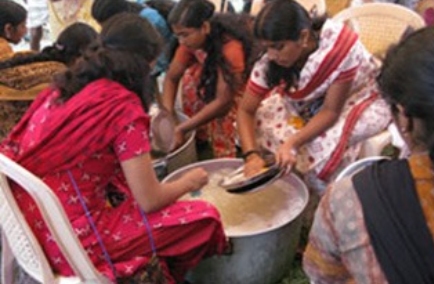
Collective dish cleaning to conserve water
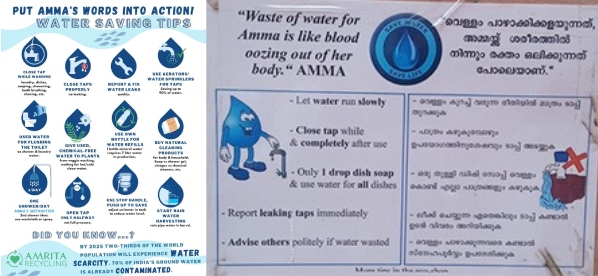
Promotion of conscious water usage kept at different parts in the university
Platewashing Faculty and students are encouraged to practice judicious water usage through awareness programs and volunteering initiatives. The university community is educated on efficient techniques for minimizing water consumption, particularly during activities such as plate washing.
Awareness and Education
Amrita actively fosters a culture of water consciousness among its students, staff, and the surrounding communities.
Courses and workshops on water sustainability and environmental science educate students about water conservation and sustainable practices. The E4Life PhD Program on Sustainable Development spans 14 thematic areas, emphasizing interconnections among water sustainability, environment, agriculture, and climate change.
Posters promoting the judicious use of water are displayed across across campus
Research and Innovation: The university has been focussing on water-related research, such as the development of low-cost filtration systems, water quality monitoring tools, and sustainable irrigation techniques.
Sustainable Landscaping Practices
Across 9 campuses of Amrita, indigenous plants are used extensivly that are well-adapted to the local climate, soil, and ecosystem and reduces the need for excessive watering, fertilizers, and pesticides. Techniques like drip irrigation, rainwater harvesting, to conserve water resources are implemented. Soil fertility and structure is enhanced through organic composting, and reducing soil compaction to promote healthy plant growth naturally. Recycling organic waste, such as grass clippings and leaves, into compost instead of sending them to landfills is also done extensively. Furthermore, habitats for pollinators, birds, and other wildlife are created by including a mix of plants and preserving natural areas.
Gardens and landscaped areas are watered using sprinklers and drip irrigation systems to minimize water consumption and promote efficient water use. Motion sensors are placed to regulate the irrigation on a timely basis.
Promoting Plantation of Native Varieties of Plants – Students with Saplings
Water Conservation Infrastructure
Amrita’s campuses have implemented state-of-the-art water conservation systems, ensuring efficient utilization and minimal wastage.
Rainwater Harvesting: Extensive rainwater harvesting systems across all campuses collect and store rainwater, which is used for irrigation and non-potable purposes.
Water Recycling: Sewage treatment plants (STPs) recycle wastewater, ensuring it is reused for gardening, cooling systems, and flushing, significantly reducing freshwater dependency.
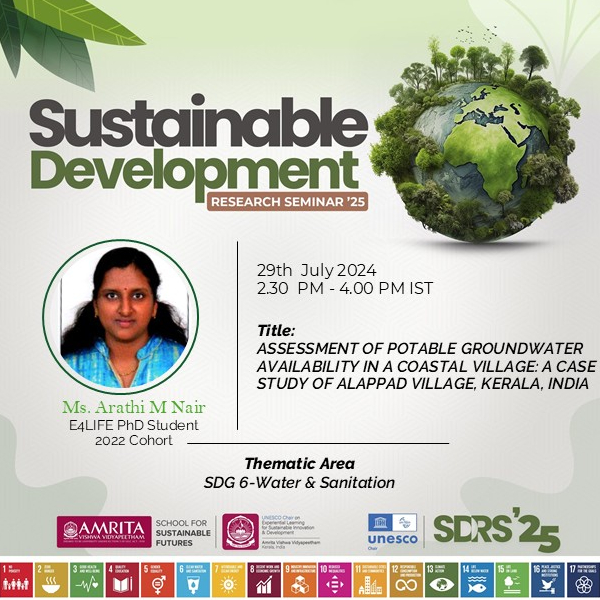
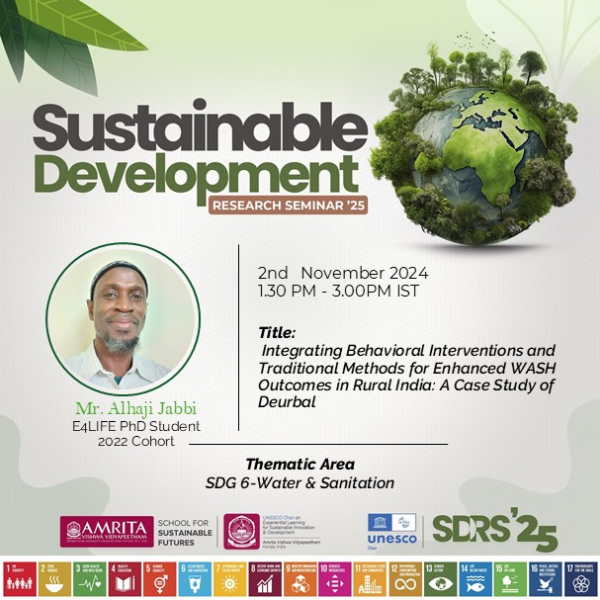
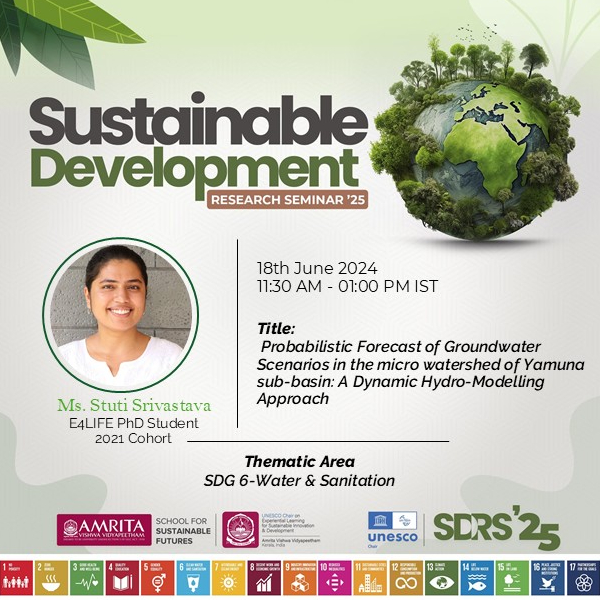
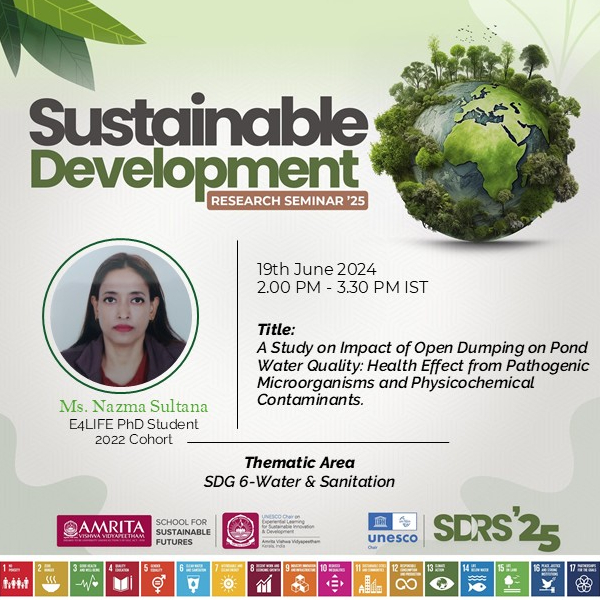
Distinguished Talks on Water Water Sustainability
Amrita School for Sustainable Futures held a Sustainable Development Research Series by the PhD scholars presenting their research on innovative approaches and solutions in the area of water sustainability.
Pioneering Water Sustainability through Innovation and Impact
Amrita’s initiatives have led to a measurable reduction in water consumption across its campuses, a significant increase in the reuse of wastewater, and greater awareness of water sustainability among its stakeholders. These efforts also contribute to the institution’s ranking in the Times Higher Education (THE) Impact Rankings, reflecting its commitment to SDG 6.
Amrita Vishwa Vidyapeetham continues to innovate in the domain of water management, with plans to expand water conservation infrastructure, enhance community programs, and invest in cutting-edge research for sustainable water solutions.
By integrating conscious water usage into its operations and educational practices, Amrita exemplifies a holistic approach to achieving water sustainability, setting a benchmark for other institutions worldwide.
List of Publications in the Area of Water
Abhinaya, P. B., Adarsh, T., Vanga, P., Sivanesh, S., Vishnuvardhan, Y., Radhika, N., & Reshma, A. S. (2022). Case study on water management through sustainable smart irrigation. In IoT with Smart Systems (Vol. 251). Springer. https://doi.org/10.1007/978-981-16-3945-6_56
Ali, B. M., Salih, M. I., Abdulqader, M. A., Bakthavatchalam, B., & Hussein, O. A. (2024). Dehydration and decarboxylation via pyrolysis process of waste oily sludge. Desalination and Water Treatment, 318. https://doi.org/10.1016/j.dwt.2024.100330
Angom, J., & Viswanathan, P. K. (2022). Contribution of MGNREGA to forest restoration. Frontiers in Forests and Global Change, 5, 91.
Angom, J., & Viswanathan, P. K. (2023). Climate-smart agricultural practices in India & South Africa. In The Palgrave Handbook of Socio-ecological Resilience. Springer.
Angom, J., & Viswanathan, P. K. (2023). Irrigation technology interventions for water security in India & Africa. –––, 15(23), 16213.
Barati, M. K., Manivasagam, V. S., Nikoo, M. R., Saravanane, P., Narayanan, A., & Manalil, S. (2022). Rainfall variability and rice sustainability. Land, 11(8). https://doi.org/10.3390/land11081242
Barati, M. K., Manivasagam, V. S., Soundharajan, B., & Manalil, S. (2023). Rice cultivation and water sustainability in Peninsular India. In Modeling and Mitigation Measures for Extreme Hydrometeorological Events. Elsevier.
Bisheko, M. J., & Rejikumar, G. (2023). Farmers’ perceptions of the Kisan Suvidha App. IEEE ICTAS, 1–5.
Bisheko, M. J., Rejikumar, G., Ibirogba, D., & Kikonyogo, S. (2023). Traditional grain storage methods in Indian agriculture. Cogent Food & Agriculture, 9(2). https://doi.org/10.1080/23311932.2023.2276559
Dandadzi, P., & Kothurkar, N. K. (2023). Sustainability of biosand filters. Environmental and Sustainability Indicators, 20, 100311.
Douglas, M., Pokkiyarath, M., & Viswanathan, P. K. (2023). Sustainable agriculture and food security in India. Migration Letters, 20(S1), 181–202.
Harini, S., Varshini, P., Muthukumaaran, S. K., Chebolu, S., Aarthi, R., Saravanan, R., & Reshma, A. S. (2023). In-situ water quality measurement—Udalka, Uttarakhand. In IoT with Smart Systems (Vol. 312). https://doi.org/10.1007/978-981-19-3575-6_66
Hasan, N., Pushpalatha, R., Manivasagam, V. S., Arlikatti, S., & Cibin, R. (2023). Global sustainable water management: A review. Water Resources Management.
Kanyagui, M. K., & Viswanathan, P. K. (2022). Water & sanitation services in India and Ghana. Water Policy, 24(6), 1073–1094.
Kanyagui, M. K., Sharma, J., Mishra, N., & Viswanathan, P. K. (2024). Health impacts of groundwater quality. Water Policy, 26(1), 111–130. https://doi.org/10.2166/wp.2023.206
Madhu, D., Nithya, G. K., Sreekala, S., & Ramesh, M. V. (2024). Landslide modelling using ML and GIS. Natural Hazards, 120(11), 9935–9956. https://doi.org/10.1007/s11069-024-06592-3
Marowa, D., & Manoj, P. (2023). Forest policy & tribal displacement in Nagarhole. Journal of Namibian Studies, 34, 6249–6275.
Matovu, B., Yildiz, M. A., et al. (2024). Coastal resilience using systems thinking. Acta Scientiarum Polonorum: Formatio Circumiectus, 23(1). https://doi.org/10.15576/ASP.FC/2024.23.1.01
Matovu, B., Brouwer, F., Bleischwitz, R., Firas, A., & Yildiz, M. A. (2023). Blue Economy resource nexus: Sand mining in Keralam. Environmental Science & Policy, 151, 1–15.
Murugan, U., Gusain, D., Balasubramani, B., et al. (2024). Review of biomimetic bionic superhydrophobic surfaces. Biofouling, 40(10), 679–701. https://doi.org/10.1080/08927014.2024.2414922
Prajwal, K. S., Nikhil, S., Reddy, P. R., Karthik, G., Sai Kiran, P., Vignesh, V., & Reshma, A. S. (2023). Water and sanitation challenges at Deurbal, Chhattisgarh. In IoT with Smart Systems (Vol. 312). https://doi.org/10.1007/978-981-19-3575-6_69
Pradeep, S., Kavana, C. P., Sai Chakith, M. R., et al. (2024). Novel butyrylcholinesterase inhibitors for Alzheimer’s due to aluminium-contaminated water. Water Resources Development and Management, 288, 119–131. https://doi.org/10.1007/978-981-99-8639-2_7
Ripanda, A., Rwiza, M. J., Nyanza, E. C., et al. (2024). Ciprofloxacin removal using jamun seed biochar. HydroResearch, 7, 164–180. https://doi.org/10.1016/j.hydres.2024.03.001
Rao, P., Dzinamarira, I., Shahabudeen, F., Chikambwe, V., & Padil, V. V. (2024). Nanoclay for sustainable agriculture. In Nanoclay-Based Sustainable Materials. Elsevier.
Sajith, M., Hema, S., & Sambhudevan, S. (2024). Photocatalytic degradation of textile dyes using PANI composites. Water, Air, and Soil Pollution, 235(9). https://doi.org/10.1007/s11270-024-07399-5
Selvam, S. K., Kumar, S. R. A., Balasubramanian, N., et al. (2024). Environmental significance of graphitic carbon nitride. Desalination and Water Treatment, 318. https://doi.org/10.1016/j.dwt.2024.100385
Sreeshna, T. R., Athira, P., & Soundharajan, B. (2024). Climate change and water availability using water footprint. Water Resources Management, 38(10). https://doi.org/10.1007/s11269-024-03839-3
Stanly, S., Rasana, N., Rajendrakumar, S., & Nithya, K. (2024). Indigenous agricultural wisdom for SDGs. Water, Air, and Soil Pollution. https://doi.org/10.1007/s11270-024-07525-3
Tamilarasan, N., Sakthivel, R., & Balaji, K. (2024). Metal oxide catalysts in co-pyrolysis of biomass & COVID waste. Environmental Technology, 45(9). https://doi.org/10.1080/09593330.2022.2151941
Thakur, C., Teutschbein, C., Kasiviswanathan, K. S., & Soundharajan, B.-S. (2024). Hydropower resilience under El Niño. Journal of Hydrology: Regional Studies, 51. https://doi.org/10.1016/j.ejrh.2023.101622
Twist, R., von Lieres, J. S., Rao, B. R., & Koshy, A. J. (2023). Vetiver grass technology for river restoration. IEEE GHTC.
Twist, R., et al. (2024). Socio-ecological linkages in river restoration. IEEE GHTC 2024, 348–355.
Uthayasuriyan, A., Duru, U. I., Nwachukwu, A., Shunmugasundaram, T., & Gurusamy, J. (2024). Flow pattern prediction using automated ML. Rudarsko Geolosko Naftni Zbornik, 39(4). https://doi.org/10.17794/rgn.2024.4.12
Zewdu, D., Krishnan, C. M., Raj, P. P. N., Makadi, Y. C., & Arlikatti, S. (2024). Climate risk via MCDM methods. Stochastic Environmental Research & Risk Assessment. https://doi.org/10.1007/s00477-024-02816-x