Bottom Financial Quintile Student Success Target at Amrita Vishwa Vidyapeetham
Home Bottom Financial Quintile Student Success Target at Amrita Vishwa Vidyapeetham
19/Dec/2025
Approved 1 June 2025 · Academic Council Resolution No. 6643 · Policy ref. AVV/ACAD/POL/2358/2025
Overview
Amrita Vishwa Vidyapeetham has a target that at least 85% of students from the bottom 20% of household incomes in India complete their degree within the normal programme length plus one year, rising to 90% for students who start in 2030–31. The target applies to every undergraduate, postgraduate and PhD programme on all 10 campuses.
The target goes with Amrita’s Bottom Financial Quintile Admission Target. Admitting more students from the poorest households only helps if they also graduate, so Amrita sets and tracks a separate completion target for them. Its aim is that bottom-quintile students graduate at the same rate as all other Amrita students.
Who the target covers
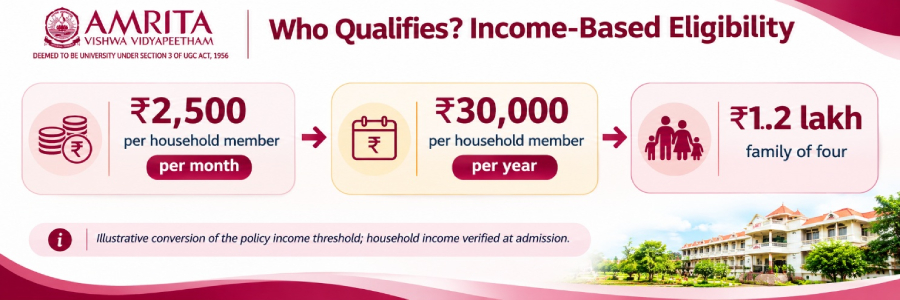
The target covers every student whose household income at admission was ₹30,000 or less per household member per year (₹2,500 per person per month). For a family of four this is ₹1.2 lakh a year. This is the same definition used in Amrita’s Bottom Financial Quintile Admission Target. How income is counted, proved and verified is set out below.
Amrita Vishwa Vidyapeetham’s Income-Based Eligibility Criteria for Economically Disadvantaged Students, illustrating the financial threshold of ₹2,500 per household member per month (₹30,000 annually), equivalent to ₹1.2 lakh per year for a family of four, to identify eligible students from the bottom financial quintile and promote equitable access to higher education.
Basis for the threshold. The limit is set from India’s official national survey of household living standards, the Household Consumption Expenditure Survey (HCES) 2023–24 by the Ministry of Statistics and Programme Implementation (MoSPI). India publishes no official national distribution of household income, so this survey is the standard national measure for ranking households.
Area
Average monthly spending per person, 10–20% class
Average monthly spending per person, 20–30% class
Bottom-20% line lies between
Rural India
₹2,473
₹2,833
₹2,473 and ₹2,833
Urban India
₹3,687
₹4,353
₹3,687 and ₹4,353
Amrita’s limit of ₹2,500 per person per month is at the low end of the rural range and well below the urban range. Because the limit is applied per household member, it holds for every family size. Every student counted is therefore within the bottom 20% of Indian households, a tighter definition than the bottom quintile itself.
Same limit for every household size. The income limit scales with the number of people in the household, so a small family is held to the same per-person standard as a large one:
Household members
Annual household income limit
Per person per month
1 (self-supporting student)
₹30,000
₹2,500
2
₹60,000
₹2,500
3
₹90,000
₹2,500
4
₹1,20,000
₹2,500
5
₹1,50,000
₹2,500
6 or more
₹30,000 × number of members
₹2,500
What counts as income. The total income of all household members from all sources in the last financial year: wages and salaries, farm income, business income, pensions, rent and any other regular income. The household is the student, their parents or guardians, and any siblings or other relatives who live with them and share expenses.
Proof accepted.
Document
Accepted on its own?
Why
Income certificate from the Tahsildar or another state revenue authority, issued within the last 12 months and stating total household income
Yes
Official statement of household income
Antyodaya Anna Yojana (AAY) ration card
Yes
AAY cards are issued only to the poorest households under the National Food Security Act, 2013
BPL or priority household (PHH) ration card
No – only with an income certificate
Priority household cards cover up to 75% of the rural and 50% of the urban population under the National Food Security Act, far more than the bottom 20%
Verification. The Admissions Office checks each document with the issuing authority, using the state’s online certificate verification service where one exists, and records the household size and income used. A student’s classification is fixed at admission, so each cohort’s completion rate is measured on the same group of students from entry to graduation.
Limitation. HCES measures household spending, not income. Low-income households spend most of what they earn, so setting the limit at or below the bottom-20% spending line is a cautious way to identify bottom-quintile households: it may leave out some eligible students, but it does not count students who are above the bottom 20%.
Targets
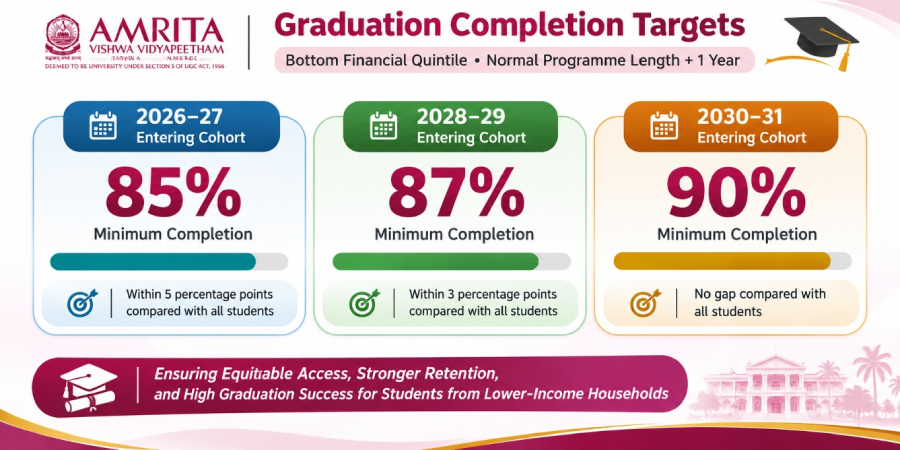
Completion is measured for each entering cohort: the share of bottom-quintile students who finish their degree within the normal programme length plus one year (for example, within 5 years for a 4-year B.Tech).
Amrita Vishwa Vidyapeetham’s Graduation Completion Targets for Economically Disadvantaged Students, outlining progressively increasing minimum completion rates of 85%, 87%, and 90% for the 2026–27, 2028–29, and 2030–31 entering cohorts, respectively, to promote equitable educational outcomes and eliminate graduation disparities.
Cohort entering
Completion target for bottom-quintile students
Gap target
2026–27
At least 85%
Within 5 percentage points of all Amrita students
2028–29
At least 87%
Within 3 percentage points
2030–31
At least 90%
No gap
Two interim targets show early whether a cohort is on track:
First-year retention. At least 95% of bottom-quintile students continue into their second year.
Scholarship continuation. At least 95% of bottom-quintile scholarship holders keep their scholarship each year. In 2024, 92% were re-awarded.
In 2024, all 20 CATALYST scholars, who are economically disadvantaged B.Tech Mechanical Engineering students at Coimbatore, were on track to graduate.
Support to help students finish
Bottom-quintile students receive academic, financial and personal support from their first week until graduation. In 2024, more than 2,500 students received scholarships based on economic need.
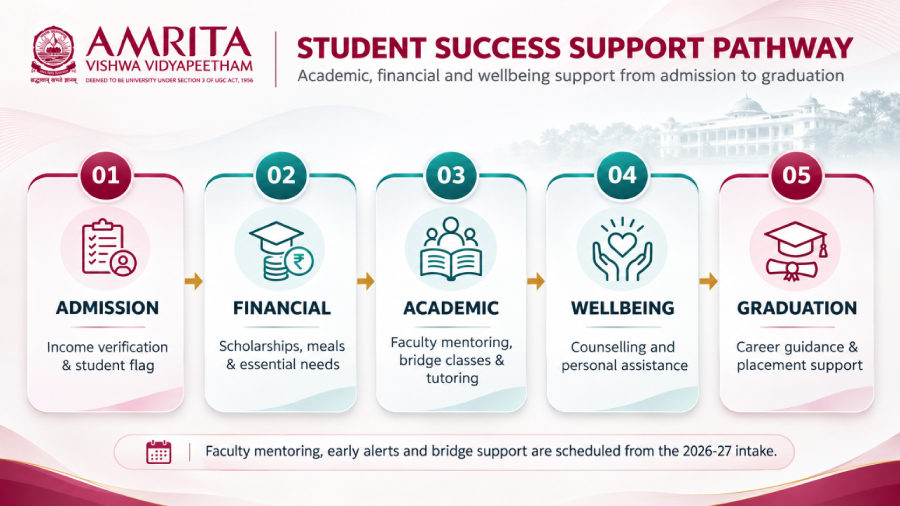
Amrita Vishwa Vidyapeetham’s Student Success Support Pathway, illustrating a five-stage framework integrating admission verification, financial assistance, academic mentoring, wellbeing services, and career guidance to promote equitable access, student retention, academic success, and successful graduation, with enhanced mentoring and early intervention support planned from the 2026–27 intake.
Support
What students receive
2024 reach
Need-based scholarships
Tuition waivers of 25% to 100%, including CATALYST (full costs and placement at ELGi Equipments) and the Rekha Eipe Memorial Scholarship for women
2,500+ students
Meals and basic needs
Subsidised meals at ₹25–₹40, meal vouchers and emergency ration kits
1,200 meal vouchers; 500+ ration kits
Counselling and legal aid
Free 24/7 counselling and free legal advice
3,000+ sessions
Faculty mentor
Every bottom-quintile student is assigned a faculty mentor who meets them each semester
From 2026–27
Early alert
Students whose attendance falls below 75% or whose CGPA falls below 7.0 are contacted within two weeks and offered tutoring, so they keep their scholarship
From 2026–27
Bridge and tutoring support
First-year bridge sessions in mathematics, English and core subjects, and peer tutoring
From 2026–27
Placement support
Career guidance, internships and campus placements
All final-year students
The faculty mentor, early alert and bridge support are new measures under this target and begin with the 2026–27 intake.
Monitoring, reporting and governance
The Academic Council approves the target, and the Dean of Student Affairs is responsible for meeting it, working with the Director of Admissions and the Scholarship Committee.
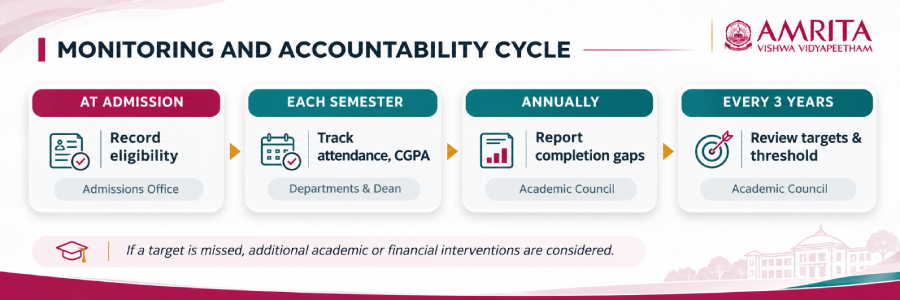
Monitoring and Accountability Cycle at Amrita Vishwa Vidyapeetham, illustrating the systematic tracking of student eligibility, academic performance, completion outcomes, and periodic target reviews to ensure institutional accountability and timely academic or financial interventions.
Student record flag. Each bottom-quintile student is flagged in the student record system at admission, so their progress can be tracked through to graduation.
Every semester. Departments report attendance, CGPA and retention for flagged students to the Dean of Student Affairs, and early-alert cases are followed up.
Every year. The Dean reports to the Academic Council on retention and completion for each cohort, compared with all other students, by campus and programme. The results are published on amrita.edu against the targets.
If a target is missed. The Academic Council approves extra academic or financial support for the next year.
Every three years. The targets, and the ₹1.2 lakh income threshold, are reviewed against the latest MoSPI Household Consumption Expenditure Survey.
Approval record
Approved by the Academic Council of Amrita Vishwa Vidyapeetham at its meeting No. 1145 on 1 June 2025, Resolution No. 6643.
Item
Details
Policy title
Bottom Financial Quintile Student Success Target
Policy reference no.
AVV/ACAD/POL/2358/2025
Approving body
Academic Council, Amrita Vishwa Vidyapeetham
Meeting no. and date
Meeting No. 1145, 1 June 2025
Resolution no.
6643
Effective from
Students entering in academic year 2026–27
Policy owner
Dean of Student Affairs
Next review
1 June 2028, three years after approval
Resolution. Resolved that the Academic Council approves the Bottom Financial Quintile Student Success Target: that at least 85% of students from households with annual income of ₹30,000 or less per household member (₹1.2 lakh for a family of four) entering in 2026–27, at least 87% entering in 2028–29 and at least 90% entering in 2030–31 shall complete their programme within its normal length plus one year, as set out in this document; and that the Dean of Student Affairs shall report progress to the Council every year.
Signed
Name
Date
Vice Chancellor
Dr. Venkat Rangan
1 June 2025
Registrar (Secretary, Academic Council)
Dr. Bipin Nair
1 June 2025
Dean of Student Affairs
Dr. Shashankan
1 June 2025
Sources
Ministry of Statistics and Programme Implementation, Household Consumption Expenditure Survey 2023–24: Fact Sheet, Figures 1R and 1U – https://www.mospi.gov.in/sites/default/files/publication_reports/HCES%20FactSheet%202023-24.pdf
National Food Security Act, 2013 – coverage of Antyodaya Anna Yojana and priority households