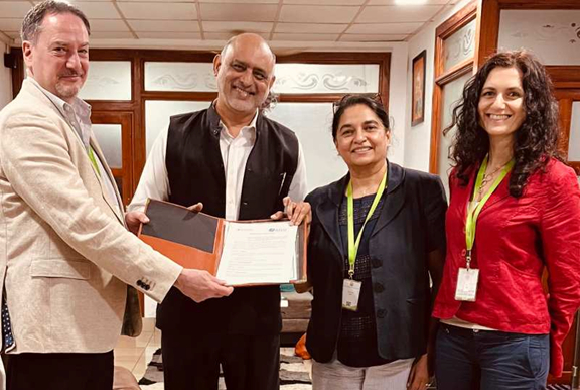
In 2025, Amrita Vishwa Vidyapeetham strengthened its global research network through three international partnerships aimed at advancing scientific innovation, knowledge exchange, and sustainable development. These collaborations bring together academic institutions and industry experts to promote interdisciplinary research, scientific data collection, experimental measurements, and evidence-based approaches to addressing global sustainability challenges. By integrating international expertise, advanced research infrastructure, and collaborative methodologies, these partnerships create opportunities to generate and analyse data relevant to the United Nations Sustainable Development Goals (SDGs), particularly in sustainable industrial technologies, engineering, biotechnology, and environmental sustainability.
| International Partnership | Key Research Areas | Contribution to Sustainable Development |
|---|---|---|
| Amrita–SKF | Tribology, material performance, industrial efficiency, and advanced engineering | Promoting collaborative research into energy efficiency, material durability, resource conservation, and sustainable industrial technologies. |
| Amrita–École Centrale de Nantes, France | Engineering innovation, sustainable infrastructure, scientific research, and environmental sustainability | Strengthening international research cooperation and creating opportunities for scientific data collection, experimental analysis, and sustainable technological development. |
| Amrita–University of Bath, UK | Biotechnology, health sciences, scientific innovation, and advanced research methodologies | Advancing international academic cooperation and creating opportunities for collaborative scientific investigations, biotechnology research, and data-driven approaches to sustainable development. |
Amrita Vishwa Vidyapeetham strengthened its international research engagement in 2025 through a strategic partnership with SKF, a global leader in bearing technologies and industrial engineering. The collaboration brings together Amrita’s academic expertise and SKF’s international research capabilities to advance scientific investigations, technological innovation, and sustainable industrial solutions. The partnership establishes opportunities for international collaboration on gathering and measuring data relevant to the United Nations Sustainable Development Goals (SDGs), particularly in industrial efficiency, responsible resource utilisation, and sustainable manufacturing.
A central focus of the partnership is tribology, the scientific study of friction, wear, lubrication, and the performance of interacting mechanical surfaces. These research areas provide a foundation for collecting, measuring, and analysing technical data related to industrial energy efficiency, material durability, equipment performance, and resource conservation. Such measurements can contribute to understanding sustainability challenges and developing evidence-based approaches to improving industrial processes.
The initiative is led by Dr. Shubrajit Bhaumik, Associate Professor and Head of the Tribology and Interactive Surfaces Research Laboratory (TRISUL) at Amrita Vishwa Vidyapeetham. The laboratory provides specialised research facilities for investigating material behaviour, surface interactions, and advanced engineering systems. Through collaboration with SKF’s international research specialists, Amrita researchers can develop experimental methodologies for gathering and measuring data on frictional resistance, wear rates, lubrication effectiveness, material degradation, and bearing performance under different operating conditions.
The partnership creates opportunities for systematic data gathering and comparative experimental investigations into factors influencing the efficiency, reliability, and sustainability of industrial equipment. Measurements of mechanical energy losses, material wear, and component durability can provide scientific information relevant to resource-efficient manufacturing. By analysing these parameters, researchers can identify opportunities to reduce energy consumption, extend equipment service life, minimise material waste, and improve the environmental performance of industrial technologies.
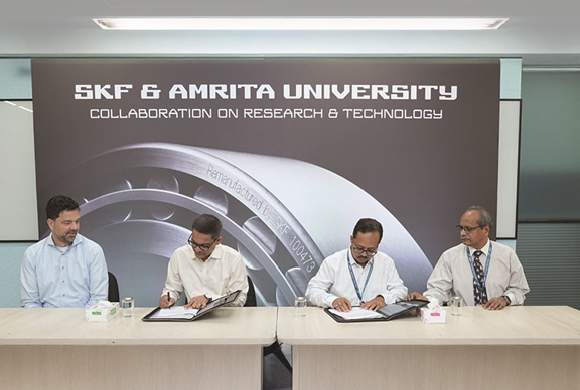
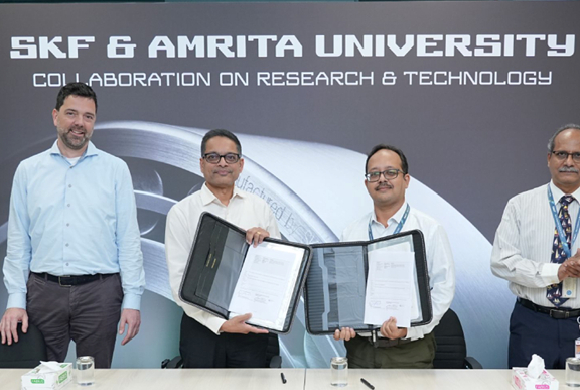
The agreement was formally signed by Mr. Sanoj Somasundaran, Director – Technology Development, ISEA, in the presence of Mr. Arnoud Reininga, Global Head – Research & Technology, SKF; Dr. Shubrajit Bhaumik; and Cmde R. Ravishankar R, Additional Director – Corporate and Industry Relations, Amrita Vishwa Vidyapeetham, Chennai. Dr. Debangshu Roy and Dr. Dipika Malpani, Principal Engineers at SKF ISEA, also contributed to the development of the collaboration through technical discussions and professional engagement.
The Amrita–SKF partnership provides a framework for international scientific cooperation in developing research methodologies, gathering experimental data, and evaluating technological performance in relation to sustainable development. The collaboration’s research focus is particularly relevant to the following Sustainable Development Goals:
By connecting Amrita’s experimental research infrastructure with SKF’s international engineering expertise, the partnership supports the development of scientific approaches for measuring sustainability-related aspects of industrial performance. Joint experimental investigations and the exchange of technical knowledge can strengthen research capacity and facilitate the generation of comparable data across academic and industrial settings.
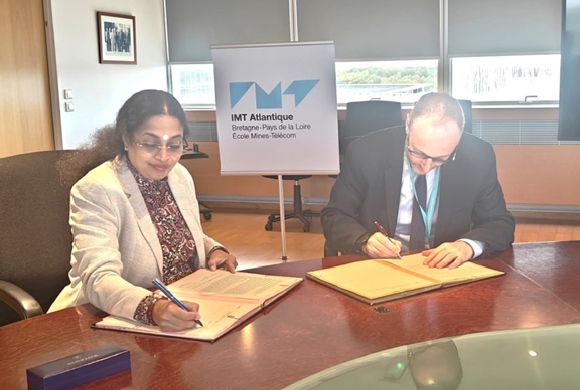
On 5 November 2025, Amrita Vishwa Vidyapeetham strengthened its international academic and research engagement by signing a Memorandum of Agreement (MoA) with École Centrale de Nantes, a leading engineering institution in France. The agreement was signed by Prof. Jean-Baptiste Avrillier, Director of École Centrale de Nantes, and Prof. Maneesha Ramesh, Pro Vice Chancellor of Amrita Vishwa Vidyapeetham, during an official visit by an Amrita delegation to France. The partnership aims to advance international academic cooperation, joint research programmes, faculty and student exchanges, and collaborative scientific initiatives. It also establishes opportunities for international collaboration on gathering and measuring data relevant to the United Nations Sustainable Development Goals (SDGs) through interdisciplinary research and scientific knowledge exchange.
A central component of the partnership is the development of joint research programmes that bring together academic expertise, technological capabilities, and research infrastructure from India and France. These programmes provide opportunities for researchers to develop common methodologies for scientific data collection, experimental measurement, comparative analysis, and the interpretation of research findings. By encouraging cooperation across international research environments, the partnership creates a foundation for generating reliable scientific information that can contribute to addressing global sustainability challenges.
The collaboration offers opportunities to investigate areas related to environmental sustainability, advanced engineering, resource efficiency, emerging technologies, and sustainable infrastructure. Potential joint research activities may involve gathering and analysing data on energy consumption, material performance, environmental conditions, technological efficiency, and other measurable sustainability-related parameters. Such scientific investigations can contribute to understanding the environmental and technological dimensions of sustainable development while supporting evidence-based approaches to innovation and resource management.
The agreement also promotes international mobility through faculty, researcher, and student exchanges. These exchanges provide opportunities for collaborative investigations, joint research proposals, knowledge sharing, and the development of standardised research methodologies. Researchers from both institutions may work together to design experimental studies, establish comparable data collection procedures, and undertake interdisciplinary analyses relevant to sustainable development. Such cooperation can strengthen institutional research capacity and encourage the application of internationally informed scientific approaches to complex societal and environmental challenges.
Another important feature of the partnership is the proposed development of dual bachelor’s degree programmes and joint master’s degree programmes, along with internship opportunities. These academic initiatives aim to provide students with access to international education, specialised research facilities, and diverse learning environments. Through joint academic programmes and research engagement, students may participate in collaborative investigations and data-driven projects addressing scientific, technological, and sustainability-related challenges.
The signing ceremony was attended by an Amrita delegation led by Prof. Maneesha Ramesh, including Prof. Raghu Raman, Dean of Amrita School of Business; Dr. Balakrishnan Shankar, Dean of the School of Engineering; Dr. Rahul Krishnan, Professor at the Amrita Center for Wireless Networks and Applications; and Ms. Sindhu Manoj, Assistant Director of International Programs. The participation of representatives from multiple academic and research disciplines reflects Amrita’s commitment to developing international partnerships that integrate engineering, management, emerging technologies, and interdisciplinary research.
The Amrita–École Centrale de Nantes partnership provides a framework for international research cooperation that can support scientific data gathering, experimental measurement, and the development of evidence-based approaches to sustainable development. Its academic and research objectives are particularly relevant to the following Sustainable Development Goals:
Through the integration of research expertise and institutional resources, both universities can explore collaborative approaches to identifying measurable sustainability parameters, developing scientific data collection protocols, and undertaking comparative investigations. These activities have the potential to strengthen the availability and quality of research evidence relevant to the SDGs.
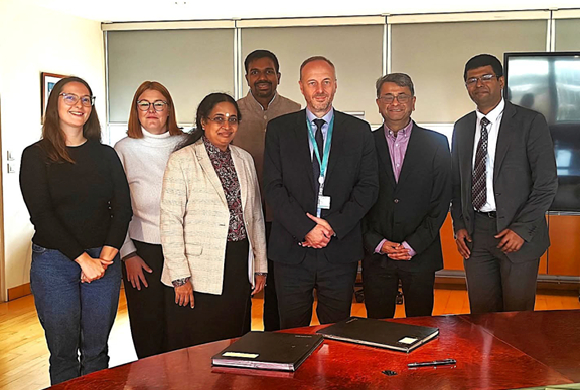
In 2025, Amrita Vishwa Vidyapeetham strengthened its international academic and research engagement through a strategic partnership with the University of Bath, United Kingdom, to advance biotechnology research, scientific innovation, academic exchange, and higher education. The collaboration brings together the academic expertise and research capabilities of both institutions to promote interdisciplinary investigations and knowledge exchange. It also creates opportunities for international collaboration on gathering and measuring data relevant to the United Nations Sustainable Development Goals (SDGs), particularly in biotechnology, health sciences, scientific innovation, and sustainable development.
A central component of the partnership is the establishment of an international academic pathway in biotechnology. Under the agreement, students from Amrita Vishwa Vidyapeetham will complete a master’s programme in India before progressing to the University of Bath’s Faculty of Science for advanced master’s-level studies in biotechnology. This arrangement provides students with opportunities to benefit from internationally recognised academic expertise, advanced laboratory facilities, specialised research infrastructure, and diverse scientific learning environments.
The collaboration provides a foundation for strengthening scientific research capabilities and developing data-driven approaches to biotechnology-related challenges. Through potential joint research initiatives, researchers and students from both universities can explore methodologies for gathering, measuring, and analysing scientific data relevant to health, biological systems, technological innovation, and sustainable development. Such investigations may contribute to understanding complex biological processes, evaluating emerging biotechnological applications, and developing evidence-based solutions to scientific and societal challenges.
By combining institutional research expertise and laboratory resources, the partnership creates opportunities for collaborative experimental studies, comparative scientific investigations, and the exchange of research methodologies. Potential research activities may involve collecting and analysing biological measurements, laboratory observations, experimental findings, and other scientific information relevant to biotechnology and sustainability. These activities can support the development of reliable research approaches and strengthen international scientific cooperation.
The partnership also encourages academic knowledge exchange and interdisciplinary engagement between India and the United Kingdom. Students participating in the international master’s pathway will have opportunities to gain exposure to different research environments, scientific techniques, and analytical approaches. Such experiences can strengthen their capacity to undertake experimental investigations, interpret scientific findings, and contribute to collaborative research initiatives addressing global challenges.
Dr. Bipin Nair, Dean of the School of Biotechnology at Amrita Vishwa Vidyapeetham, highlighted the mutual academic benefits of the collaboration, emphasising the value of combining Amrita’s established biotechnology programmes with the University of Bath’s internationally recognised faculty and research expertise. Prof. Duncan Craig, Dean of the Faculty of Science at the University of Bath, expressed enthusiasm for the partnership, highlighting the alignment of educational values and institutional objectives, particularly in developing future scientific leaders and creating benefits for students, universities, and the wider community.
The first cohort of Amrita students is expected to join the University of Bath during the 2025–26 academic year, marking an important milestone in the development of a long-term international academic and research relationship.
The Amrita–University of Bath partnership establishes opportunities for international scientific cooperation in biotechnology research, experimental data gathering, scientific measurement, and the application of evidence-based approaches to sustainable development. The collaboration’s academic and research objectives are relevant to several United Nations Sustainable Development Goals:
Through interdisciplinary engagement, both universities can explore approaches to identifying measurable scientific parameters, developing common experimental protocols, and undertaking comparative research investigations. These opportunities can strengthen research capacity and contribute to generating scientific knowledge relevant to the SDGs.