Energy Reviews to Identify Energy Wastage at Amrita Vishwa Vidyapeetham
Home Energy Reviews to Identify Energy Wastage at Amrita Vishwa Vidyapeetham
December 30, 2025
Overview
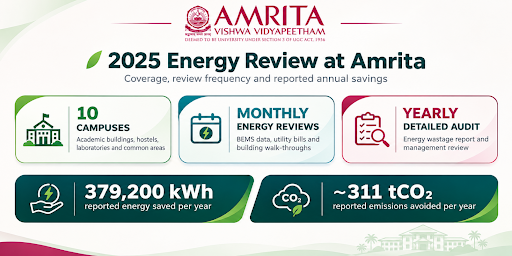
Amrita Vishwa Vidyapeetham reviews energy use every month to find where energy waste is highest, and runs a detailed energy audit every year. Reviews cover all 10 campuses: academic buildings, hostels, labs and common areas.
The latest full energy wastage review (report dated 2 November 2025) found that the most waste comes from lighting and air conditioning. Monitoring and fixes since then save 379,200 kWh and about 311 tCO₂ a year.
Amrita Vishwa Vidyapeetham’s 2025 energy review process across 10 campuses, highlighting monthly monitoring, annual energy audits, and reported annual savings of 379,200 kWh and approximately 311 tCO₂ in avoided emissions.
Who Carries out the Reviews
The Office of Sustainability runs the reviews with campus facility teams. The Amrita School for Sustainable Futures prepares the full wastage report.
Review
Done by
How often
Energy data review (BEMS, sub-meters, utility bills)
Office of Sustainability with campus Estate and Electrical teams
Monthly
Building walk-through inspections
Campus Carbon Management Committees and maintenance staff
Monthly
Detailed energy audit and wastage report
Amrita School for Sustainable Futures, with engineering faculty and students
Yearly
Review of findings and actions
Carbon Neutrality Management Committee
Yearly
The Review Process
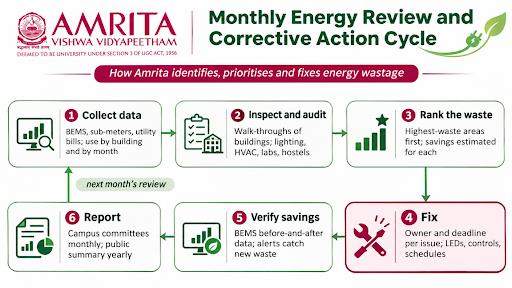
Each review follows six steps, and the cycle repeats every month.
Amrita Vishwa Vidyapeetham’s six-step monthly energy review process, highlighting energy monitoring, wastage identification, corrective actions, savings verification, and reporting to improve campus energy efficiency.
Collect data. Energy use per building comes from the BEMS, sub-meters and utility bills.
Inspect and audit. Teams walk through buildings and check lighting, air conditioning, insulation, lab equipment and hostel use.
Rank the waste. Data and inspection findings are compared to rank the areas of highest waste and estimate the saving in each.
Fix. Each issue gets an owner and a deadline, such as LED retrofits, sensor controls or new operating schedules.
Verify savings. BEMS data from before and after each fix confirms the saving, and automatic alerts flag new waste.
Report. Results go to campus committees each month and are published on amrita.edu each year.
Where Waste is Highest
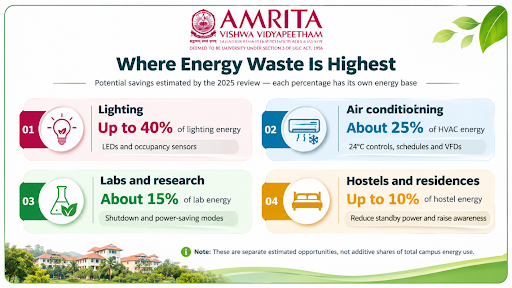
The 2025 review ranked four areas by how much energy could be saved, with lighting the largest. The savings below are the review’s estimates for each area.
Area (highest waste first)
Waste found
Estimated saving
Action taken
Lighting
Inefficient fittings; lights left on in empty rooms
Up to 40% of lighting energy
LED retrofits (1,200 LEDs in older buildings, 2025); motion sensors in low-traffic areas
Air conditioning (HVAC)
Poor temperature control in several buildings
About 25% of HVAC energy
Occupancy-based schedules; programmable thermostats set to 24°C; variable frequency drives
Labs and research facilities
Equipment left running after hours
About 15% of lab energy
Shutdown after use; consolidated lab hours; power-saving modes
Hostels and residences
Standby power from devices left plugged in
Up to 10% of hostel energy
Awareness campaigns, including Energy Conservation Week
Amrita Vishwa Vidyapeetham’s Energy Efficiency Assessment (2025), highlighting estimated energy-saving opportunities across lighting (up to 40%), air conditioning (25%), laboratories (15%), and hostels (up to 10%) through energy-efficient technologies, optimised operations, and sustainable energy management practices. Percentages represent separate sector-specific saving opportunities.
The review also estimated that changing everyday habits could cut overall waste by 10–15%. Students, faculty and maintenance staff were consulted to find waste that meters miss.
Reporting and Follow-up
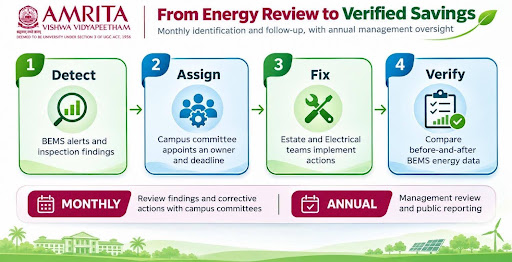
Every finding gets an owner and a deadline, and its savings are checked on the BEMS afterwards.
Amrita Vishwa Vidyapeetham’s Systematic Energy Management Framework, illustrating the four-stage process of detecting energy inefficiencies, assigning responsibilities, implementing corrective actions, and verifying energy savings through monthly monitoring and annual management review.
Monthly review results go to each campus Carbon Management Committee, which assigns fixes to the Estate and Electrical teams.
The BEMS sends automatic alerts when a building uses more energy than usual, so new waste is caught between reviews.
The yearly wastage report goes to the Carbon Neutrality Management Committee, which approves the next year’s efficiency projects.
A summary of findings and savings is published every year on amrita.edu.