Carbon Management and Emission Reduction Process at Amrita Vishwa Vidyapeetham
Home Carbon Management and Emission Reduction Process at Amrita Vishwa Vidyapeetham
December 15, 2025
Overview
Amrita Vishwa Vidyapeetham runs a formal, university-wide process to measure, manage and reduce its carbon dioxide emissions, with a target of net-zero emissions by 2030. The process covers all 10 campuses and about 32,000 students, faculty and staff, and follows the GHG Protocol Corporate Standard.
The process is set by Amrita’s Sustainable Campus Policy and its Net-Zero Strategy. It supports SDG 7 (Affordable and Clean Energy) and SDG 13 (Climate Action).
Governance
A university-level Carbon Neutrality Management Committee owns the process. Each campus has its own Carbon Management Committee that carries it out.
Sets targets and policy, approves the annual carbon plan and budget
Annual
Office of Sustainability
Compiles the GHG inventory, runs the carbon dashboards, publishes the annual GHG report
Monthly data, annual report
Campus Carbon Management Committees
Run reduction projects on each campus, track energy and fuel use, propose corrective actions
Monthly
Estate, Facilities and Electrical departments
Collect meter, fuel and fleet data; operate solar, BEMS and generators
Daily to monthly
The Carbon Management Process
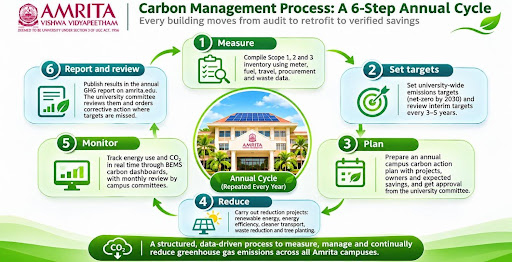
Carbon is managed through a six-step cycle that repeats every year, so each year’s results set the next year’s actions.
Amrita Vishwa Vidyapeetham’s six-step annual carbon management cycle, highlighting greenhouse gas emissions measurement, target setting, reduction planning, implementation, monitoring, and reporting to support its net-zero emissions goal by 2030.
Measure. The Office of Sustainability compiles the Scope 1, 2 and 3 inventory each year from meter, fuel, travel, procurement and waste data.
Set targets. The Carbon Neutrality Management Committee sets university-wide targets against the inventory and reviews interim targets every 3 to 5 years.
Plan. Each campus Carbon Management Committee prepares an annual carbon action plan with projects, owners and expected savings, approved by the university committee.
Reduce. Campuses carry out the projects: renewable energy, energy efficiency, cleaner transport, waste reduction and tree planting.
Monitor. BEMS carbon dashboards track energy use and CO₂ in real time, and campus committees review progress monthly.
Report and review. Results are published in the annual GHG report on amrita.edu. The university committee reviews them and orders corrective action where targets are missed.
Measuring Emissions
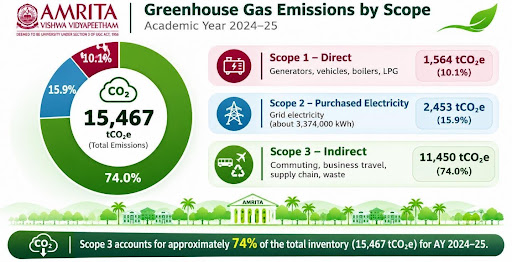
Amrita’s latest inventory, for academic year 2024–25, puts total emissions at 15,467 tCO₂e. That is about 0.48 tCO₂e per person across all scopes. Emissions are counted using the GHG Protocol and published emission factors.
Scope
Sources measured
Data source
Emissions (tCO₂e, AY 2024–25)
Scope 1 (direct)
Diesel generators, vehicle fleet, boilers and LPG
Fuel purchase and logbook records
1,564
Scope 2 (purchased electricity)
Grid electricity, about 3,374,000 kWh
Utility bills and BEMS meters
2,453
Scope 3 (indirect)
Commuting, business travel, supply chain, waste
Travel surveys, travel desk records, procurement and waste records
11,450
Total
15,467
Amrita Vishwa Vidyapeetham’s greenhouse gas emissions for 2024–25, highlighting total emissions of 15,467 tCO₂e, with Scope 3 contributing 74%, Scope 2 accounting for 15.9%, and Scope 1 representing 10.1%.
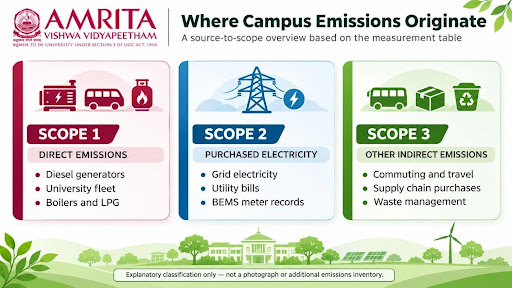
Amrita Vishwa Vidyapeetham’s greenhouse gas emission sources, categorised into Scope 1 (direct emissions), Scope 2 (purchased electricity), and Scope 3 (indirect emissions from commuting, travel, procurement, and waste management).
Emission factors used: grid electricity 0.727 kgCO₂e/kWh (CEA India 2024), diesel 2.68 kgCO₂e/litre (IPCC 2006), LPG 2.14 kgCO₂e/kg, travel factors from UK DEFRA 2025 and ICAO. A real-time Building Energy Management System (BEMS) on every campus feeds a carbon dashboard that tracks CO₂ from electricity, heating and cooling. A consolidated inventory to ISO 14064-1 is being prepared.
Reduction Actions
Each scope has its own reduction measures, and each measure is tracked against measured savings.
Area
Action
Measured result
Renewable energy (Scope 2)
Solar PV across campuses, including 306 kWp rooftop PV on academic buildings
4 MW renewable capacity; rooftop PV generates 567,228 kWh a year
Energy efficiency (Scope 2)
BEMS dashboards with Energy Use Intensity tracking and alerts; sensor-based lighting; occupancy-based HVAC control
379,200 kWh saved a year
Generators (Scope 1)
Less diesel generator use as solar and grid supply improve
Diesel generator energy down from 1,091 GJ (2022) to 617 GJ (2024)
Fleet and transport (Scopes 1 and 3)
Electric and CNG vehicles, solar auto-rickshaws, carpooling
45% of the fleet is electric or CNG
Cooking fuel (Scope 1)
Biofuel substitution for LPG
Lower LPG emissions
Waste (Scope 3)
Segregation, recycling and composting
About 300 tCO₂e avoided
Buildings
New and renovated buildings designed to ECBC, IGBC and LEED standards
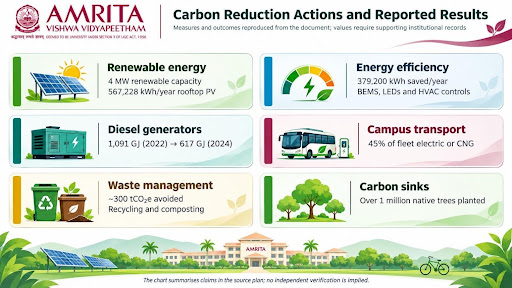
Amrita Vishwa Vidyapeetham’s carbon reduction initiatives, highlighting renewable energy adoption, energy efficiency, reduced diesel consumption, sustainable transport, waste management, and tree planting to minimise greenhouse gas emissions.
Targets, Monitoring and Reporting
Amrita’s headline commitment is net-zero emissions by 2030, then 100% renewable energy by 2035.
Year
Target
Scope
2025
Cut grid electricity dependence to about 30% of demand
Scope 2
2024–2026
Complete a consolidated university-wide GHG inventory (ISO 14064-1) and reduce fossil fuel use
Scopes 1, 2, 3
2026–2029
Scale up renewables, electrify transport and equipment, expand nature-based carbon removal
Scopes 1, 2, 3
2030
Net zero, with a 65% absolute GHG reduction
Scopes 1, 2, 3
2035
100% renewable energy
Scope 2
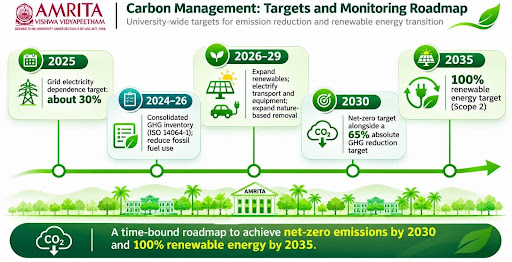
Amrita Vishwa Vidyapeetham’s carbon management roadmap (2024–2035), highlighting greenhouse gas monitoring, renewable energy expansion, sustainable transport, and its targets of net-zero emissions by 2030 and 100% renewable energy by 2035.
Progress is monitored monthly through the BEMS carbon dashboards and the campus committees. The Office of Sustainability publishes an annual GHG emissions report on amrita.edu, and the Carbon Neutrality Management Committee reviews it each year and orders corrective action where a campus is off track.