Last Updated: December 12th, 2025

Amrita Vishwa Vidyapeetham has established wastewater-treatment infrastructure across its campuses to manage wastewater generated from academic, residential, healthcare and other institutional activities. The university follows an integrated wastewater-management approach focused on collection, treatment, quality assessment and reuse of treated wastewater for appropriate non-potable applications.
The university’s Zero Liquid Discharge (ZLD) and No Septic Tank approach supports the collection and treatment of wastewater generated on campus. These initiatives contribute to pollution prevention, improved water quality and the objectives of SDG 6: Clean Water and Sanitation, particularly Target 6.3, which addresses wastewater treatment, pollution reduction and safe reuse.
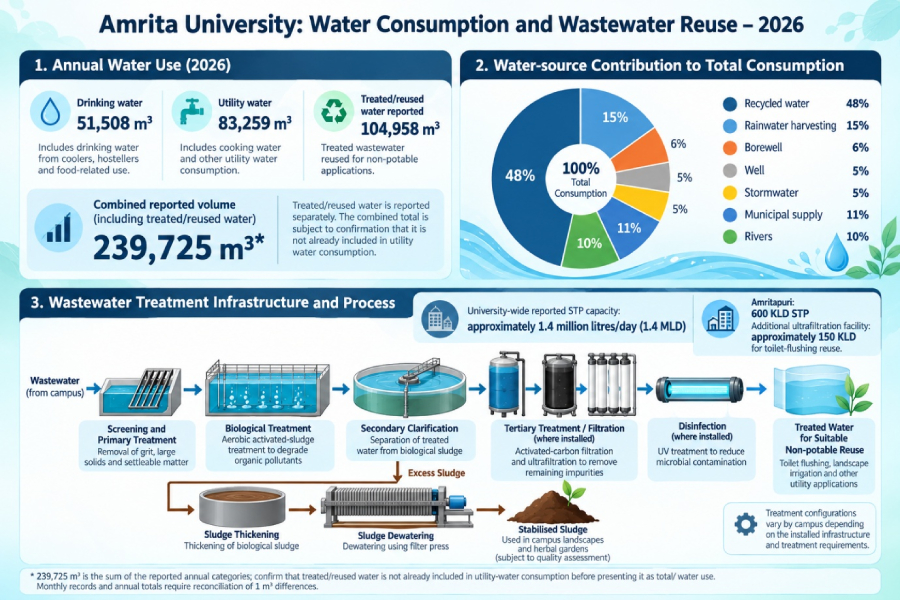
Amrita operates decentralised sewage treatment plants (STPs) across its campuses to treat wastewater generated through academic, residential, healthcare and utility activities. The combined treatment capacity across the university is approximately 1.4 million litres per day (1.4 MLD).
At the Amritapuri campus, wastewater-management infrastructure includes a 600 KLD sewage treatment plant. An additional ultrafiltration facility treats approximately 1.5 lakh litres of STP-treated water per day for reuse in toilet flushing.
The treatment infrastructure supports wastewater recovery and reuse for non-potable applications, reducing dependence on freshwater resources and minimising the risk of untreated wastewater entering the surrounding environment.
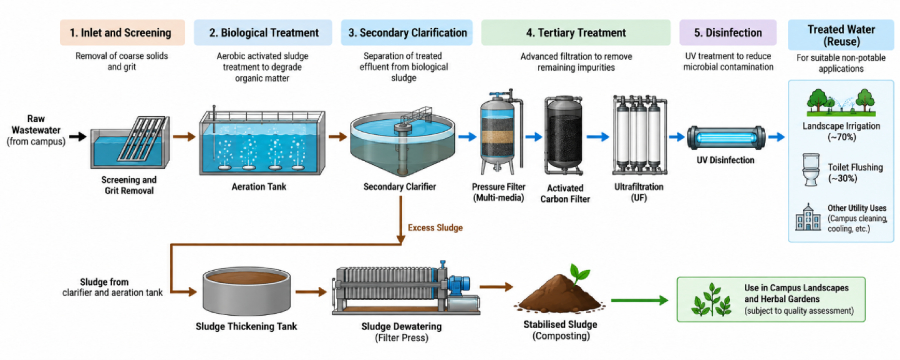
The university’s wastewater-treatment systems use a multi-stage treatment approach to remove suspended solids, organic pollutants and other impurities before treated water is reused or discharged.
The treatment stages include:
The treatment configuration may vary between campus facilities depending on the installed infrastructure and treatment requirements.
During 2025, Amrita Vishwa Vidyapeetham reported 104,958 m³ of treated and reused wastewater across its campuses.
The university-wide water-use figures for 2025 are presented below:
| Drinking water | 51,508 m³ |
| Utility water | 83,259 m³ |
| Combined drinking and utility water input | 134,767 m³ |
| Treated and reused wastewater | 104,958 m³ |
| Total reported water consumption | 239,725 m³ |
The volume of treated and reused wastewater was equivalent to approximately 78% of the combined drinking and utility water input. This indicator reflects the scale of wastewater reuse in relation to freshwater input and should not be interpreted as the percentage of wastewater generated that was treated.
Treated wastewater is reused for suitable non-potable applications, including:
The recovery and reuse of treated wastewater help reduce freshwater demand and support efficient campus water management.
The university incorporates energy-efficient and digital monitoring approaches into wastewater-treatment operations. Selected STPs are supported by solar energy systems to reduce dependence on conventional electricity and minimise the carbon footprint of wastewater treatment.
IoT-enabled monitoring systems support operational oversight and the tracking of important treatment parameters, including:
These monitoring approaches support treatment-process assessment, operational transparency and efficient plant management.
Water-quality assessment is an important component of wastewater management. Treated effluent is assessed to evaluate treatment performance and determine its suitability for reuse or discharge.
Monitoring and quality-assurance activities include:
These activities support responsible wastewater management and help ensure that treated effluent is suitable for its intended application and managed in accordance with applicable environmental standards.
Biological sludge generated during wastewater treatment is managed through processes such as thickening, dewatering and composting. Nutrient-rich compost recovered from sludge processing can be utilised in campus landscapes and herbal gardens, subject to appropriate treatment and quality assessment.
This approach promotes resource recovery, reduces waste generation and supports a circular approach to wastewater and nutrient management.
Amrita adopts a range of measures to prevent water pollution and maintain the effective operation of its wastewater infrastructure. These include:
These measures help minimise the risk of untreated wastewater entering surrounding water bodies and support responsible campus wastewater management.
Amrita is also exploring decentralised and nature-based approaches to wastewater treatment.
At Amritapuri, a 500-litre-per-day vertical-garden wastewater-treatment prototype incorporates multiple treatment components, including:
This initiative explores the integration of biological treatment processes and plant-based systems for decentralised wastewater management.
Amrita Vishwa Vidyapeetham continues to strengthen wastewater management through efficient operation of STPs, improved monitoring, treated-water reuse and the adoption of innovative treatment technologies.
Continued assessment of effluent quality, infrastructure performance, sludge management and reuse practices will support the university’s efforts to improve water quality, prevent pollution and promote sustainable wastewater management.
Through wastewater collection and treatment, recovery and reuse of treated water, effluent-quality assessment and pollution-prevention measures, Amrita Vishwa Vidyapeetham contributes to SDG Target 6.3: Improving Water Quality and Wastewater Management. These initiatives support the reduction of untreated wastewater discharge, improved water-use efficiency and the responsible management of water resources.