Last Updated: December 12th, 2025

Amrita Vishwa Vidyapeetham is committed to protecting water resources through sustainable water management, wastewater treatment and reuse, water-quality monitoring, rainwater harvesting, pollution prevention, and responsible infrastructure management. In alignment with the Sustainable Campus Policy and United Nations Sustainable Development Goal 6 (SDG 6: Clean Water and Sanitation), the university continues to strengthen its water-management systems and promote efficient use of water across its campuses.
The university’s approach combines technology-enabled water monitoring, wastewater treatment, water conservation infrastructure, groundwater recharge, and institutional awareness programmes. These initiatives aim to reduce freshwater dependency, prevent contamination of water systems, and support long-term water security.
In 2025, Amrita Vishwa Vidyapeetham recorded a total water consumption of 239,726 m³ across its campuses, catering to a population of over 39,000. The university adopts an integrated water-management approach that combines monitoring of drinking and utility water consumption with wastewater treatment and the reuse of treated water for appropriate non-potable purposes.
In 2025, the reported treated/reused wastewater volume of 104,958 m³ was equivalent to approximately 78% of the combined drinking and utility water input of 134,767 m³. The treated wastewater is recovered for suitable non-potable applications, including toilet flushing, irrigation, and other utility purposes, subject to treatment performance and water-quality requirements. This approach helps to reduce dependence on additional freshwater resources and promotes a more circular water-management system across campus operations.
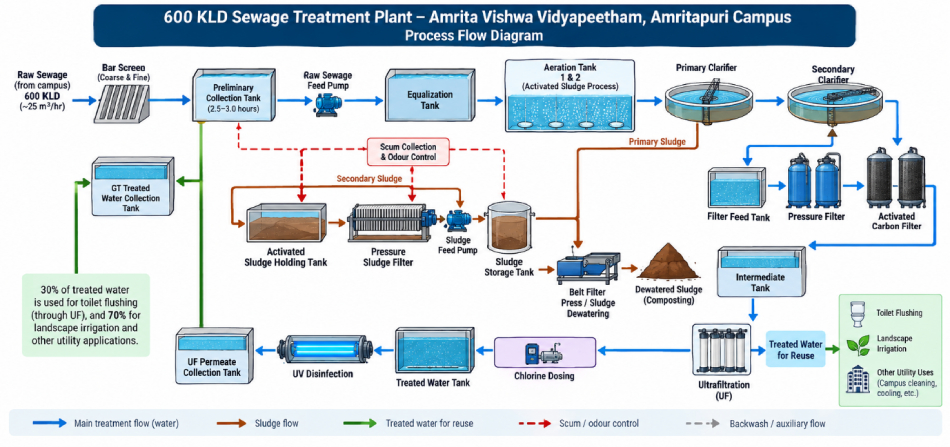
Amrita operates sewage treatment plants (STPs) across its campuses to treat wastewater generated from various campus activities, with a combined treatment capacity of approximately 1,400 m³/day across the university. The treatment systems incorporate biological treatment processes, aeration, clarification, filtration, and sludge-management mechanisms.
The university also proposed advanced STP (STP-IV) with a capacity of 4,000 m³/day for development during the coming academic year. Its commissioning and operational status should be confirmed before inclusion as existing treatment capacity.
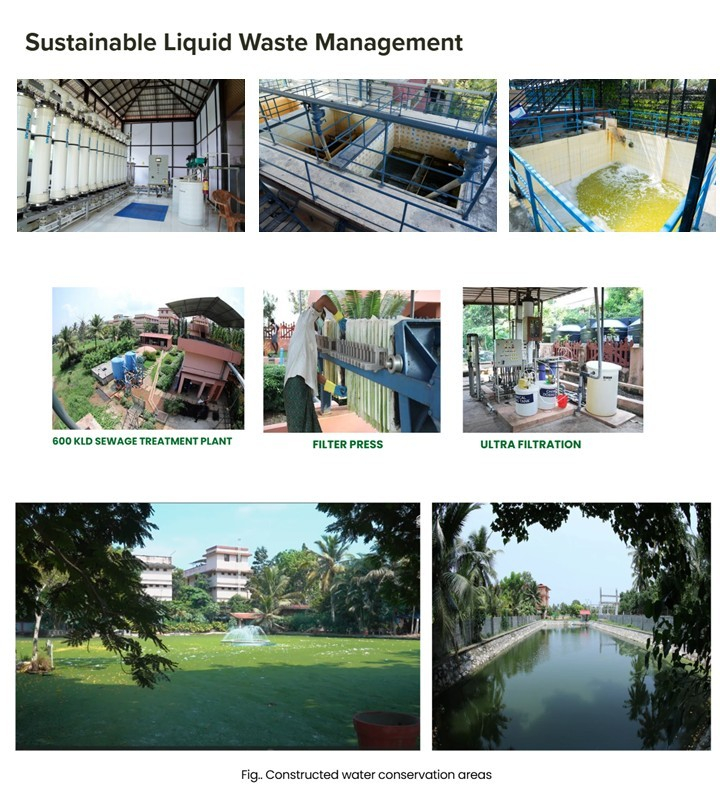
At the Amritapuri campus, wastewater-management infrastructure includes a 600 KLD sewage treatment plant (STP). An additional ultrafiltration facility treats approximately 1.5 lakh litres of STP-treated water per day for reuse in toilet flushing. According to the campus presentation, treated wastewater is allocated between toilet flushing (30%) and landscape irrigation (70%). The recovery and reuse of treated wastewater help reduce dependence on freshwater resources for non-potable applications and support sustainable campus operations.
Regular water-quality assessment forms an important part of the university’s water-pollution prevention and management strategy. Monitoring helps evaluate the quality of incoming water, identify potential contamination, and determine its suitability for different uses.
Through its water-testing facilities, the university has the capacity to analyse the following parameters
| Physical | pH | Acidity or alkalinity of water |
| Turbidity | Water clarity and suspended particles | |
| Total Suspended Solids (TSS) | Suspended solid content | |
| Total Dissolved Solids (TDS) | Dissolved substances in water | |
| Chemical | Total Hardness | Hardness expressed as CaCO₃ |
| Total Alkalinity | Buffering capacity of water | |
| Calcium | Calcium concentration | |
| Magnesium | Magnesium concentration | |
| Chloride | Chloride concentration | |
| Total Iron | Total iron concentration | |
| Residual Free Chlorine | Remaining chlorine after disinfection | |
| Sulphate* | Sulphate concentration | |
| Biological | Total and Feacal Coliform | Microbial Contamination, |
| Advanced analytical facility | Chloride by Ion Chromatography | Instrument-based chloride determination |
These parameters help characterise the physical and chemical properties of water, identify potential quality concerns, and assess its suitability for different applications.
Water-quality monitoring is also important for assessing treated wastewater before reuse. The quality requirements should be appropriate to the intended application and applicable regulatory standards.
Amritapuri campus has developed dedicated water-conservation areas to support rainwater retention, water storage, and groundwater recharge. Approximately 5.3 acres of campus land have been identified as water-conservation areas. These areas include constructed water bodies and associated conservation infrastructure that contribute to managing rainfall runoff and supporting local water availability.
The campus has documented a rooftop rainwater catchment area of approximately 35,391.6 m², distributed across the following building categories:
| Academic and utility buildings | 15,481.0 m² |
| Boys’ hostel zone | 9,136.0 m² |
| Girls’ hostel zone | 4,566.0 m² |
| Research and institutional buildings | 6,208.6 m² |
| Total | 35,391.6 m² |
The reported rooftop rainwater-harvesting potential is approximately 6.83 crore litres. Rainwater harvesting, water-body storage, and groundwater-recharge measures together form an integrated approach to managing rainfall, reducing surface runoff, and strengthening campus water security.
Amrita implements the following measures to protect water-supply systems, wastewater networks, and surrounding water bodies:
Amrita conducts periodic inspections and maintenance of water pipelines, storage tanks, and related infrastructure to prevent leaks and contamination. Key measures include:
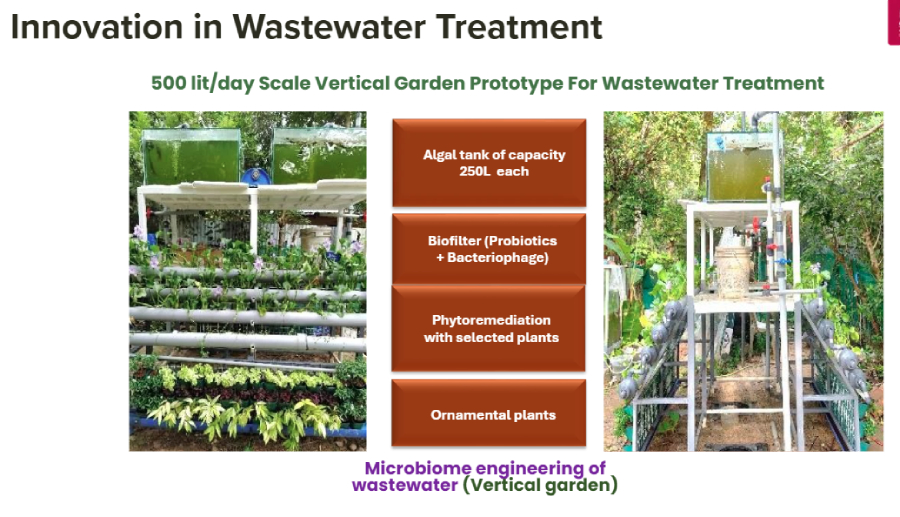
Amritapuri campus has developed a 500-litre/day vertical-garden wastewater-treatment prototype integrating biological and plant-based treatment processes. The system includes algal tanks, a probiotic and bacteriophage-based biofilter, and phytoremediation using selected plants.
Amrita promotes water conservation and pollution prevention through awareness programmes, staff and contractor training, and collaboration between students, researchers, and campus operations teams.
Key priorities include:
Through water-quality monitoring, wastewater treatment and reuse, rainwater harvesting, groundwater recharge, and pollution-prevention initiatives, Amrita Vishwa Vidyapeetham remains committed to protecting water resources and advancing SDG 6 – Clean Water and Sanitation.
Additional information