


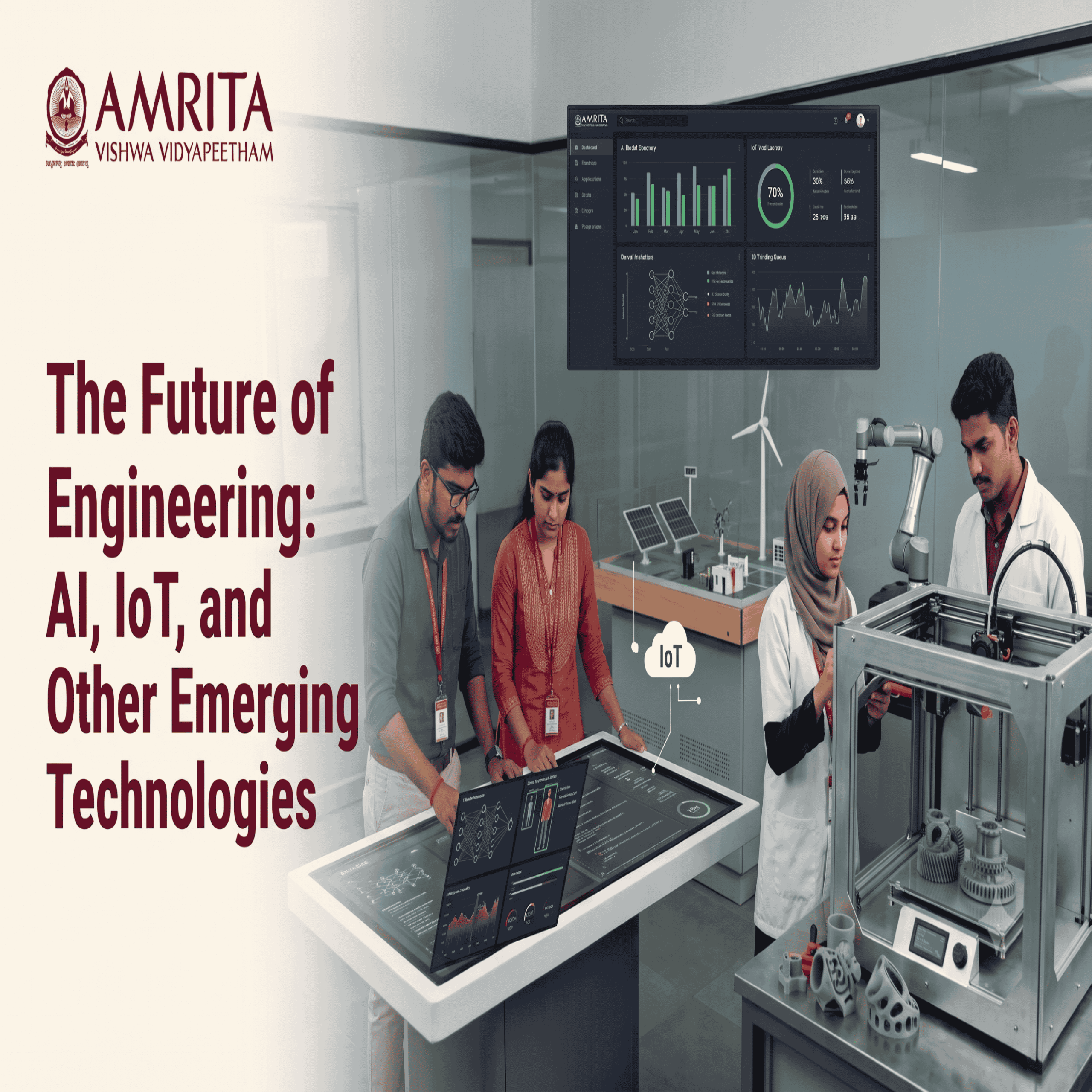
The field of engineering is undergoing a profound transformation, driven by the rapid advancement of emerging technologies. From AI in engineering to the Internet of Things (IoT), these innovations are reshaping the way engineers approach problem-solving, design, and manufacturing. As the world enters the era of Industry 4.0, it is crucial for aspiring engineers to understand the impact of these technologies and how they will shape the future of the profession.
In this article, we will explore the key emerging technologies that are revolutionizing engineering, including artificial intelligence, IoT, 3D printing, renewable energy, and more. We will also discuss the importance of integrating these technologies into engineering education and the role of academic institutions like Amrita University in preparing students for the challenges and opportunities of the future.
AI in engineering and Machine Learning (ML) are at the forefront of the technological revolution. These technologies enable systems to learn from data, make predictions, and improve over time. AI and ML are being applied in various areas of engineering, such as
AI algorithms can analyze complex datasets to enhance efficiency and reduce operational costs in manufacturing. By optimizing processes and automating repetitive tasks, AI is helping engineers streamline operations and improve productivity.
AI-powered predictive maintenance systems can monitor the health of equipment and infrastructure in real-time, identifying potential issues before they lead to costly breakdowns. This proactive approach improves reliability, reduces downtime, and extends the lifespan of assets.
AI and ML can assist engineers in optimizing product designs by analyzing vast amounts of data, simulating scenarios, and identifying the most effective solutions. This leads to improved performance, reduced material usage, and faster time-to-market.
The Internet of Things (IoT) is connecting everyday objects to the internet, allowing them to collect and exchange data. This technology is creating smart environments where devices communicate seamlessly, leading to improved automation and control. In engineering, IoT is being used to:
IoT sensors can monitor the health of bridges, buildings, and other critical infrastructure, providing real-time data on structural integrity, environmental conditions, and potential hazards. This enables engineers to make informed decisions and proactively address maintenance needs.
IoT devices can track assets throughout the supply chain, providing visibility and optimizing logistics. By monitoring inventory levels, transportation routes, and environmental conditions, engineers can streamline operations and reduce costs.
IoT is playing a significant role in the development of smart cities. Engineers are designing IoT systems that facilitate communication between devices, improving overall functionality. Smart cities utilize IoT for traffic management, energy efficiency, and public safety, enhancing the quality of life for residents.
Additive Manufacturing, commonly known as 3D printing, is transforming product design and manufacturing processes. This technology enables the creation of complex geometries and customized parts with high precision and minimal waste. The benefits of 3D printing in engineering include:
3D printing allows engineers to quickly create physical prototypes of their designs, reducing development time and enabling faster iteration. This accelerates the product development cycle and facilitates early detection of design flaws.
3D printing enables the production of customized and personalized products tailored to individual needs. This is particularly valuable in fields like medical engineering, where patient-specific implants and prosthetics can be created.
3D printing reduces material waste and enables the use of eco-friendly materials. By producing parts on-demand and minimizing inventory, 3D printing contributes to a more sustainable manufacturing process.
The urgent need to address climate change has driven significant advancements in renewable energy technologies. Engineers are developing innovative solutions to harness solar, wind, hydro, and other sustainable energy sources. The key areas of focus include:
Engineers are working on improving the efficiency and affordability of solar panels, developing new materials and designs to maximize energy capture. They are also designing smart grid systems to integrate solar energy into existing power networks.
Advancements in wind turbine technology, such as larger blades and more efficient generators, are increasing the power output and reliability of wind energy systems. Engineers are also developing offshore wind farms to harness the abundant wind resources available at sea.
The intermittent nature of renewable energy sources requires efficient energy storage solutions. Engineers are developing advanced battery technologies, such as lithium-ion and flow batteries, to store excess energy and ensure a stable supply of clean power.
To prepare students for the challenges and opportunities of the future, engineering education must adapt and integrate emerging technologies in engineering into their curricula. Amrita University, one of India’s premier private institutions for higher education and research, is at the forefront of this transformation.
Amrita University offers a dynamic curriculum that undergoes rigorous updates every three years, ensuring alignment with the standards of leading institutions. The university provides a comprehensive education that emphasizes both technical skills and ethical development, preparing students to become knowledgeable and principled professionals.
Moreover, Amrita University maintains strong partnerships with industry leaders such as Microsoft, Infosys, Bosch, and Wipro, creating exceptional placement opportunities for students. These collaborations expose students to real-world challenges and provide hands-on experience with cutting-edge technologies.
The future of engineering lies in embracing emerging technologies in engineering such as AI, IoT, 3D printing, renewable energy, and more. These technologies are reshaping industries, driving innovation, and presenting both opportunities and challenges for engineers.
To thrive in this rapidly evolving landscape, aspiring engineers must develop a deep understanding of these technologies and their applications. They must also cultivate a mindset of continuous learning, adaptability, and collaboration.
Institutions like Amrita University play a crucial role in preparing students for the future of engineering. By providing a comprehensive education that integrates emerging technologies, fostering industry partnerships, and emphasizing ethical development, Amrita University equips students with the knowledge, skills, and values necessary to succeed in the era of Industry 4.0.
If you are considering a career in engineering or looking to enhance your skills in emerging technologies, Amrita University offers a wide range of programs tailored to meet the demands of the future. From undergraduate to postgraduate studies, Amrita University provides an exceptional learning environment that nurtures innovation, creativity, and social responsibility.
The key emerging technologies in engineering include artificial intelligence (AI), the Internet of Things (IoT), 3D printing, renewable energy technologies, and more. These technologies are transforming various aspects of engineering, from design and manufacturing to infrastructure monitoring and smart city development.
AI in engineering is being applied in areas such as automation, predictive maintenance, and design optimization. AI algorithms can analyze complex datasets to enhance efficiency, reduce operational costs, and improve product performance. AI is also enabling engineers to make data-driven decisions and streamline processes.
IoT is connecting everyday objects to the internet, allowing them to collect and exchange data. In engineering, IoT is being used for infrastructure monitoring, supply chain optimization, and smart city development. IoT sensors can provide real-time data on the health of assets, optimize logistics, and improve overall functionality.
3D printing, also known as additive manufacturing, is transforming product design and manufacturing processes. It enables the creation of complex geometries and customized parts with high precision and minimal waste. 3D printing facilitates rapid prototyping, personalization, and sustainable manufacturing practices.
To prepare for the future of engineering, aspiring engineers should develop a deep understanding of emerging technologies in engineering such as AI, IoT, 3D printing, and renewable energy. They should also cultivate a mindset of continuous learning, adaptability, and collaboration. Pursuing education at institutions like Amrita University, which integrate emerging technologies into their curricula and foster industry partnerships, can provide a strong foundation for success in the era of Industry 4.0.


