


Ammachi Labs conducted a seminar on Adult Learning on September 22, 2016. The resource person was Meltem Alkoyak-Yildiz, M. A. a Research Fellow at the Ludwig-Maximilians-University in Munich, Germany.
Meltem has a Master’s Degree in Educational Sciences with focus on Sociology and Philosophy. Her research area is inner empowerment, value-based education and inclusion of educationally alienated populations into formal-non formal educational settings.
One of the biggest pedagogical challenges is the question of how to reach different groups with different socio-economic backgrounds for educational programs by ensuring the transfer of the newly gained knowledge.
In this session, Meltem Alkoyak-Yildiz concentrates her talk on the challenges around the question of why Adults do (not) participate in educational programs. Following research Questions came into consideration and were discussed:
To give an overview of the psychological learning mechanisms and the different emotional motives and motivational aspirations of adult learners, with perspectives on planning and conducting educational programs.
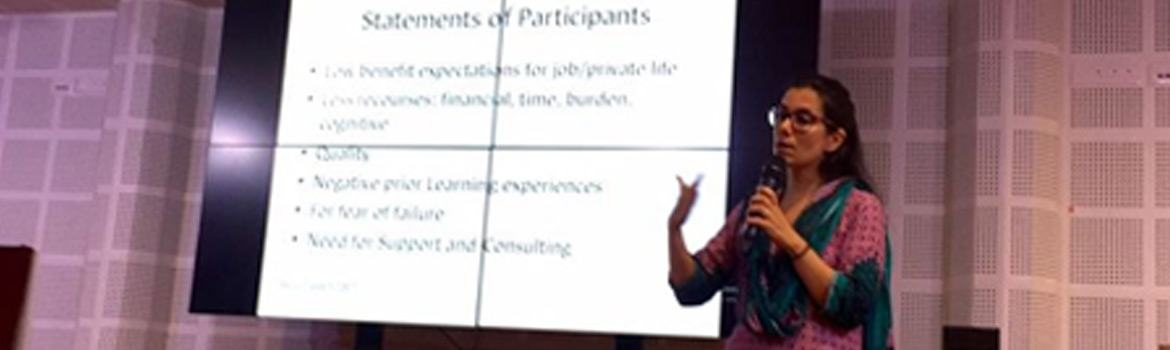
Gained knowledge about emotio-motivational models and learning aspirations of adults. Forums discussion about the integration of the models into the educational programs of AMMACHI Labs.Meltem Alkoyak-Yildiz, handling the workshop.
Adults acquire and integrate new knowledge different than children. In this regard, the learning outcome of adults depends stronger on the
Especially for the empowerment of vulnerable and socio-economic disentvanteged populations, the knowledge about the reasons why Adults not participate in educational programs is highly critical. Barz & Tippelt (2007) claim following reasons on to be the strongest indicators for the absence of adult participants in educational programs:
Analysis from person-centric interviews of the above mentioned study revealed that participants don’t participate if the benefit of the educational program is considered as low and if they have negative prior learning experiences or fear of failure (ibidem). Both perspectives are highly driven by motivational factors. Taking these results into consideration the session of Meltem Alkoyak-Yildiz presented different types of learning motives by Urhahne (2007) and discussed them in relation to transfer of knowledge into practice. Forum discussions were led by the question to link this theory into AMMACHI Labs valuable educational programs for the Indian rural area.