


Last Updated: December 24th, 2025

In accordance with the Chancellor’s vision and Amrita’s Sustainable Campus Policy, Amrita Vishwa Vidyapeetham has adopted water-conscious building standards across its campuses. These standards integrate water-positive design principles into the built environment, with an emphasis on responsible consumption, water replenishment, environmental sustainability, and ecological restoration.
Amrita incorporates a range of water-efficient infrastructure measures into its buildings. In high-rise facilities, pressure-control devices are installed at three-floor intervals to regulate flow and prevent excessive water use. Dual-flush systems in toilets and urinals further reduce consumption. Remote water-monitoring systems support real-time oversight and more effective resource management. In addition, treated water accounts for 30% of the water used for flushing, helping conserve potable water resources.
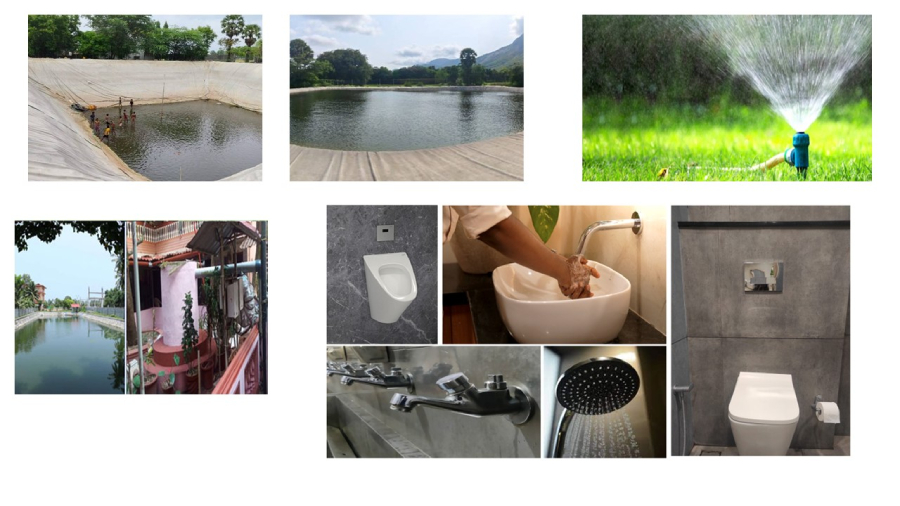
Rainwater harvesting forms an integral part of Amrita’s approach to responsible water management. Approximately 65,000 square metres of rooftop area are utilized for rainwater collection. Through improved system management and enhanced rainwater utilization, the annual harvesting yield increased from 55,000 cubic metres in the previous year to 60,000 cubic metres in 2025, representing an increase of approximately 9.1%. The harvested water is stored in 16 tanks with a combined storage capacity of 24,000 cubic metres. Complementary infrastructure, including 16 check dams and three remotely managed borewells, further supports water conservation, groundwater recharge, and local water security. Together, these measures contribute to more effective rainwater management and sustainable water resource utilization across the campus.
Across its campuses, Amrita employs water-saving technologies to improve efficiency in day-to-day operations. Plate-washing machines, power-cleaning methods for building floors, and sprinkler and drip-irrigation systems for landscaped areas help limit unnecessary consumption. Aerated taps installed in high-use locations, including dining halls, reduce water flow while maintaining functionality. The university also plans to extend sensor-operated taps across the campus by 2027–28 to strengthen water efficiency and conservation practices.
Amrita Vishwa Vidyapeetham is committed to using water responsibly and maximising opportunities for reuse. The Amrita Institute of Medical Sciences campus is being developed with the intention of achieving GRIHA and LEED green-building certifications. Its stated design objectives include a zero-carbon footprint, zero wastewater discharge, and, ultimately, more than 45% solar-powered energy supply. Environmentally responsible construction materials are being incorporated, while over 70% of the campus area is planned as green space featuring native trees, plants, shrubs, and water bodies.
The university provides an uninterrupted, 24-hour water supply for drinking and other essential needs. Reliable access helps minimise unnecessary water storage by residents in anticipation of shortages. This practice follows IS 2065: 1983 (Second Revision), Code of Practice for Water Supply in Buildings, and is aligned with Section 601 of the International Plumbing Code (2018).
Amrita uses self-curing construction methods to limit evaporation and reduce water requirements during building works, in accordance with IS 10262-2009.
Rainwater-harvesting systems are provided for university buildings and hostels in accordance with IS 15797 (2008), Rooftop Rainwater Harvesting – Guidelines. These arrangements also follow the requirements cited under Section 606 of the International Plumbing Code (2018).
Pressure-reducing valves are used to maintain appropriate water pressure within distribution pipelines and minimise avoidable losses. This measure follows IS 9739 (1981), Pressure Reducing Valves for Domestic Water Supply Systems, and Section 604 of the International Plumbing Code (2018).
A dedicated plumbing team carries out regular inspections, preventive maintenance, and timely repair of leaks across the campus. Aerators and pressure-reducing tap nozzles help control water flow, while proximity-sensor taps in washing areas prevent unnecessary discharge. These practices follow SP 35 (1987), Handbook on Water Supply and Drainage (with Special Emphasis on Plumbing), and Section 312 of the International Plumbing Code (2018).
The university uses ASTM and C-PVC piping systems to help maintain reliable water distribution and minimise leakage. The stated specifications are aligned with IS 15778 (2007), Chlorinated Polyvinyl Chloride (CPVC) Pipes for Potable Hot and Cold-Water Distribution Supplies, and Section 402 of the International Plumbing Code (2018).
Dual-siphon flushing cisterns are installed in toilets to support efficient water use. Male washrooms also provide separate urinals and flush toilets to avoid unnecessary flushing. These fittings follow IS 774 (2004), Flushing Cisterns for Water Closets and Urinals (Other Than Plastic Cisterns), and Section 402 of the International Plumbing Code (2018).
Rainwater and recycled water are used for construction activities, consistent with the water-reuse practices described in EPA/625/R-04/108, Guidelines for Water Reuse.
Amrita applies its water-conservation standards across campus facilities through a combination of infrastructure, operational practices, and maintenance. Continuous water supply discourages excessive storage, while self-curing methods reduce water requirements during construction. Rainwater-harvesting systems serve buildings and hostels, supported by prompt leak detection and repair. Pressure-control devices and water-efficient fittings, including dual-flush units and sensor-operated taps, help reduce consumption at points of use. Durable ASTM and C-PVC pipes support reliable distribution, and purpose-specific sanitary fixtures limit avoidable water use.
Amrita Vishwa Vidyapeetham’s water-conscious building standards reflect its commitment to sustainable campus development and responsible stewardship of water resources. By combining rainwater harvesting and groundwater-recharge systems with efficient plumbing, monitoring technologies, and regular maintenance, the university works to reduce demand and prevent wastage. Its application of Indian and international building and plumbing standards, alongside plans to expand sensor-based fixtures and pursue green-building certifications, demonstrates an ongoing commitment to improving water efficiency.