


Last Updated : December 15, 2025
Amrita Vishwa Vidyapeetham continues to strengthen sustainable water management through systematic monitoring, wastewater treatment and the reuse of treated water across its campuses. Wastewater generated from academic, residential, healthcare and utility facilities is treated and recovered for suitable non-potable applications. These initiatives help reduce dependence on freshwater resources, improve water-use efficiency and support the university’s commitment to SDG 6: Clean Water and Sanitation.
Amrita operates sewage treatment plants (STPs) across its campuses to treat wastewater generated through campus activities. The treatment infrastructure incorporates wastewater treatment processes and sludge-management practices to support effective treatment and water recovery.
Water reuse is monitored through infrastructure and measurement systems that include:
These systems support the measurement and verification of treated-water recovery and reuse.
In 2025, Amrita Vishwa Vidyapeetham recorded a reported total water consumption of 239,726 m³ across its campuses, serving a population of more than 39,000. This includes drinking water, utility water and treated wastewater reused for appropriate non-potable applications.
The university-wide water-use figures for 2025 are:
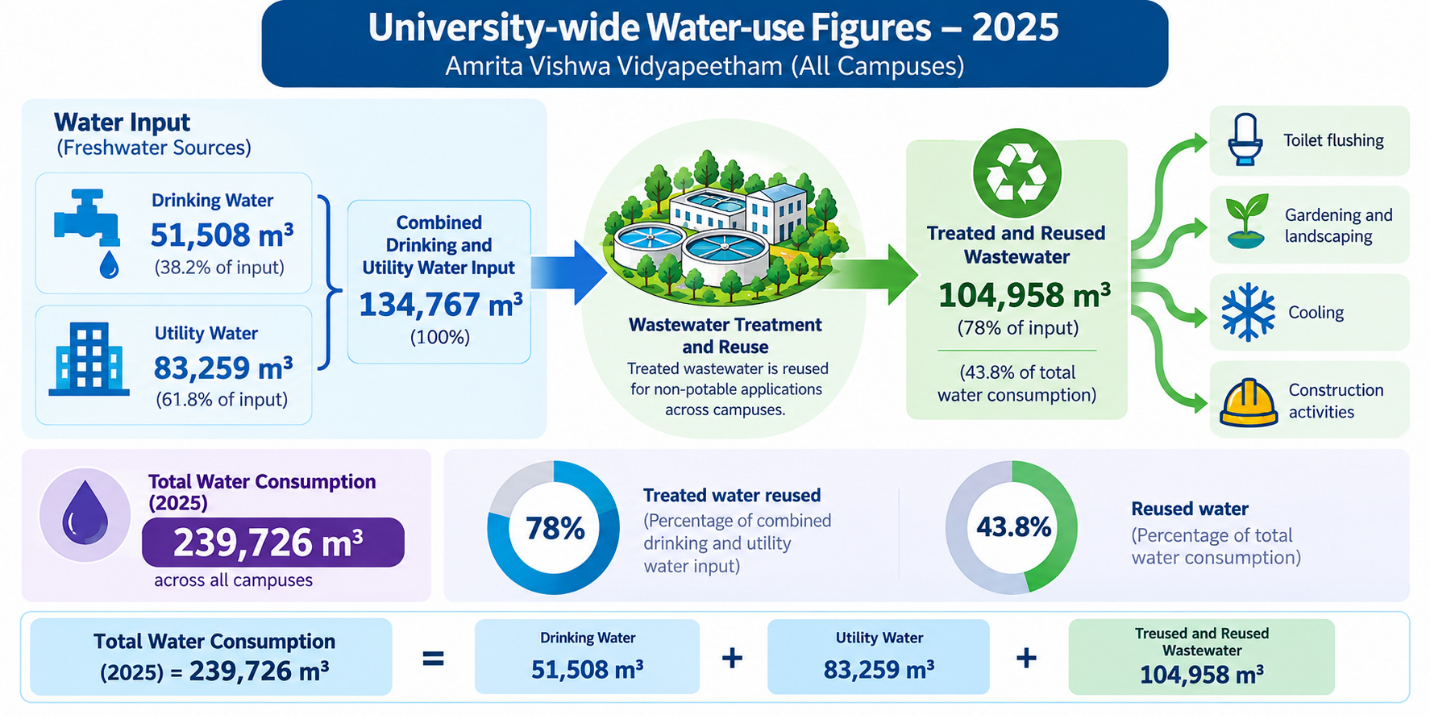
Treated and reused wastewater amounted to approximately 78% of the combined drinking and utility water input. Reclaimed water is used for suitable non-potable purposes, including toilet flushing, gardening, landscaping, cooling and construction-related activities, thereby reducing the demand for freshwater.
| Year | Drinking and utility water input (m³) | Treated and reused water (m³) | Total reported consumption (m³) | Reuse/input ratio |
| 2021 | 94,346 | 56,608 | 150,954 | 60% |
| 2022 | 94,521 | 64,274 | 158,795 | 68% |
| 2023 | 121,639 | 86,364 | 208,003 | 71% |
| 2024 | 128,614 | 93,889 | 222,503 | 73% |
| 2025 | 134,767 | 104,958 | 239,726* | 78% |
The figures indicate a continuing increase in treated-water reuse across the university. The reuse/input ratio represents the volume of treated and reused water divided by the combined drinking and utility water input.
At the Amritapuri campus, wastewater-management infrastructure includes a 600 KLD sewage treatment plant (STP). An additional ultrafiltration facility treats approximately 1.5 lakh litres of STP-treated water per day for reuse in toilet flushing.
According to the campus presentation, treated wastewater is allocated between toilet flushing (30%) and landscape irrigation (70%). The recovery and reuse of treated wastewater help reduce dependence on freshwater resources for non-potable applications and support sustainable campus operations.
Regular water-quality assessment forms an important part of the university’s water-pollution prevention and management strategy. Monitoring helps evaluate the quality of incoming water, identify potential contamination and determine its suitability for different applications.
Through its water-testing facilities, the university has the capacity to assess the following parameters:
| Category | Parameters |
| Physical | pH, turbidity and total suspended solids (TSS) |
| General water-quality parameters | Total dissolved solids (TDS), total hardness, calcium, magnesium and total alkalinity |
| Chemical | Chloride (using ion chromatography), total iron and residual free chlorine |
| Additional parameter | Sulphate, subject to testing availability |
These parameters help characterise the physical and chemical properties of water, identify potential quality concerns and assess its suitability for different applications.
The above list represents available in-house testing capacity. Total coliform and E. coli testing are not currently included in the university’s available in-house testing facilities.
The Amritapuri campus incorporates rainwater harvesting and water-conservation measures to strengthen water security and reduce dependence on external freshwater sources.
Key features include:
These measures contribute to rainwater capture, conservation and improved campus water management.
Treated wastewater reuse supports the maintenance of campus green spaces, gardens and landscaped areas. Irrigation using reclaimed water helps reduce the use of freshwater for landscaping and supports the maintenance of campus vegetation.
The 2024 report highlighted the use of recycled water to support green infrastructure across campuses, including herbal gardens, green spaces and landscaped areas. Such practices contribute to sustainable campus development and the conservation of ecological resources
Amrita is also exploring decentralised and nature-based approaches to wastewater treatment. One initiative at Amritapuri is a 500-litre-per-day vertical-garden wastewater-treatment prototype.
The system incorporates multiple treatment components, including:
This initiative demonstrates the potential of integrating biological treatment processes and plant-based systems into decentralised wastewater-management approaches.
Amrita adopts a range of measures to prevent water pollution and improve the management of water-supply and wastewater infrastructure. These include:
These measures support the protection of water resources and the effective operation of campus water infrastructure.
Amrita Vishwa Vidyapeetham aims to further strengthen its water-management practices through improved wastewater-treatment infrastructure, increased reuse of treated water, rainwater harvesting, water-quality monitoring and the integration of innovative treatment technologies.
Through systematic measurement, wastewater recovery, responsible reuse and pollution-prevention initiatives, the university continues to advance water-use efficiency and sustainable water management in alignment with SDG 6: Clean Water and Sanitation.
Amrita Vishwa Vidyapeetham reinforces its commitment to sustainable water management by improving wastewater treatment capacity, adopting digital monitoring technologies, and integrating water reuse into campus environmental initiatives. Across its campuses, treated wastewater is reused for appropriate applications, supporting SDG 6: Clean Water and Sanitation and the university’s long-term ambition to achieve net-zero water loss.
Each Amrita campus has three advanced Sewage Treatment Plants (STPs) with the combined capacity to treat 75% of the water consumed. Upgrades to aeration and sludge-handling systems further enhance treatment operations. The treated water is used for toilet flushing, gardening, landscaping, and cooling, thereby reducing reliance on freshwater resources.