University-Wide Commitment to Responsible Water Use and Conservation
Institutional approach. Amrita Vishwa Vidyapeetham implements an institution-wide approach to water stewardship across its nine campuses, bringing together policy, water-efficient operations, infrastructure, resource recovery, monitoring, education and research. Guided by the university’s Sustainable Campus Policy, these efforts are intended to reduce avoidable consumption, encourage responsible water use and support long-term protection of freshwater resources.
2025 OPERATIONS
Water-saving operating practices reported across all buildings and hostels, with monitoring logs referenced.
POLICY TARGET
40–50% of total water demand to be met through recycled and harvested water; a target, not a reported achieved figure.
Policy, Accountability and Operational Management
The Sustainable Campus Policy establishes a framework for prudent water use, encompassing conservation measures, resource-efficient facilities, water reuse and participation by the university community. Its implementation approach includes annual water-reduction targets, periodic performance reviews and awareness initiatives that reinforce accountability among students, faculty and staff.
In 2025, Amrita reported the adoption of water-saving operating practices in all campus buildings and hostels. Examples include timed irrigation and controlled washing stations, with monitoring logs identified as the basis for verifying implementation. By linking day-to-day operations with monitoring and review, the university seeks to make water conservation a sustained institutional practice rather than an isolated activity.
Efficient Water Infrastructure and Performance Monitoring
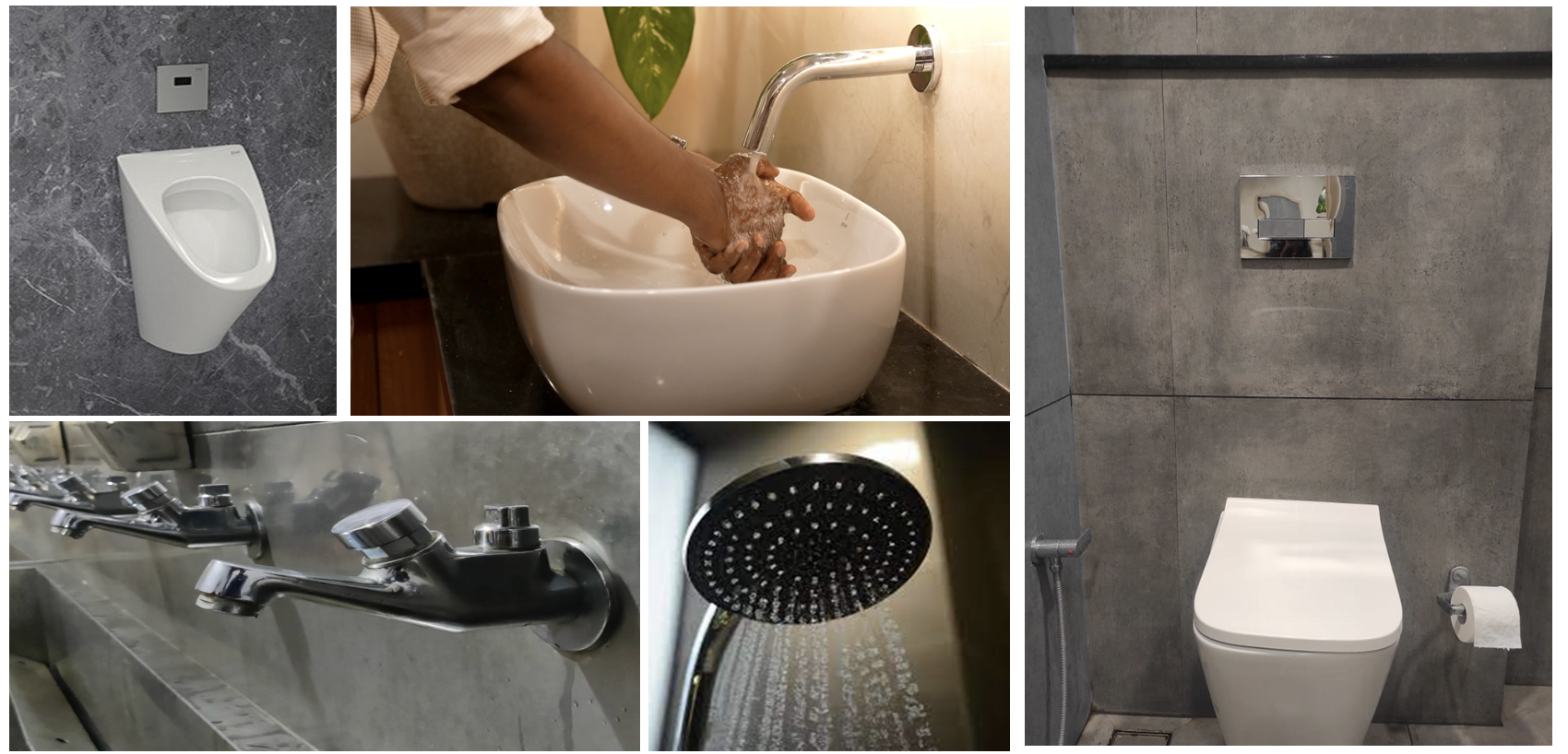
Campus water-conservation measures include low-flow fixtures, dual-flush toilets, aerated taps, waterless urinals and sensor-operated faucets that reduce unnecessary use at the point of consumption. Comprehensive water metering and automated monitoring systems are used to review consumption patterns, support early identification of leaks and inform operational decisions.
Water efficiency is also incorporated into campus development standards. New buildings are expected to provide dual plumbing arrangements, facilitate the use of sewage treatment plant (STP)-treated water, manage stormwater and include provision for groundwater recharge. These design measures integrate conservation considerations into long-term infrastructure planning.
Water Efficient Fixtures
Water recovery, recycling and rainwater harvesting
Amrita complements demand-reduction measures with rainwater harvesting, greywater treatment and wastewater recycling. Rainwater harvesting systems across its campuses collect water for irrigation and other non-potable requirements. STPs support the recovery and reuse of wastewater for landscape maintenance, cooling applications and flushing, thereby reducing dependence on freshwater for suitable non-potable uses.
The Sustainable Campus Policy sets an objective of meeting 40–50% of overall water demand through recycled and harvested sources. This figure represents the university’s stated reuse goal and should be distinguished from actual performance, which requires corresponding water-balance and treatment records for confirmation.
Water-sensitive landscapes and ecological stewardship
Landscaping practices across the nine campuses prioritise indigenous plant species suited to local climate, soil and ecological conditions. Such planting can help limit irrigation needs while reducing reliance on additional fertilisers and pesticides. Gardens and planted areas use drip and sprinkler irrigation, together with automated or sensor-assisted irrigation controls, to distribute water more efficiently.
Organic materials, including leaves and grass cuttings, are composted to enrich soil and improve growing conditions. Measures that maintain soil structure and avoid unnecessary compaction complement these practices. The inclusion of diverse planting and the protection of natural areas also support habitats for birds, pollinators and other wildlife, integrating water-sensitive maintenance with campus biodiversity goals.
Awareness, learning and research for behavioural change
Water stewardship is promoted through educational programmes, training sessions, workshops, student sustainability campaigns and conservation messages displayed on campus. Practical initiatives encourage careful water use in routine activities, including plate washing. Participation by students, faculty and staff supports a culture in which efficient water use becomes part of everyday campus life and community engagement.
Teaching and research further strengthen this approach. Courses and workshops address water sustainability and environmental science, while the E4Life PhD Programme in Sustainable Development covers 14 thematic areas connecting water, environmental protection, agriculture and climate change. The university also undertakes water-related research involving affordable filtration approaches, water-quality monitoring and sustainable irrigation methods.
Institutional impact and continued improvement
Together, these actions demonstrate a coordinated institutional approach to SDG 6 through demand management, reuse of treated and harvested water, water-aware infrastructure, responsible landscaping and community participation. The university’s stated direction is to strengthen water-conservation facilities, extend educational and community engagement and advance research that addresses sustainable water challenges.
By embedding responsible consumption in policy, infrastructure, teaching, research and community participation, Amrita advances a comprehensive campus-wide response to SDG 6. Continued performance monitoring and periodic review provide a basis for assessing implementation and identifying further opportunities to conserve and reuse water.
Distinguished Talks on Water Water Sustainability
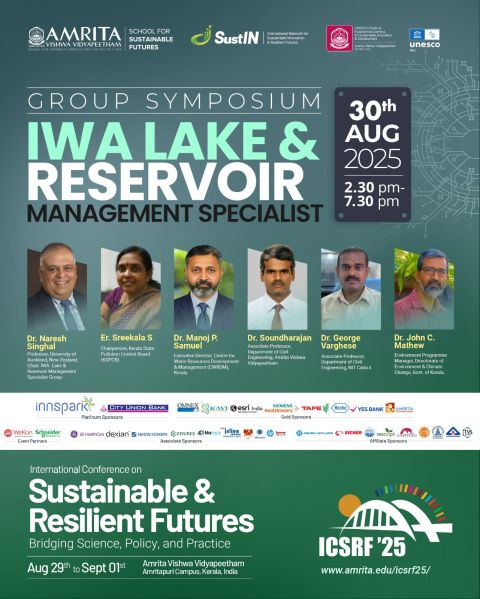
Amrita Vishwa Vidyapeetham reinforced its commitment to sustainable water management and responsible water stewardship through the International Conference on Sustainable & Resilient Futures (ICSRF 2025). The conference featured the IWA Symposium on Lake and Reservoir Management, facilitating interdisciplinary knowledge exchange on lake and wetland conservation, sustainable reservoir management, integrated water and land management, and community-based water conservation strategies. The conference also hosted an NGO Conclave, bringing together grassroots organizations, civil society representatives, researchers, and sustainability professionals to exchange knowledge and practical approaches to environmental challenges. These initiatives complemented Amrita’s institutional efforts in water conservation, research, education, and stakeholder engagement, contributing to SDG 6: Clean Water and Sanitation
The IWA Symposium on Lake and Reservoir Management
List of Publications in the Area of Water
Rajendrakumar, Selvaraj, et al. “Drivers and barriers towards achieving SDG 6 on clean water and sanitation for all-an Indian perspective.” World Development Sustainability 7 (2025): 100228. https://doi.org/10.1016/j.wds.2025.100228
Reddy, D. P., Sai, C. M., Venkatasubramanian, K., & Aishwarya, N. (2025, January). Cost-Effective Way of Making Piped Drinking Water Distribution Sustainable in Rural Areas. In 2025 International Conference on Next Generation Communication & Information Processing (INCIP) (pp. 570-575). IEEE. https://doi.org/10.1109/INCIP64058.2025.11019164
Dandadzi, P., Kothurkar, N. K., & Nithya, K. (2025). Seasonal Dynamics of Drinking Water Quality in a Marginalized Rural Village in Odisha, India: A Water Quality Index-Based Assessment. Air, Soil and Water Research, 18, 11786221251349343. https://doi.org/10.1177/11786221251349343
Raj, M., Pande, S., & Ramesh, M. V. (2025). Cultural dynamics and endogeneity in psychological drivers of adoption of community-based water purification technology in rural India. iScience, 28(12). https://doi.org/10.1016/j.isci.2025.113857
KM, K. R., Khan, S. B., Govindarajan, P., TR, M., Alojail, M., & Gadekallu, T. R. (2025). Machine learning-driven intelligent water quality assessment for enhanced drinking safety and real-time consumer awareness. Hydrology Research, 56(2), 136-152. https://doi.org/10.2166/nh.2025.097
Srivastava, S., Singh, A., & Dwivedi, D. (2025). Facing groundwater depletion in India: The role of human activities and climate extremes. Groundwater for Sustainable Development, 29, 101430. https://doi.org/10.1016/j.gsd.2025.101430
Joseph, Riya, Jeevan Mathew Tharayil, Prabhasankar VP, Kishore MS, and Viswanath Parol. “Assessing the Impact of Brahmapuram Landfill, Kochi, Kerala, India, on Groundwater Quality: A Physicochemical, Correlation, and Statistical Analysis Using WQI.” ACS ES&T Water 5, no. 9 (2025): 5377-5386. https://doi.org/10.1021/acsestwater.5c00470
Anitha Mary, X., Sharma, B., Johnson, I., Chalmers, J., Karthik, C., & Chowdhury, S. (2025). Performance analysis of groundwater quality index models for predicting water district in Tamil Nadu using regression techniques. International Journal of Computational Materials Science and Engineering, 14(02), 2350048. https://doi.org/10.1142/S2047684123500483
Appukuttan, S., Karthiayani, V. P., & Siva, S. (2026). The role of nonstate actors in groundwater augumentation and recharge for conservation in watershed management programmes in India: A case study. In Hydrosystem Restoration Handbook (pp. 155-183). Elsevier. https://doi.org/10.1016/B978-0-443-29104-3.00003-3
Damasco, M., S, R., N, T., S, S., Rahut, D. B., & Timilsina, R. R. (2025). Eco-profile approach in watershed and river basin management for addressing water rights and conflicts at micro scale. Frontiers in Water, 7, 1511044. https://doi.org/10.3389/frwa.2025.1511044
Gusha, M., Sreelakshmi, R., Suryaparvathy, S., Ustenko, V., Sheshadri, S., & Ramesh, R. (2025, October). Diagnosing community readiness for effective water governance using machine learning: a pilot from rural India. In 2025 IEEE Global Humanitarian Technology Conference (GHTC) (pp. 32-38). IEEE. https://doi.org/10.1109/GHTC66843.2025.11266220
Singh, A. (2025). The Requirement of Sustainable Water Management and Its Progress in India. In Sustainable Development and the Evolution of Civil Engineering (pp. 325-398). IGI Global Scientific Publishing. https://doi.org/10.4018/979-8-3693-2448-6.ch0011
Velayudhan, N. K., Zaman, D., Devidas, A. R., Tiwari, M. K., von Lieres, J. S., & Ramesh, M. V. (2025). Blockchain-IoT and optioneering driven framework for smart water management in emerging urban areas. iScience, 28(12). https://doi.org/10.1016/j.isci.2025.113927
Kumari, A., Kamaraj, N., Selvaraj, R., & Nanoth, R. (2025). Emerging trends and future outlook on chromium removal in the lab, pilot scale, and industrial wastewater system: an updated review exploring 10 years of research. Environmental Monitoring and Assessment, 197(5), 547. https://doi.org/10.1007/s10661-025-13904-y
Adhithya, S., Nithya, K., Sathish, A., & Kumar, V. (2025). Uncovering the feasibility of using live Chlorella microbiomes in domestic and industrial wastewater treatment: Insights into monoculture and synergistic mixed co-cultured system. Journal of Industrial and Engineering Chemistry, 149, 140-156. https://doi.org/10.1016/j.jiec.2025.02.006
Singh, P. K., Parikh, H., Saxena, A., Mishra, B., Tyagi, R., Awasthi, M. K., … & Tiwari, A. (2025). Managing municipal wastewater remediation employing alginate-immobilized marine diatoms and silver nanoparticles. Energy & Environment, 36(5), 2333-2344. https://doi.org/10.1177/0958305X241246185
Lal, S., Sreehari, R., Hwang, B., & Batabyal, S. K. (2025). Biomimetic hierarchical FeS-functionalized 3D cotton architectures inspired by floral morphology for enhanced solar-driven desalination and wastewater remediation. Chemical Engineering Journal, 167097. https://doi.org/10.1016/j.cej.2025.167097
Vijayashanthy, S., Priyanka, E. B., Thangavel, S., Anand, R., Bhavana, G. B., Khan, B., & Jeyanthi, K. (2025). Performance of polyvinyl alcohol graphene oxide membrane for microplastic removal in wastewater with an IoT based monitoring approach. Scientific Reports, 15(1), 20774. https://doi.org/10.1038/s41598-025-06072-z
Shimly, S., Rasana, N., Rajendrakumar, S., & Nithya, K. (2025). Toward cleaner waters: Advances in micro and nano plastics mitigation and insights in aquatic MNPs profiling and management. Journal of Environmental Chemical Engineering, 119535. https://doi.org/10.1016/j.jece.2025.119535
Ullas, S., Maheswari, B. U., Ponnekant, S., & Kumar, T. M. (2025). A three stage attention enabled stacked deep CNN-BiLSTM (ASDCBNet) model for end-to-end monitoring of wastewater treatment plant. Applied Water Science, 15(8), 203. https://doi.org/10.1007/s13201-025-02575-2
Ullas, S., Maheswari, B. U., Ponnekanti, S., & Kumar, T. M. (2025). Automated system to optimize the process and energy consumption for sewage treatment plant based on gas emission by using sensors and iot. IEEE Access, 13, 115972-115989. https://doi.org/10.1109/ACCESS.2025.3585283
Manikandan, A., Bulusu, A., Parthasaradhi, H., Prakash, K. R. B., Jayan, R., Kunnambath, A. R., & Mohan, R. (2023, December). An Empirical Study of Sewage Issues and Management Systems in a Rural Village of India. In International Conference on Pollution Control for Clean Environment (pp. 51-63). Singapore: Springer Nature Singapore. https://doi.org/10.1007/978-981-97-7842-3_6
Ullas, S., Maheswari, B. U., & Ponnekanti, S. (2025, September). Predictive Modelling of Dissolved Oxygen in Sewage Treatment Plants Using Machine Learning: Optimising Energy Costs. In 2025 5th International Conference on Emerging Research in Electronics, Computer Science and Technology (ICERECT) (pp. 1-5). IEEE. https://doi.org/10.1109/ICERECT65215.2025.11379863
Kalpakam, T. H., Ravindran, T., & Mohan, R. (2025, August). Enhanced Water Leakage Detection and Automation of the Ground Microphone Technology. In 2025 International Conference on Networks & Advances in Computational Technologies (NetACT) (pp. 1-6). IEEE. https://doi.org/10.1109/NetACT65906.2025.11188239
Sowmya, B. L., Pavithra, R. V., Kumar, V. D., Neelima, N., Nandan, V., & Venugopal, V. (2025, May). Time series monitoring of urban lake health using sentinel-2 satellite imagery: A case study from bengaluru city, india. In 2025 International Conference on Electronics, Computing, Communication and Control Technology (ICECCC) (pp. 1-6). IEEE. https://doi.org/10.1109/ICECCC65144.2025.11063849
Abba, A., & Sabarinath, S. (2025). Sustainable management of water hyacinth (Eichhornia crassipes): Community-Led strategies for livelihood enhancement in rural India. Results in Engineering, 26, 105033. https://doi.org/10.1016/j.rineng.2025.105033
Govindarajan, P., Shahapuram, V. K., Ganesh, P. S., Basavalingappa, V. M., Balarama, K. Y., Kumar, S. P., … & Padil, V. V. T. (2025). Tracking microplastic pathways: Real-time IoT monitoring for water quality and public health. MethodsX, 103674. https://doi.org/10.1016/j.mex.2025.103674
Bisheko, M. J., & G, R. (2025). Challenges and interventions in water resource management for horticultural crop production in rural and tribal communities in India. Cogent Food & Agriculture, 11(1), 2452335. https://doi.org/10.1080/23311932.2025.2452335
Lal, S., Gowthaman, T., Ghosh, S., & Batabyal, S. K. (2025). Integrating atmospheric water harvester with hydrovoltaics: simultaneous freshwater production and power generation. Separation and Purification Technology, 357, 130086. https://doi.org/10.1016/j.seppur.2024.130086
Arjun, P., Gopinath, G., Resmi, T. R., Sabitha, A. R., Jesiya, N. P., Anjali, N., & Surendran, U. (2025). Groundwater residence time in alluvial aquifer using emanation from Rn-222 (222Rn) and its health impact in different aquifers. Applied Radiation and Isotopes, 112222. https://doi.org/10.1016/j.apradiso.2025.112222