


December 30, 2025
Amrita Vishwa Vidyapeetham has a university-wide plan to upgrade its existing buildings to higher energy efficiency, as part of its goal of net-zero emissions by 2030. The plan covers all 10 campuses and about 10 million sq. ft. of built-up area.
Under Amrita’s energy efficiency standard, adopted on 24 November 2023, every renovation of an existing building must meet set efficiency requirements: reflective roofing, insulated walls, high-efficiency glazing and optimised HVAC controls. Upgrades follow India’s Energy Conservation Building Code (ECBC), ASHRAE 90.1 and IGBC/LEED green building criteria. Amrita campuses hold IGBC Platinum green campus certification (November 2023) and LEED certification (August 2024).
The university-level Carbon Neutrality Management Committee approves the building upgrade plan and its yearly priorities. Campus Carbon Management Committees and the Estate and Facilities teams carry out the upgrades.
| Body | Role in the upgrade plan |
|---|---|
| Carbon Neutrality Management Committee | Approves the annual upgrade programme and budget; reviews results each year |
| Office of Sustainability | Keeps the building energy register; tracks savings on the BEMS dashboards |
| Campus Carbon Management Committees | Run energy audits; rank buildings for upgrade; oversee works on each campus |
| Estate, Facilities and Electrical departments | Specify, procure and install upgrades; maintain equipment |
| Engineering schools and School for Sustainable Futures | Provide audit expertise and research, including student and PhD projects |
Existing buildings are upgraded in a yearly cycle: audit, prioritise, retrofit, then verify the savings.
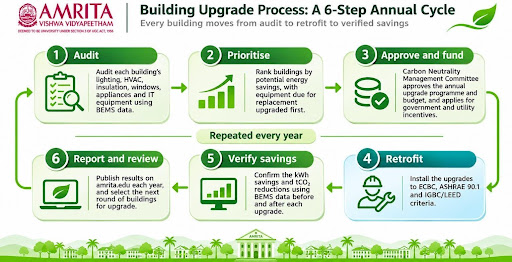
building upgrade process · 6 steps, repeated each year
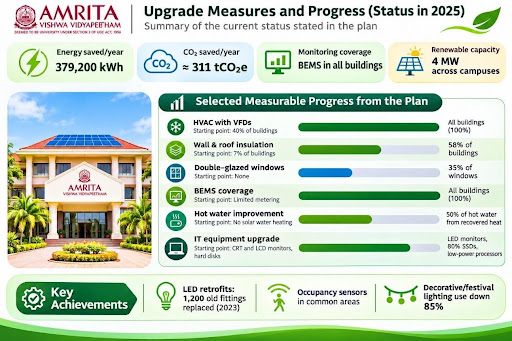
Upgrades to existing buildings already save 379,200 kWh and about 311 tCO₂ a year, as measured by the Building Energy Management System (BEMS).
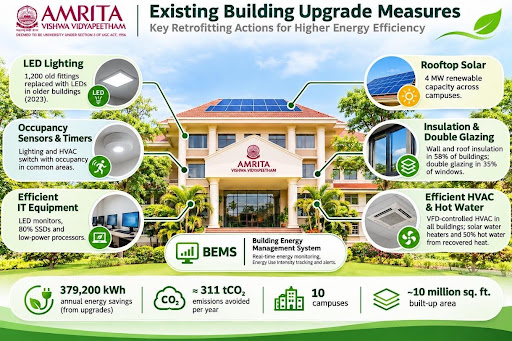
| Measure | Starting point (2014) | Status (2025) |
|---|---|---|
| LED lighting | Conventional fittings | 1,200 old fittings replaced with LEDs in older buildings in 2023 |
| Occupancy sensors and timers | None | Installed in common areas; lighting and HVAC switch with occupancy |
| HVAC with variable frequency drives | 40% of buildings | All buildings |
| Wall and roof insulation | 7% of buildings | 58% of buildings |
| Double-glazed windows | None | 35% of windows retrofitted |
| Building energy monitoring | Limited metering | BEMS in all buildings, with Energy Use Intensity tracking and alerts |
| Rooftop solar | Diesel generators as backup | 4 MW renewable capacity across campuses |
| Hot water | No solar water heating | Solar water heaters; 50% of hot water from air-conditioner waste heat |
| IT equipment | CRT and LCD monitors, hard disks | LED monitors, 80% SSDs, low-power processors |
| By | Upgrade target |
|---|---|
| 2026 | Energy audit of every existing building on all 10 campuses; buildings ranked by potential savings |
| 2027 | 90% of lighting energy-efficient (LED with sensors) |
| 2028 | Insulation in 80% of buildings (from 58%); double glazing in 60% of windows (from 35%) |
| 2028 | Smart workspace controls and efficient thermal comfort systems in 70% of buildings |
| 2030 | 100% of existing buildings meet the efficiency standard; net-zero emissions |
| 2035 | 100% renewable energy |
The annual upgrade programme takes the highest-saving buildings first, plus any equipment due for replacement. Results are published each year on amrita.edu.