Amrita Vishwa Vidyapeetham’s Energy Efficiency Plan aims to cut energy use per person by 20% by 2030, against a 2024 baseline. It covers all 10 campuses, about 10 million sq. ft. of buildings and about 32,000 students and staff.
The plan is part of Amrita’s Sustainable Campus Policy and its goal of net-zero emissions by 2030. It works in three ways: use less energy, use it more efficiently, and supply what remains from renewable sources. All campus buildings follow Bureau of Energy Efficiency (BEE) standards, and Amrita holds IGBC Platinum and LEED green building certification.

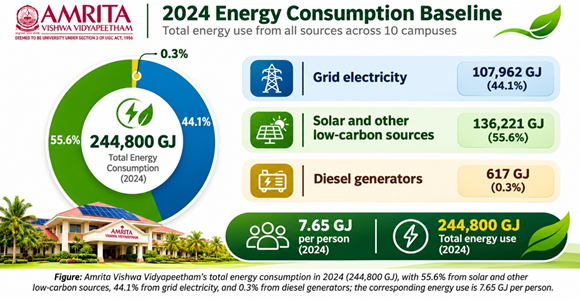
Amrita used 244,800 GJ of energy from all sources in 2024, about 7.65 GJ per person. This is the baseline the plan measures against.
| Source (2024) | Energy (GJ) |
|---|---|
| Grid electricity | 107,962 |
| Solar and other low-carbon sources | 136,221 |
| Diesel generators | 617 |
| Total | 244,800 |
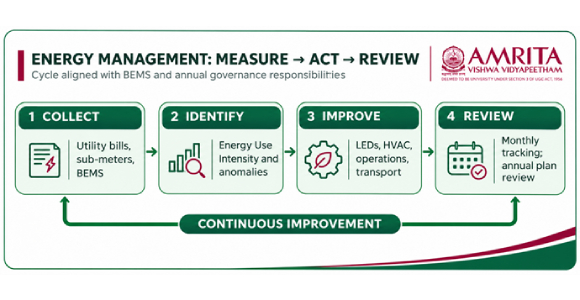
Energy use is tracked through utility bills, sub-meters and a Building Energy Management System BEMS in every building. The BEMS reports Energy Use Intensity for each building in real time and flags unusual use. Energy reviews are held every month to find areas of high waste.
The Carbon Neutrality Management Committee owns the plan and reviews it every year. Campus teams run it day to day.
| Body | Role |
|---|---|
| Carbon Neutrality Management Committee | Approves the plan, its targets and budget; reviews progress each year |
| Office of Sustainability | Runs the BEMS dashboards and monthly energy reviews; reports results |
| Campus Carbon Management Committees | Carry out measures on each campus; act on review findings |
| Estate, Facilities and Electrical departments | Operate and maintain equipment; install upgrades |
| National Service Scheme and student clubs | Run awareness campaigns such as Energy Conservation Week |
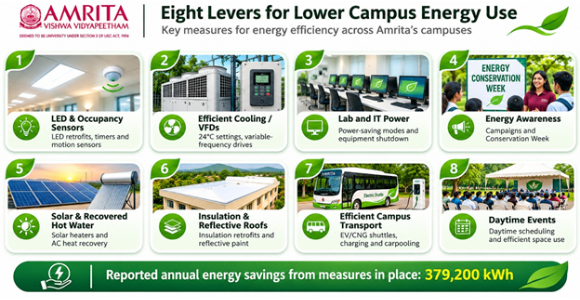
The plan sets measures in eight areas. Measures already in place save 379,200 kWh a year, as measured by the BEMS.
| Area | Measures | Results so far |
|---|---|---|
| Lighting | LED retrofits; motion sensors and timers in common areas; limits on decorative lighting | 1,200 LEDs fitted in older buildings and 1,000 in new spaces (2023); decorative and festival lighting use down 85% |
| Cooling (HVAC) | Thermostats set to 24°C per BEE guidance; variable frequency drives; shorter operating hours; shaded or double-glazed windows | VFD-controlled HVAC in all buildings |
| Building use | Shorter hours in low-use buildings; insulation retrofits; reflective paint; green roofs | Insulation in 58% of buildings |
| Computers and labs | Power-saving modes; shutdown after use; consolidated lab hours; energy-efficient computers | Efficient monitors and low-power processors across labs |
| Water heating | Solar water heaters; heat recovered from air conditioners; off-peak limits | 50% of hot water from recovered heat |
| Transport | Solar-powered and electric shuttles; fewer trips in low-demand periods; solar EV charging; carpooling and cycling | 5 solar EV charging stations; 45% of the fleet electric or CNG |
| Events | Daytime scheduling; solar generators | In place for campus events |
| Awareness | Energy Conservation Week (27–30 November 2023) with posters, debates, an ideathon and a hackathon | Run by the National Service Scheme |
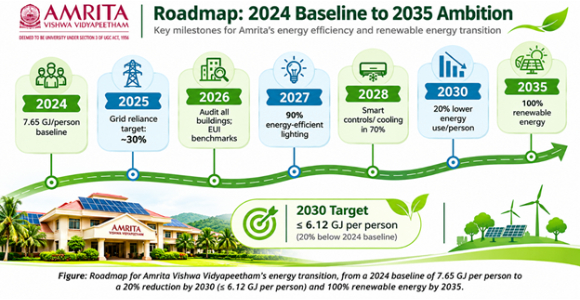
The plan’s main target is a 20% cut in energy use per person by 2030, measured against 7.65 GJ per person in 2024.
| By | Target |
|---|---|
| 2025 | Grid electricity dependence cut to about 30% of demand |
| 2026 | Energy audit of every building; Energy Use Intensity benchmark set for each one |
| 2027 | 90% of lighting energy-efficient |
| 2028 | Smart controls and efficient cooling in 70% of buildings |
| 2030 | Energy use per person 20% below 2024; net-zero emissions |
| 2035 | 100% renewable energy |