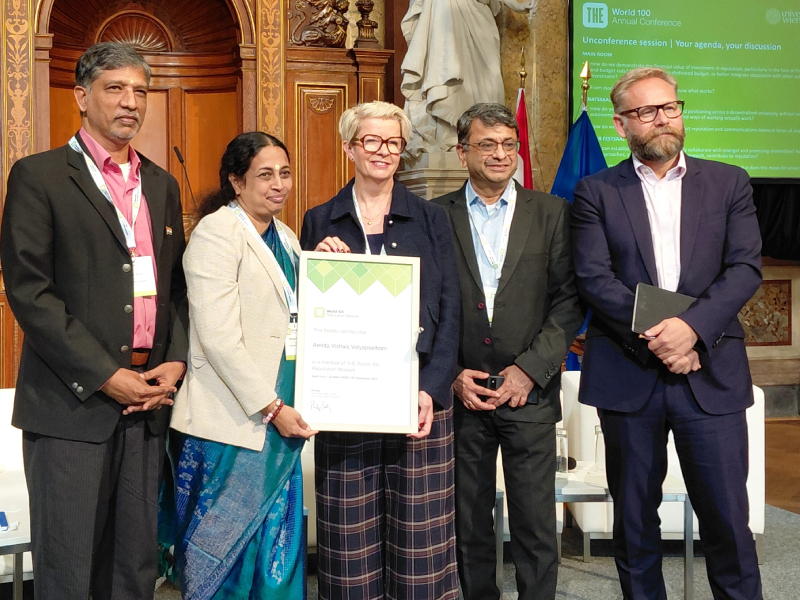
Amrita Vishwa Vidyapeetham’s leadership in sustainable development and community resilience was prominently featured at the Times Now Summit 2026, where Dr. Maneesha Vinodini Ramesh, Pro Vice Chancellor and Dean, Amrita School for Sustainable Futures, delivered a compelling fireside address on “India@100: The Sustainability Blueprint.”
At a time when climate uncertainty, water stress, and migration are converging into complex national challenges, Dr. Maneesha’s voice stands out for a reason, her insights are not theoretical, but grounded in two decades of on-ground implementation across thousands of communities. Her address brought to the forefront a critical shift India must make: from isolated interventions to integrated, community-driven, and technology-enabled resilience systems.
Highlighting distress migration in regions such as Odisha and West Bengal, she pointed out how livelihood insecurity forces entire families to relocate, often losing access to welfare systems in the process. Amrita’s approach addresses this at the root through climate-resilient agriculture, multi-cropping, and livelihood diversification, enabling communities to extend income cycles and reduce forced migration.
Central to her vision is the use of technology as an enabler of governance. She presented Amrita’s landslide early warning systems, deployed across the Western Ghats and Northeast India, which use deep-earth sensors and real-time data analytics to deliver actionable, impact-based alerts. These systems are not just technological innovations, but examples of how data can drive anticipatory action, helping shift disaster management toward true disaster resilience.
Equally significant is Amrita’s work in human development. From tablet-based education in underserved regions to empowering over 10,000 women with technical skills through low-cost digital training platforms, the institution is building communities that are not just supported, but self-reliant and adaptive.
On India’s water future, Dr. Maneesha acknowledged the progress of the Jal Jeevan Mission while emphasizing the need for the next phase to address deeper systemic gaps. She called for a holistic water strategy, one that integrates groundwater sustainability, climate variability, public health, and community awareness, emphasising that infrastructure alone cannot solve a problem rooted in behavior, access, and ecology.
A defining element of her perspective is the role of education in nation-building. Through initiatives like Amrita’s Live-in-Labs® and E4Life PhD programs, students are immersed in real-world challenges, where innovation is driven by empathy and lived experience. This model, she emphasized, is critical for shaping a generation capable of solving complex societal problems.
Concluding her address, Dr. Maneesha called for a decisive national shift from reactive spending after disasters to proactive investment in early warning, preparedness, and predictive systems. “Resilience,” she implied, “is not built in crisis, it is built long before it.
Her message at the summit was clear: India’s path to a sustainable future lies in combining compassion with technology, and policy with community ownership. Through its scalable, human-centered models, Amrita Vishwa Vidyapeetham continues to demonstrate how academic institutions can go beyond knowledge creation to become engines of real-world transformation in India and across the globe.