


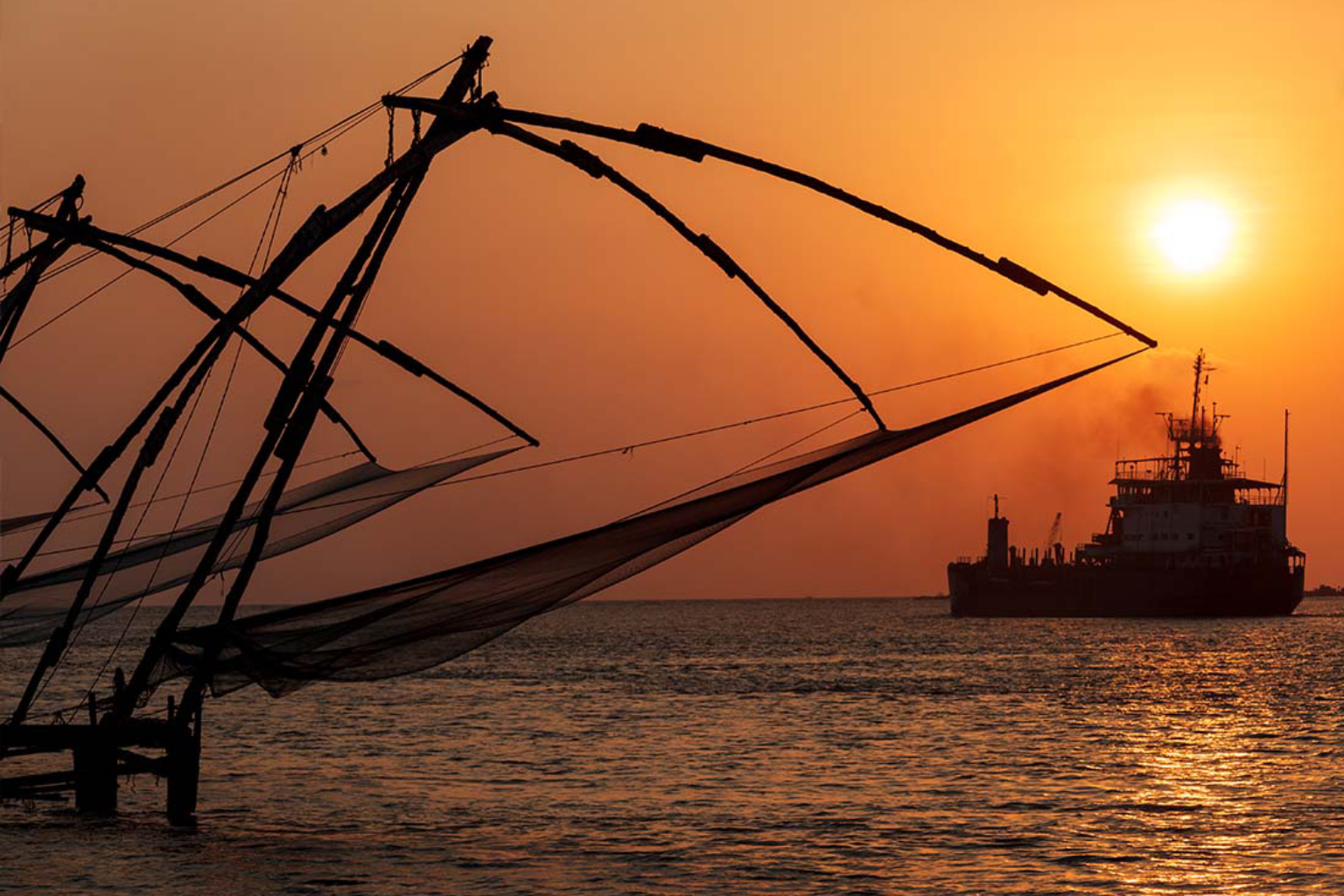
The fishing families along Keralam’s Arabian Sea coastline have a long history and spiritual bond with the waters that goes beyond mere livelihood. When one fisherman is lost at sea, entire communities grieve. Climate change has increased the severity and unpredictability of storm surges.
This reality struck on July 31, 2026, when a fishing vessel carrying a 14-member crew was hit by powerful, rough waves and overturned off the coast in Neendakara, Keralam. Gautam Krishna, 26, remains missing, with his father and grandfather deceased in the accident. The rest of the crew members survived.
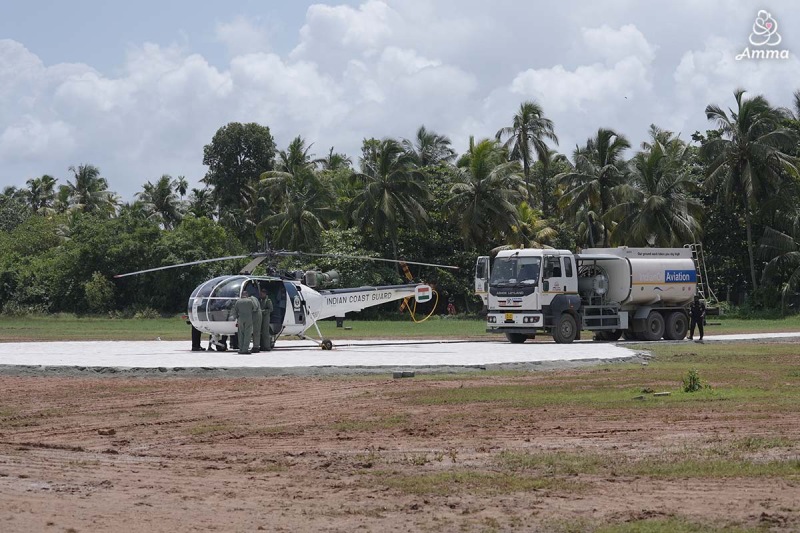
The Navy and Coast Guard had immediately begun search and rescue, but there were no helipad or refueling facilities for search helicopters in the surrounding area. At the request of Union Minister Suresh Gopi, local volunteers, staff, and institutional workers stepped forward to build a helipad at Amrita University’s Campus in Amritapuri.
Completed overnight in just 12 hours, the construction was completed on the morning of August 9, 2026, allowing rescue helicopters involved in the search for the missing fishermen off the Neendakara coast to use the grounds as an operational base.
For fishing communities, the sea is both a livelihood and a place of considerable risk. Fishermen can spend several days offshore, beyond the reach of conventional mobile networks, with limited access to communication, safety information, and emergency assistance.
The story of OceanNet began with a concern that was deeply human. Amma had witnessed the difficulties faced by fishing communities at sea – fishing vessels sinking, collisions, fishermen going missing, and families not knowing what had happened.
The risks were brought into sharp focus by the 2012 Enrica Lexie incident off the Keralam coast, in which two Indian fishermen aboard the fishing vessel St. Antony were killed after Italian marines aboard the oil tanker Enrica Lexie opened fire, saying they had mistaken the fishing boat for pirates. The incident highlighted the vulnerability of vessels operating at sea, where communication and situational awareness can be critical during emergencies.
Amma asked researchers at Amrita University to explore whether technology could help address this gap.
That question led to OceanNet, an indigenous maritime communication system developed by Amrita University through the Amrita Center for Wireless Networks and Applications (AmritaWNA).
OceanNet was designed to keep fishing vessels connected beyond conventional cellular coverage. It provides Internet connectivity and bidirectional communication between fishing vessels and the shore. It also enables emergency messages to be sent in both directions, allowing information to move from the vessel to the shore and from the shore to the vessel.
The system supports real-time vessel tracking and provides early warnings for possible boat-to-boat and boat-to-ship collisions, as well as alerts related to maritime border crossings. The system can also communicate weather and disaster alerts to fishing vessels. Fishermen can use familiar devices such as smartphones, while vessel information such as location, speed, and course can be monitored from the shore.
The network uses a shore-based base station and communication nodes on fishing vessels. Vessels can function as super nodes or adaptive nodes and help extend communication to other vessels. Through multi-hop communication, information can move from the shore to one vessel and then from one vessel to another, allowing the network to reach farther offshore.
Amrita University led the research, design and development of OceanNet. The project was supported and co-funded by the Information Technology Research Academy (ITRA) under the Ministry of Electronics and Information Technology (MeitY), Government of India, from 2014 to 2020. After 2020, Amrita continued to support and fund the research. The research was carried out in collaboration with the Indian Institute of Space Science and Technology (IIST) and the Indian Institute of Information Technology and Management–Keralam (IIITM-K).
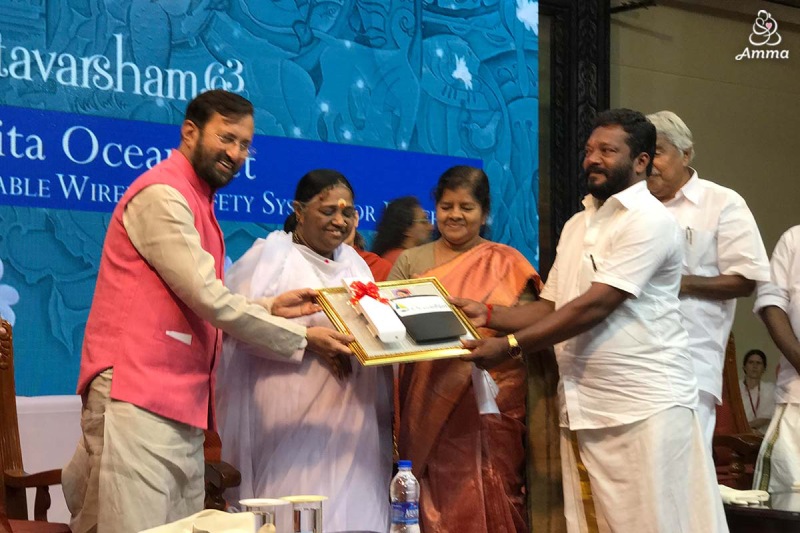
The technology was developed and tested under real conditions at sea, with direct interaction with fishing communities. Shri Prakash Javadekar, then Union Minister of Human Resource Development publicly launched OceanNet in 2016, in the presence of Amma.
The beginning of the system enabled Internet connectivity for fishing boats up to approximately 60km offshore, beyond the normal cellular range that was at a maximum of 13km. Today, after further development, it reaches up to 70km.
The technology was tested at sea for approximately 450 hours and involved 18 fishing boats integrated into the pilot deployment. The system demonstrated communication up to approximately 50km offshore, and later work explored extending communication farther through vessel-assisted networking.
The research also resulted in U.S. Patent No. US10045227, titled “Mobile Infrastructure for Coastal Region Offshore Communications and Networks,” covering key elements of the mobile infrastructure used to extend communication in coastal and offshore regions.
A defining feature of the OceanNet research has been its community-centred approach. Researchers worked directly with fishermen, vessel owners, captains, crew members and families to understand their communication, safety and livelihood needs and to refine the technology based on their experience.
The work therefore went beyond installing equipment on fishing vessels.
Training programmes, demonstrations and community outreach were conducted to help fishermen use the communication system and digital services effectively. User support and training were also provided in Malayalam.
This approach led to the development of the broader OceanNet Digital Ecosystem, combining digital access with digital capacity and community participation.
The objective is not simply to connect fishermen to the Internet, but to enable them to make meaningful use of digital technologies for safety, access to information and livelihood resilience.
OceanNet brings together technology and community participation to improve the safety, resilience and digital inclusion of fishing communities. Beyond connectivity, the broader OceanNet Digital Ecosystem aims to help fishermen make effective use of digital services and information that can support their safety and livelihoods.
The journey reflects Amrita’s approach to research: begin with a real societal problem, work with the community, develop the technology, test it in the real environment and build solutions that can create sustained social impact.
It began with a simple question — how can fishermen remain connected after they sail beyond the coastline? Now it has grown into a long-term research effort to ensure that going beyond cellular coverage does not mean going beyond communication, information and help.


