



In 2025, Amrita Vishwa Vidyapeetham strengthened its commitment to international collaboration, comparative research, and the development of global best practices for tackling the United Nations Sustainable Development Goals (SDGs) through partnerships with universities, United Nations agencies, international research institutions, and civil society organisations. These collaborations promoted interdisciplinary knowledge exchange, comparative analysis of sustainability approaches, and the identification of innovative solutions to shared social, environmental, and economic challenges.
Amrita’s international engagement was advanced through three interconnected approaches: institutional leadership in global sustainability networks, collaborative research programmes with international academic partners, and strategic partnerships supporting long-term cooperation. Together, these initiatives provided opportunities for participating institutions to examine different approaches to sustainable development, share research findings, exchange implementation experiences, and explore practices that could be adapted across diverse geographical and socioeconomic contexts.
A central component of this international engagement was the International Network for Sustainable Innovation and Resilient Futures (SustIN), led by Amrita through its UNESCO Chair on Experiential Learning for Sustainable Innovation and Development. SustIN connects universities, UNESCO Chairs, research institutions, and development organisations to promote international cooperation in sustainable innovation and community resilience. The network provides a collaborative platform for reviewing comparative SDG approaches, developing shared research and monitoring methodologies, and exchanging international best practices in areas such as climate action, sustainable livelihoods, inclusive development, and community-based innovation.
Amrita’s contribution to these international collaborations is closely connected to its Live-in-Labs® programme, which integrates experiential learning, interdisciplinary research, and participatory community engagement in rural India. Through this initiative, researchers and students work with communities to understand development challenges and explore locally appropriate solutions related to water governance, disaster-resilient livelihoods, renewable energy, women’s empowerment, and participatory monitoring. The programme provides practical research experiences and community-based approaches that can be documented, examined comparatively, and shared with international partners through collaborative research, academic conferences, and scholarly publications.
By connecting community-level research with international academic networks, Amrita promotes opportunities to assess the relevance and adaptability of sustainability practices across different regional contexts. This approach encourages the exchange of scientific methodologies, the identification of common implementation challenges, and the exploration of research-informed solutions that respond to local needs while contributing to broader global sustainability objectives.
Throughout 2025, Amrita’s international conferences, research partnerships, UNESCO Chair initiatives, and collaborative academic engagements further supported the review of comparative approaches and advancement of international best practices for addressing the SDGs. These activities brought together researchers, policymakers, development practitioners, and institutional partners to exchange knowledge, examine innovative interventions, and strengthen cooperation in areas including climate resilience, gender equality, inclusive education, ethical artificial intelligence, sustainable energy, public health, and disaster risk reduction.
Through these interconnected initiatives, Amrita Vishwa Vidyapeetham continues to bridge local sustainable development practices with international research and policy dialogue, contributing to a collaborative environment in which institutions can learn from diverse experiences and explore transferable solutions. Its international engagements during January–December 2025 reflect an ongoing commitment to strengthening global partnerships, promoting comparative learning, and advancing research-informed best practices that support the achievement of the United Nations Sustainable Development Goals, particularly SDG 17 (Partnerships for the Goals).
In 2025, Amrita signed new agreements with international partners to support joint research, comparison of sustainability approaches and the exchange of methods. These agreements extend Amrita’s existing network of more than 70 international MoUs.
| Partner | Country | Date (2025) | Focus of collaboration | SDGs |
|---|---|---|---|---|
| UNESCO: Chair on Assistive Technologies in Education | International (UNESCO, Paris) | September | AI, sign-language and audio-description tools for inclusive education; international capacity-building | 4, 9, 10, 17 |
| École Centrale de Nantes | France | 5 November | Joint and dual degrees, student and faculty exchange, joint research programmes | 4, 9, 17 |
| National Research Council of Italy, Institute for Geo-Hydrological Protection (CNR-IRPI) | Italy | November | Joint research on geohazards, hydrology, disaster resilience and environmental protection | 6, 11, 13, 15, 17 |
| University of Roma Tre | Italy | November | Academic exchange and joint research in sustainable architecture, climate resilience and community-based design | 9, 11, 13, 17 |
Amrita worked with the partners below in 2025 through visits, joint platforms, conferences and research collaboration.
| Partner | Country / type | SDGs | Collaboration in 2025 | Date and key people |
|---|---|---|---|---|
| UNESCO | UN agency | 4, 5, 9, 10, 17 | Third Amrita UNESCO Chair launched; Women4Ethical AI South Asia Chapter co-chaired by Amrita; ICGT 2025 and ICSRF 2025 partner | January–December 2025. Audrey Azoulay (Director-General), Gabriela Ramos (Assistant Director-General), Tim Curtis (Director, New Delhi Office) |
| Durham University | United Kingdom | 6, 7, 13, 17 | Delegation visit; joint academic programmes and research leading to a joint centre on energy resilience | July 2025, Amritapuri. Prof. Rob Lynes CMG, Prof. Clive Roberts |
| École Centrale de Nantes | France | 4, 9, 17 | MoU on joint degrees, exchange and joint research | 5 November 2025. Prof. Jean-Baptiste Avrillier |
| CNR-IRPI | Italy | 6, 11, 13, 15, 17 | MoU on geohazards, hydrology and disaster resilience research | November 2025, Piacenza. Dr Tommaso Moramarco |
| University of Roma Tre | Italy | 9, 11, 13, 17 | MoU on sustainable architecture and climate-resilient, community-based design | November 2025, Piacenza. Dr Giovanni Formica |
| Université de Nantes | France | 4, 5, 9, 17 | Leadership meeting and talk on women’s empowerment and AI | June 2025, Nantes. Carine Bernault (President), Prof. Colin de la Higuera (UNESCO Chair) |
| University of Minnesota | United States | 3, 9, 17 | Joint research priorities in biomanufacturing, AI and materials science under the Amrita Research Strategy | April 2025, ARISE 2025. Dr Shashank Priya |
| Arizona State University | United States | 7, 9, 17 | International speaker at ARISE 2025 | April 2025. Dr Arunachala Mada Kannan |
| Case Western Reserve University | United States | 9, 17 | International speaker at ARISE 2025 | April 2025. Dr Vipin Chaudhary |
| Gates Foundation, Asian Development Bank, ERIA, EkStep Foundation | International development and philanthropy | 1, 8, 9, 17 | Investments for Innovation Roundtable on financing SDG innovation | ICSRF 2025, Amritapuri |
| KAUST, Université de Genève, TERI | Saudi Arabia, Switzerland, India | 4, 13, 17 | Panel on embedding sustainability in education, research and practice | ICSRF 2025, Amritapuri |
| Government of Mauritius, Ministry of ICT | Mauritius | 9, 16, 17 | AI Safety Conclave and white paper on safe AI for the Global South | December 2025. Dr Avinash Ramtohul (Minister) |
| UN Women, WFP, European Commission, GFDRR–World Bank, CDRI | UN and international agencies | 5, 11, 13, 17 | NDMA–UN Women workshop on women in disaster risk reduction | April 2025 |
| E4LIFE scholars from Zambia, Nigeria, Zimbabwe, Uganda, Ghana, Iran, Tanzania and the UK | Nine countries | 2, 3, 5, 6, 13, 17 | First cohort of 23 international PhD graduates in sustainable development | August 2025 |
The Sustainable Innovation Network (SustIN), led by Amrita Vishwa Vidyapeetham under its UNESCO Chair on Experiential Learning for Sustainable Innovation and Development, serves as an international platform for strengthening research collaboration, reviewing comparative approaches, and developing international best practices for addressing the United Nations Sustainable Development Goals (SDGs).
Bringing together universities, UNESCO Chairs, research institutions, and civil society organisations worldwide, SustIN promotes interdisciplinary cooperation, knowledge exchange, and collaborative research to identify effective strategies for tackling sustainability challenges. By connecting institutions across diverse geographical, social, and economic contexts, the network creates opportunities to compare regional approaches to SDG implementation, evaluate innovative solutions, and share transferable best practices in community resilience, sustainable innovation, environmental protection, and inclusive development.
By the end of 2024, SustIN had expanded to more than 150 member institutions across 28 countries, reflecting its growing international reach and commitment to collaborative sustainable development.
In 2025, a significant initiative under this international network was the International Conference on Sustainable & Resilient Futures (ICSRF 2025), jointly organised at Amrita’s Amritapuri campus by SustIN, Amrita’s UNESCO Chair, and the Amrita School for Sustainable Futures.
The conference provided an international platform for researchers, academic institutions, policymakers, and sustainability practitioners to exchange research findings, review comparative approaches, and discuss innovative practices for addressing the SDGs. Through nine thematic research tracks, participants explored sustainability challenges and potential solutions in areas including climate action, disaster risk reduction, community resilience, governance, public policy, and integrated SDG implementation.
These international research exchanges provided opportunities to examine how sustainability initiatives are implemented across different countries and communities, identify context-specific innovations, and explore approaches that may be adapted to other regions. Such collaborative learning contributes to the ongoing development of internationally informed practices for sustainable development.
Through SustIN and ICSRF 2025, Amrita Vishwa Vidyapeetham continues to strengthen international collaboration and research for reviewing comparative SDG approaches, exchanging scientific knowledge, and advancing international best practices for tackling the Sustainable Development Goals.
The initiative reflects Amrita’s commitment to SDG 17 (Partnerships for the Goals) while promoting interdisciplinary contributions to climate action, sustainable communities, quality education, and resilient development.
Amrita Vishwa Vidyapeetham strengthened its international engagement in sustainable development through its three UNESCO Chairs and participation in UNESCO’s global UNITWIN (University Twinning and Networking) Programme. These international academic and research networks promote interdisciplinary collaboration, knowledge exchange, comparative research, and the development of innovative approaches to addressing the United Nations Sustainable Development Goals (SDGs).
Through partnerships with universities, UNESCO Chairs, research institutions, policymakers, and international organisations, Amrita contributes to reviewing comparative approaches, sharing research findings, and advancing international best practices for tackling the SDGs. These collaborations enable institutions to examine sustainability challenges across diverse geographical, social, and economic contexts, identify effective interventions, and explore the adaptation of successful practices to different communities.
The UNESCO Chair on Experiential Learning for Sustainable Innovation and Development, established in 2020, promotes international research collaboration, experiential learning, and community-driven approaches to sustainable development. The Chair leads the Sustainable Innovation Network (SustIN) and supports the International Conference on Sustainable & Resilient Futures (ICSRF), bringing together academic institutions, researchers, and sustainability practitioners to exchange knowledge and compare approaches to global sustainability challenges. Through Amrita’s Live-in-Labs® programme, the Chair shares community-based models for addressing challenges related to sustainable livelihoods, environmental protection, disaster resilience, and inclusive development. These initiatives provide opportunities to examine implementation experiences, evaluate context-specific innovations, and identify transferable practices for sustainable development.
The UNESCO Chair on Gender Equality and Women’s Empowerment, established in 2016, advances international research cooperation, policy dialogue, and knowledge sharing to address gender inequalities and promote inclusive development. In January 2025, the Chair strengthened its international engagement through its role as Co-Chair of the South Asia Chapter of UNESCO’s Women4Ethical AI Network. This international collaboration connects researchers, policymakers, technology specialists, and other stakeholders to examine comparative approaches to gender-responsive artificial intelligence, ethical technology governance, and women’s participation in emerging technologies. Through collaborative research and international dialogue, the network creates opportunities to identify effective strategies for reducing algorithmic bias, improving digital inclusion, and sharing best practices in responsible AI development.
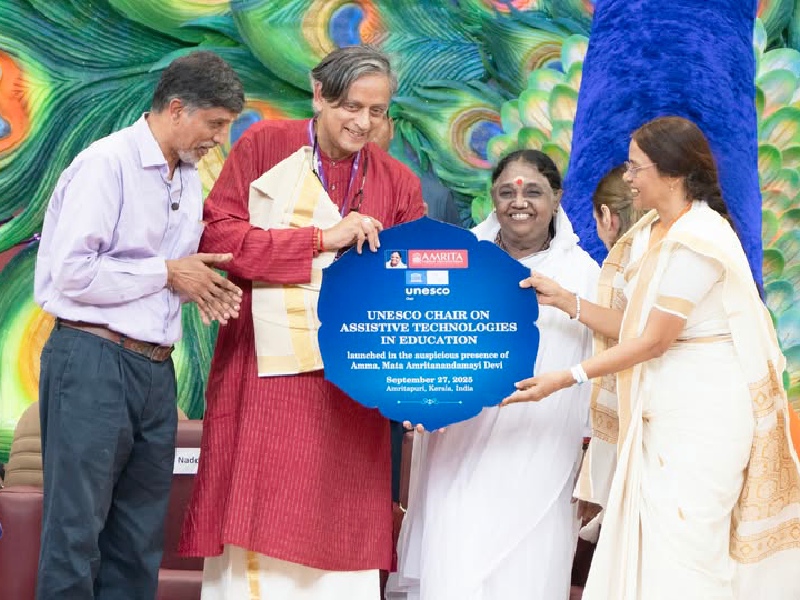
In September 2025, Amrita Vishwa Vidyapeetham and UNESCO launched the university’s third UNESCO Chair, the UNESCO Chair on Assistive Technologies in Education, further strengthening international collaboration in accessible education, inclusive technologies, and digital innovation. The agreement was signed by UNESCO Director-General Audrey Azoulay and Amrita Vice Chancellor Dr. P. Venkat Rangan. Co-led by Dr. Prema Nedungadi and Dr. Raghu Raman, the Chair promotes international research cooperation to examine comparative approaches to accessible education, evaluate emerging assistive technologies, and advance best practices for supporting learners with disabilities.
The Chair’s research areas include artificial intelligence-based accessibility solutions, Indian Sign Language recognition, audio-description technologies, accessible digital interfaces, and inclusive educational platforms. An important technological application associated with this work is an accessible interface integrated into the Government of India’s UMANG e-governance platform. Through international research partnerships and knowledge exchange, the initiative provides opportunities to compare accessibility solutions, evaluate technological approaches, and develop research-informed practices that can be adapted across educational and social contexts.
Collectively, Amrita’s three UNESCO Chairs provide an international platform for collaborative research, comparative analysis, knowledge exchange, and the identification of global best practices in sustainable innovation, gender equality, ethical artificial intelligence, accessible education, and inclusive technological development. Their activities encourage participating institutions to examine different approaches to addressing sustainability challenges, share practical experiences, and explore the transferability of successful interventions across countries.
Through the UNITWIN network and associated international partnerships, Amrita Vishwa Vidyapeetham continues to strengthen international research cooperation and contribute to the advancement of sustainable development. By connecting community-based innovations, interdisciplinary scientific expertise, and global academic networks, these initiatives support the ongoing review of comparative approaches and development of international best practices for tackling the United Nations Sustainable Development Goals, particularly SDG 4 (Quality Education), SDG 5 (Gender Equality), SDG 9 (Industry, Innovation and Infrastructure), SDG 10 (Reduced Inequalities), and SDG 17 (Partnerships for the Goals).
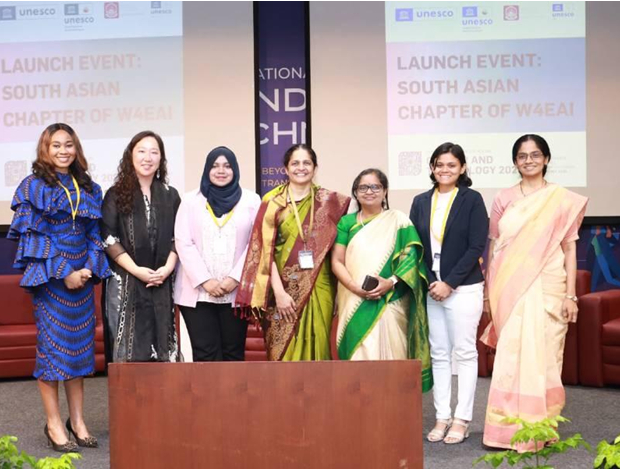
In January 2025, Amrita Vishwa Vidyapeetham, in collaboration with UNESCO, inaugurated the South Asia Chapter of Women4Ethical AI at its Amritapuri campus, strengthening international cooperation in ethical artificial intelligence, gender equality, and inclusive technological development. Co-chaired by Amrita, the initiative brings together stakeholders from India, Bangladesh, Bhutan, Nepal, the Maldives, and Sri Lanka to promote collaborative research, policy dialogue, knowledge exchange, and the development of international best practices for addressing the United Nations Sustainable Development Goals (SDGs).
The chapter provides a regional platform for international collaboration and research to review comparative approaches and develop best practices for tackling the SDGs, particularly in gender-responsive AI governance, digital inclusion, equitable access to technology, and women’s empowerment. By connecting researchers, policymakers, technology specialists, academic institutions, and international organisations, the initiative encourages participating countries to examine their respective approaches to ethical AI development and identify effective strategies that can be adapted across different national contexts.
A central focus of the collaboration is examining how South Asian countries implement the gender-related provisions of UNESCO’s Recommendation on the Ethics of Artificial Intelligence. Through comparative policy discussions, regional knowledge exchange, and collaborative assessments, the chapter supports the identification of common challenges, emerging regulatory approaches, and opportunities to strengthen gender equality in AI systems. These activities provide a foundation for reviewing national experiences and developing shared approaches to responsible and inclusive AI governance.
The initiative also promotes the exchange of international best practices in gender-sensitive AI policy, regulatory incentives, algorithmic fairness, and women’s participation in science and technology. By examining approaches adopted across South Asian countries, participating institutions can explore strategies to reduce gender bias in AI applications, improve women’s access to digital opportunities, and strengthen inclusive innovation ecosystems.
Another important area of cooperation is the development of career guidance and capacity-building approaches that encourage women and girls to participate in artificial intelligence, digital technologies, and emerging scientific fields. Through regional collaboration, the chapter creates opportunities to share educational practices, examine barriers to women’s participation, and explore effective interventions for improving representation and leadership in technology-related professions.
The Women4Ethical AI South Asia Chapter contributes to SDG 4 (Quality Education), SDG 5 (Gender Equality), SDG 9 (Industry, Innovation and Infrastructure), SDG 10 (Reduced Inequalities), and SDG 17 (Partnerships for the Goals). Its wider focus on responsible technological development and inclusive policy approaches also offers potential connections to SDG 11 (Sustainable Cities and Communities) and SDG 13 (Climate Action), where ethical AI applications address urban and environmental challenges.
Through this international initiative, Amrita Vishwa Vidyapeetham and UNESCO are strengthening regional cooperation in comparative policy research, ethical technology development, and knowledge sharing. By bringing together diverse national perspectives and encouraging the exchange of research-informed approaches, the chapter provides a foundation for reviewing comparative strategies, identifying transferable solutions, and advancing international best practices for tackling the Sustainable Development Goals.
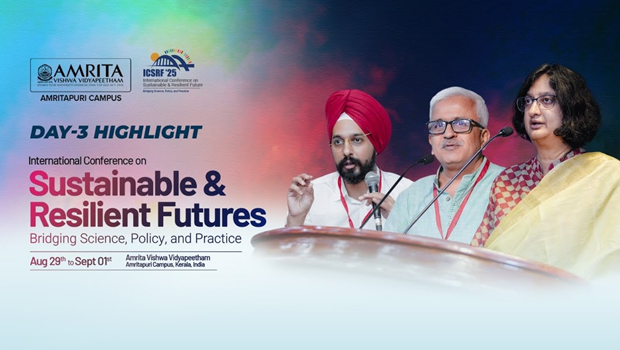
Amrita Vishwa Vidyapeetham strengthened international collaboration and research for sustainable development by organising the International Conference on Sustainable & Resilient Futures (ICSRF 2025) at its Amritapuri campus over four days in late August and early September 2025. The conference, themed “Experiential Learning, Inclusiveness & Sustainable Innovations,” was jointly hosted by Amrita’s UNESCO Chair on Experiential Learning for Sustainable Innovation and Development, the Amrita School for Sustainable Futures, and the Sustainable Innovation Network (SustIN). Bringing together more than 700 participants and 80 speakers from over 20 countries, the conference provided an international platform for reviewing comparative approaches, exchanging research findings, and advancing best practices for tackling the United Nations Sustainable Development Goals (SDGs).
The conference facilitated interdisciplinary research collaboration among universities, international organisations, policymakers, industry representatives, civil society organisations, and sustainability practitioners. Through international knowledge exchange, comparative discussions, and collaborative initiatives, participants examined diverse approaches to sustainable development and explored strategies that could be adapted across geographical, institutional, and socioeconomic contexts. The initiative encouraged the identification of innovative solutions, evaluation of existing sustainability practices, and development of research-informed approaches to addressing global challenges.
The programme was organised into nine thematic research tracks, covering climate action, ecosystem restoration and disaster risk reduction; sustainable agriculture and food security; health and digital healthcare; equitable education and traditional knowledge; circular economy and net-zero transitions; sustainable livelihoods; governance, policy and global SDG impact; data-driven sustainability and artificial intelligence; and integrated action for the SDGs. These thematic areas provided opportunities for researchers and practitioners to compare international experiences, discuss implementation challenges, and share transferable practices for achieving sustainable development outcomes.
An important component of ICSRF 2025 was its international comparative discussions on integrating sustainability into education, research, and institutional practices. Experts representing organisations and institutions including UNESCO, The Energy and Resources Institute (TERI), King Abdullah University of Science and Technology (KAUST), Saudi Arabia, and the Université de Genève, Switzerland, contributed perspectives on sustainability education, interdisciplinary research, and practical implementation approaches. These discussions encouraged the exchange of institutional experiences and the identification of approaches that could inform sustainable development initiatives across countries.
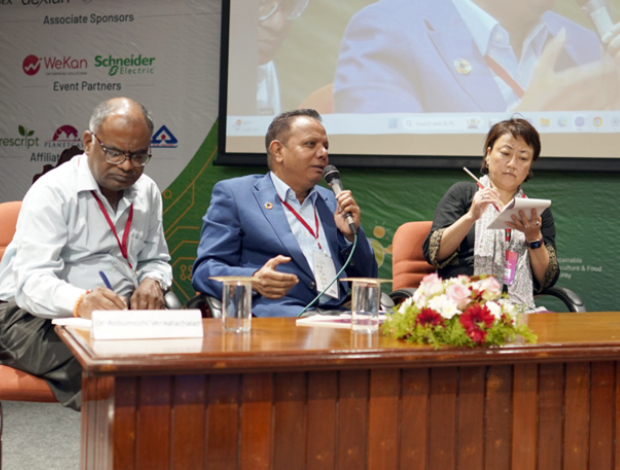
The conference also featured the Investments for Innovation (I4I) Roundtable, which brought together representatives associated with the Gates Foundation, Asian Development Bank, Economic Research Institute for ASEAN and East Asia (ERIA), EkStep Foundation, and industry. The roundtable provided a platform for reviewing comparative financing approaches, examining investment models for sustainability innovation, and discussing mechanisms for supporting research-driven solutions to development challenges. By facilitating dialogue among international development institutions, philanthropic organisations, and innovation stakeholders, the initiative encouraged the exchange of knowledge on financing strategies that could support scalable and sustainable interventions.
Another significant component was the NGO Conclave, which connected civil society organisations and community-based development practitioners with academic researchers and international sustainability stakeholders. The conclave encouraged the sharing of field experiences, participatory development approaches, and locally developed solutions to social and environmental challenges. Through these exchanges, participants could examine the effectiveness of community-led initiatives, identify common implementation challenges, and explore the adaptation of successful practices to different regional contexts.
ICSRF 2025 also promoted technological innovation and knowledge sharing through the launch of three digital platforms designed to support sustainable development and community resilience. The SREE geo-platform was introduced to support community-led resilience through geospatial information and participatory approaches. The GeoSanskriti platform focused on documenting and preserving intangible cultural heritage through digital technologies, while Digital Twin Rural Clusters explored the application of digital modelling to rural development and climate adaptation. These platforms provided practical examples of technology-enabled approaches that could inform collaborative research, comparative assessments, and the development of adaptable sustainability solutions.
In addition to facilitating international research exchange, ICSRF 2025 adopted a carbon-neutral conference approach aligned with ISO 14068, demonstrating the integration of environmental responsibility into the organisation of international academic events. This initiative offered a practical model for incorporating carbon management, environmental sustainability, and responsible event practices into large-scale conferences. The approach also created opportunities for institutions to examine and adapt sustainability-oriented event management practices within their own operational contexts.
Through its international research discussions, comparative panels, innovation roundtables, civil society engagement, and technology demonstrations, ICSRF 2025 strengthened opportunities for reviewing comparative approaches and developing international best practices for tackling the SDGs. The conference connected scientific research with practical sustainability initiatives, encouraging participants to exchange experiences, identify transferable solutions, and explore collaborative approaches to implementation.
The initiative contributed to multiple Sustainable Development Goals, particularly SDG 2 (Zero Hunger), SDG 3 (Good Health and Well-being), SDG 4 (Quality Education), SDG 9 (Industry, Innovation and Infrastructure), SDG 11 (Sustainable Cities and Communities), SDG 12 (Responsible Consumption and Production), SDG 13 (Climate Action), SDG 15 (Life on Land), and SDG 17 (Partnerships for the Goals).
By convening researchers, international institutions, policymakers, industry leaders, and community organisations, Amrita Vishwa Vidyapeetham reinforced its commitment to international collaboration, interdisciplinary research, and the exchange of sustainable development knowledge. ICSRF 2025 served as a platform for comparing global sustainability practices, sharing innovative approaches, and advancing research-informed international best practices to address the United Nations Sustainable Development Goals.
Selected participating organisations
| Organisation | Country / type |
|---|---|
| UNESCO New Delhi Regional Office for South Asia | UN agency |
| United Nations ESCAP | UN regional commission |
| Government of Karnataka (Additional Chief Secretary and Development Commissioner) | India, state government |
| National Bank for Agriculture and Rural Development (NABARD) | India, development finance institution |
| Gates Foundation | United States, philanthropy |
| Asian Development Bank (ADB) | Multilateral development bank |
| Economic Research Institute for ASEAN and East Asia (ERIA) | International research institute |
| The Energy and Resources Institute (TERI) | India, research institute |
| King Abdullah University of Science and Technology (KAUST) | Saudi Arabia |
| Université de Genève | Switzerland |
| EkStep Foundation | India, non-profit |
| Mata Amritanandamayi Math | India, NGO |
Amrita Vishwa Vidyapeetham, in collaboration with UNESCO and IEEE, organised the International Conference on Gender and Technology (ICGT 2025) from 16–19 January 2025 at its Amritapuri campus. Held under the theme “Beyond Boundaries: Gender, Tech and Transformative Change,” the conference provided an international platform for collaborative research, knowledge exchange, and the review of comparative approaches to promoting gender equality, inclusive innovation, and responsible technological development. The initiative brought together approximately 500 stakeholders, including more than 60 speakers representing government institutions, international organisations, academia, civil society, industry, and gender-focused financing institutions.
The conference strengthened international collaboration and research aimed at reviewing comparative approaches and advancing best practices for tackling the United Nations Sustainable Development Goals (SDGs). Participating organisations included UNESCO, the Asian Development Bank, Google, and Fractal Analytics (fractal.ai). Through interdisciplinary discussions, research presentations, and interactions among policymakers and technology specialists, participants explored diverse approaches to addressing gender disparities in artificial intelligence, digital innovation, technology education, and employment opportunities. These exchanges encouraged the identification of effective strategies for strengthening women’s participation, leadership, and representation in rapidly evolving technological sectors.
A significant focus of ICGT 2025 was the comparative examination of gender-responsive technology policies, ethical artificial intelligence, digital inclusion, and equitable access to emerging technologies. International experts and researchers shared perspectives on institutional practices, regulatory approaches, and technological interventions designed to reduce gender inequalities. By examining experiences across different sectors and national contexts, the conference created opportunities to identify transferable practices and explore collaborative solutions for addressing structural barriers to women’s participation in science, technology, engineering, and mathematics.
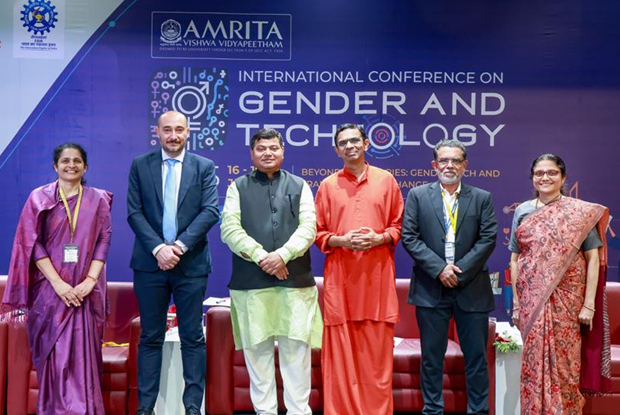
The conference also contributed to international academic collaboration through the acceptance of more than 90 research papers, providing a platform for disseminating scientific findings, exchanging methodological approaches, and encouraging interdisciplinary research partnerships. These contributions supported discussions on gender-sensitive technological development and offered research-informed perspectives on promoting equitable innovation and inclusive digital ecosystems.
An important innovation-oriented component of the conference was the GenAI x Gender Tech Hackathon, which generated 50 team projects addressing challenges at the intersection of generative artificial intelligence, gender equality, and technology. All projects were released as open-source resources, enabling researchers, developers, educational institutions, and other stakeholders to access, adapt, and build upon the solutions. This approach promoted collaborative innovation, knowledge sharing, and the wider application of technology-based interventions across institutional and geographical boundaries.
By combining international policy dialogue, comparative research discussions, academic knowledge exchange, and open-source technological innovation, ICGT 2025 created opportunities to identify effective approaches and share international best practices for advancing gender equality in technology. The conference encouraged collaboration among researchers, policymakers, development organisations, and industry representatives to examine common challenges and explore solutions that could be adapted to different socioeconomic and technological environments.
The initiative contributed particularly to SDG 5 (Gender Equality), SDG 9 (Industry, Innovation and Infrastructure), SDG 10 (Reduced Inequalities), and SDG 17 (Partnerships for the Goals). Its emphasis on international partnerships, inclusive technological development, and collaborative innovation reinforced the importance of cross-sector cooperation in addressing gender-related challenges within the global digital economy.
Through ICGT 2025, Amrita Vishwa Vidyapeetham strengthened its role in facilitating international collaboration, comparative research, and the exchange of best practices for tackling the SDGs. By bringing together diverse global perspectives and promoting openly accessible technological solutions, the conference supported continued cooperation toward gender-responsive innovation, equitable digital participation, and sustainable technological development.
In December 2025, Amrita Vishwa Vidyapeetham organised the AI Safety Conclave: Safe AI for the Global South, bringing together approximately 300 participants, including policymakers, international representatives, researchers, technology specialists, and institutional leaders. The conclave featured participation from the Government of India’s IndiaAI Mission, the Minister of Information and Communication Technology of the Republic of Mauritius, and Gabriela Ramos, UNESCO’s Assistant Director-General. The initiative provided an international platform for examining comparative approaches to artificial intelligence safety, strengthening research collaboration, and advancing best practices for responsible and inclusive technological development.
The conclave focused on the growing importance of international collaboration and research in reviewing comparative approaches and developing best practices for tackling the United Nations Sustainable Development Goals (SDGs). By bringing together perspectives from international organisations, government institutions, and the technology research community, the event facilitated discussions on the ethical, regulatory, and operational challenges associated with emerging artificial intelligence systems. Particular attention was given to the diverse infrastructure conditions, institutional capacities, and socioeconomic realities of India and other countries in the Global South.
A major outcome of the conclave was the release of the white paper, Principles for Ethical and Safe Agentic AI Orchestration Across Infrastructure Gradients. Drawing on international practices and research perspectives, the publication presents principles and safety guidelines for the responsible development and deployment of agentic artificial intelligence systems across different technological environments. It addresses the need for AI safety frameworks that remain relevant not only to advanced digital infrastructures but also to regions facing limitations in connectivity, computing resources, institutional capacity, and technological accessibility.
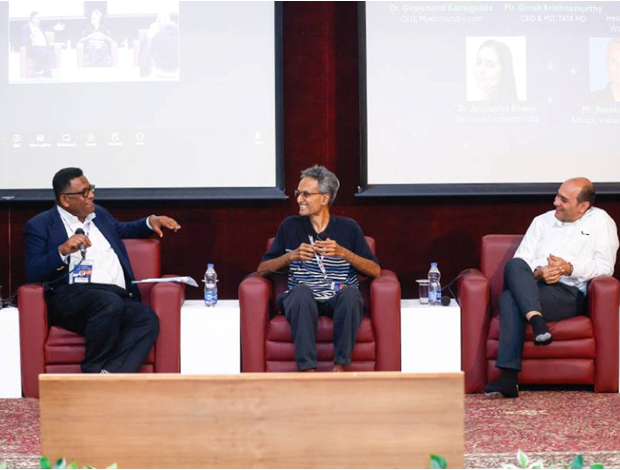
The white paper examines the application of ethical and safe AI principles across healthcare, education, finance, energy, and public services, recognising that these sectors have different operational requirements, levels of technological readiness, and potential risks. By considering these variations, the framework offers an approach to adapting AI safety practices to different infrastructure conditions while promoting responsible innovation, public accountability, and equitable access to emerging technologies. The conclave also encouraged the comparative review of international AI governance and safety approaches, creating opportunities to examine how existing principles can be adapted to the needs of developing economies. Discussions highlighted the importance of context-sensitive technological solutions, institutional safeguards, and responsible AI deployment practices that consider differences in infrastructure availability and public-service delivery. This international exchange supported the identification of shared challenges and the development of research-informed approaches to strengthening AI safety across diverse national and institutional settings.
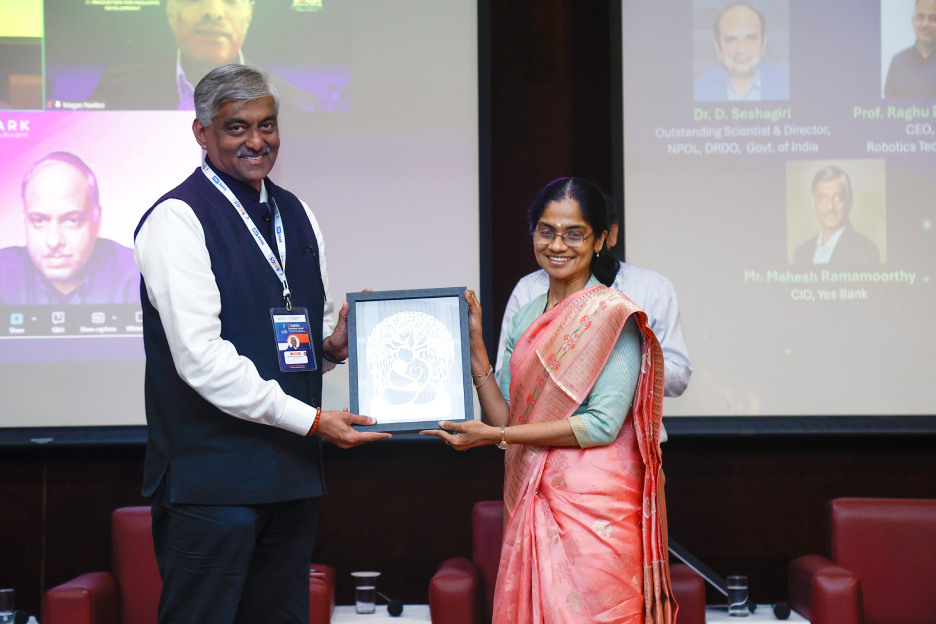
Through the publication of its white paper, the initiative moved beyond international dialogue to provide a documented set of principles and practical guidance that can inform further research, policy development, and institutional decision-making. The framework offers a foundation for continued international collaboration, comparative evaluation, and the adaptation of AI safety practices across countries with varying levels of technological infrastructure.
The AI Safety Conclave contributes to SDG 3 (Good Health and Well-being) through its focus on safe AI applications in healthcare; SDG 4 (Quality Education) through responsible educational technologies; SDG 9 (Industry, Innovation and Infrastructure) through inclusive and resilient technological innovation; SDG 16 (Peace, Justice and Strong Institutions) through ethical governance, accountability, and responsible AI practices; and SDG 17 (Partnerships for the Goals) through international cooperation and knowledge exchange. By convening international stakeholders and releasing a research-informed framework for ethical and safe agentic AI, Amrita Vishwa Vidyapeetham strengthened its contribution to international collaboration, comparative approaches, and the development of best practices for tackling the Sustainable Development Goals. The initiative demonstrates how global research perspectives can inform context-sensitive technological guidelines, supporting responsible AI innovation and sustainable development across India and the wider Global South.
In 2025, Amrita Vishwa Vidyapeetham strengthened its engagement in international sustainable development cooperation through participation in the Civil 20 (C20) South Africa Summit, an important global platform connecting civil society organisations with the G20 process. Building upon the leadership of Amrita’s Chancellor, Sri Mata Amritanandamayi Devi (Amma), who chaired Civil 20 India during India’s G20 Presidency in 2023, the university continued contributing to international dialogue, collaborative policy discussions, and the exchange of best practices for addressing the United Nations Sustainable Development Goals (SDGs). Representing the perspectives and experiences of C20 India, Dr. Krishnashree Achuthan participated in the C20 South Africa Summit, contributing to the continuity of international civil society engagement across successive G20 presidencies. The initiative provided opportunities to share India’s experiences in community-centred sustainable development, inclusive innovation, and participatory approaches while engaging with diverse international perspectives on emerging social, economic, and environmental challenges.
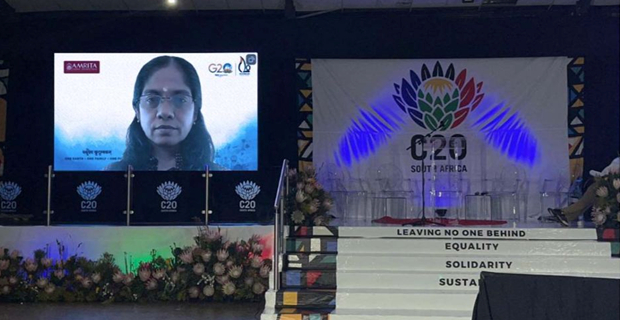
The Civil 20 process facilitates international collaboration and comparative review of approaches to sustainable development by connecting civil society organisations, researchers, policymakers, advocacy groups, and community-based institutions across countries. Through this collaborative framework, participating organisations exchange practical experiences, examine different policy and implementation strategies, and identify approaches that may be adapted to diverse national and regional contexts. The continuity of engagement between C20 India and C20 South Africa supports the sharing of institutional knowledge and lessons learned across G20 presidencies.
In 2025, the C20 process involved more than 3,000 civil society organisations across 14 working groups, creating a broad international platform for examining sustainable development challenges and exploring collective responses. The working groups addressed important global priorities, including climate justice, gender equality, ethical artificial intelligence governance, and disability inclusion. These thematic areas encouraged comparative discussions on policy approaches, institutional practices, and community-based interventions aimed at promoting equitable and sustainable development.
A significant dimension of the collaboration was the opportunity to review comparative approaches and exchange international best practices in advancing gender equality and social inclusion. Civil society representatives could share experiences related to women’s empowerment, inclusive participation, accessibility, and the protection of vulnerable and marginalised communities. Such exchanges help identify common implementation challenges and explore practical approaches to strengthening equity across different socioeconomic and cultural settings.
The C20 South Africa process also provided an international forum for examining climate justice and environmentally sustainable development, encouraging dialogue on the social dimensions of climate action, community resilience, and equitable transitions. By bringing together civil society perspectives from different countries, the platform supported the comparison of approaches to environmental governance and the consideration of locally relevant solutions to global sustainability challenges.
Another important area of international cooperation was ethical AI governance and disability inclusion, reflecting the growing need for responsible technological development and equitable access to digital opportunities. Discussions across these themes provided opportunities to consider different regulatory and institutional approaches, share inclusive development practices, and strengthen understanding of how emerging technologies can support human well-being while reducing inequalities.
Amrita’s participation reinforced the importance of international partnerships in connecting research, civil society experience, and policy dialogue. The C20 platform enables participating institutions to contribute practical knowledge, learn from approaches adopted in other countries, and support the development of shared recommendations for addressing complex sustainability challenges. Its emphasis on cross-border cooperation and continuity between G20 presidencies provides a mechanism for exchanging lessons and informing future international civil society engagement.
The initiative contributes particularly to SDG 5 (Gender Equality) through its focus on women’s empowerment and inclusive participation; SDG 10 (Reduced Inequalities) through disability inclusion and social equity; SDG 13 (Climate Action) through climate justice and environmental sustainability; SDG 16 (Peace, Justice and Strong Institutions) through participatory governance and civil society engagement; and SDG 17 (Partnerships for the Goals) through international cooperation and multistakeholder dialogue. Through its participation in the Civil 20 South Africa Summit 2025, Amrita Vishwa Vidyapeetham continued its commitment to strengthening international collaboration, exchanging research-informed perspectives, and promoting inclusive approaches to sustainable development. By contributing to a global civil society platform that connects experiences across successive G20 presidencies, the university supported opportunities for reviewing comparative approaches, sharing transferable practices, and advancing international best practices for tackling the United Nations Sustainable Development Goals.
Amrita Vishwa Vidyapeetham strengthened its commitment to international research collaboration, interdisciplinary innovation, and sustainable development through the Amrita Research & Innovation Symposium for Excellence (ARISE 2025), inaugurated on 2 April 2025 at its Amritapuri campus. The five-day symposium brought together more than 75 distinguished speakers from around the world, creating an international platform for exchanging scientific knowledge, reviewing comparative research approaches, and exploring innovative solutions to complex societal and environmental challenges.
The symposium featured leading international researchers, including Dr. Shashank Priya from the University of Minnesota, USA; Dr. Arunachala Mada Kannan from Arizona State University, USA; and Dr. Vipin Chaudhary from Case Western Reserve University, USA. Their participation strengthened opportunities for international academic dialogue, collaborative research, and the exchange of expertise across emerging scientific and technological disciplines. Through interactions among researchers, institutional leaders, and innovation specialists, ARISE 2025 encouraged the examination of different research methodologies, institutional approaches, and technological solutions with potential applications in sustainable development.
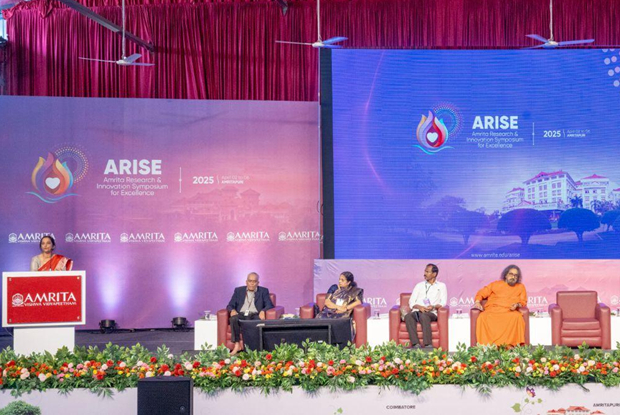
A significant milestone of ARISE 2025 was the official launch of the Amrita Research and Innovation Strategy, establishing a structured institutional roadmap for advancing socially responsible research, interdisciplinary collaboration, and innovation addressing critical societal needs. Building upon the research priorities identified during ARISE 2024, the strategy provides a framework for strengthening research excellence while expanding international academic partnerships and promoting practical solutions to development challenges.
The strategy identifies important areas for international research cooperation, including biomanufacturing, artificial intelligence, materials science, sustainable development, AI-driven solutions, biomedical innovation, and data science. In particular, it highlights joint research priorities with the University of Minnesota, USA, in biomanufacturing, artificial intelligence, and materials science. These areas offer opportunities for collaborative scientific investigations, knowledge exchange, and comparative evaluation of emerging technologies that can contribute to sustainable industrial development, healthcare innovation, and resource-efficient solutions.
Through its emphasis on international collaboration and comparative research, ARISE 2025 provided opportunities for participating institutions to examine different approaches to scientific innovation, exchange research experiences, and identify promising practices that may be adapted across national and institutional contexts. Such exchanges support the development of research-informed approaches to addressing challenges related to technological accessibility, environmental sustainability, public health, and inclusive economic development.
The symposium also reinforced the importance of integrating social responsibility and sustainable development into institutional research strategies. By encouraging collaboration across disciplines and geographical boundaries, Amrita’s research roadmap seeks to connect scientific advancements with practical societal applications. Its focus on compassion-driven research highlights the importance of developing technologies and innovations that respond to community needs while considering their broader social and environmental implications.
The international participation at ARISE 2025 further supported opportunities for reviewing comparative approaches and advancing best practices in research and innovation. Interactions among global researchers and institutional partners encouraged the sharing of scientific expertise, exploration of complementary research capabilities, and identification of potential areas for collaborative investigation. These activities provide a foundation for future joint research, comparative studies, and the development of adaptable solutions to sustainability challenges.
ARISE 2025 contributes particularly to SDG 3 (Good Health and Well-being) through biomedical research and healthcare innovation; SDG 4 (Quality Education) through international academic exchange and research capacity-building; SDG 9 (Industry, Innovation and Infrastructure) through advanced materials, biomanufacturing, and technological innovation; and SDG 17 (Partnerships for the Goals) through international institutional collaboration. Its broader research priorities also create opportunities to contribute to additional SDGs through interdisciplinary and sustainability-focused innovation.
By convening international scientific experts and launching a comprehensive research and innovation strategy, Amrita Vishwa Vidyapeetham strengthened its institutional framework for global research partnerships, comparative learning, and socially responsible innovation. ARISE 2025 provided a foundation for reviewing international research approaches, sharing scientific knowledge, and pursuing collaborative initiatives that can contribute to the development of international best practices for tackling the United Nations Sustainable Development Goals.
Amrita Vishwa Vidyapeetham strengthened its commitment to international research collaboration, experiential learning, and community-driven sustainable development through the E4LIFE International PhD Programme in Sustainable Development. In August 2025, the university celebrated the graduation of its first cohort of 23 fully funded doctoral scholars, representing nine countries: India, Zambia, Nigeria, Zimbabwe, Uganda, Ghana, Iran, Tanzania, and the United Kingdom. This milestone demonstrated the programme’s contribution to international academic cooperation, interdisciplinary research, and the development of practical solutions to global sustainability challenges.
Designed to support up to 100 doctoral scholars annually, the E4LIFE programme brings together researchers from diverse geographical, cultural, and academic backgrounds to investigate critical sustainable development challenges. Through international collaboration and comparative research, scholars examine community needs, explore different approaches to development, and contribute to the identification of innovative practices that can inform sustainable development initiatives across countries.
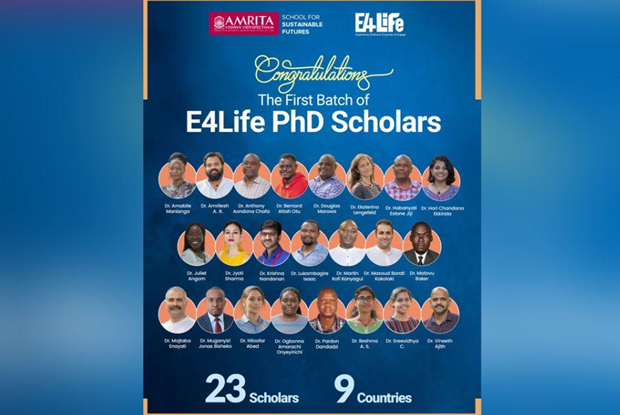
A distinctive feature of the programme is its integration with Amrita’s Live-in-Labs® initiative, which enables international doctoral researchers to conduct field-based investigations in rural Indian communities. This experiential research model connects academic knowledge with real-world development challenges, allowing scholars to engage directly with communities, understand local priorities, and examine the practical application of sustainability interventions. By combining interdisciplinary research with participatory community engagement, the programme creates opportunities to review comparative approaches, evaluate context-specific solutions, and develop transferable best practices for tackling the United Nations Sustainable Development Goals (SDGs).
The first graduating cohort undertook doctoral research across several interconnected areas, including climate resilience, tribal welfare, public health, food security, gender equity, sustainable agriculture, and community livelihoods. These research themes reflect the importance of addressing sustainable development through integrated approaches that consider environmental, social, technological, and economic dimensions.
In Karnataka, research explored the development of sustainable fish feed using jackfruit and seabuckthorn, examining alternative ingredients that could contribute to resource-efficient aquaculture and sustainable food production. This work illustrates how locally available biological resources can be investigated for innovative applications in food systems and aquatic livelihoods, offering opportunities for further comparative research on sustainable aquaculture practices.
In Uttar Pradesh, doctoral research addressed anaemia prevention and sanitation innovations, connecting public health challenges with community-level interventions. These investigations demonstrate the value of interdisciplinary approaches to understanding health inequalities, improving hygiene and sanitation practices, and developing locally appropriate solutions. Such research can contribute to comparative learning on the effectiveness and adaptability of community-based health interventions in different socioeconomic environments.
In Kerala, scholars investigated blockchain-based tools and blue-economy strategies for fishing communities, exploring how emerging technologies and sustainable resource-management approaches could support coastal livelihoods. These initiatives connect digital innovation with community development and marine sustainability, providing opportunities to examine alternative approaches to improving transparency, economic participation, and resilience within coastal economies.
The international composition of the E4LIFE programme strengthens opportunities for cross-cultural knowledge exchange and comparative analysis of sustainable development practices. Scholars from different countries bring diverse research perspectives, institutional experiences, and understandings of community development challenges. Their engagement with rural Indian communities provides a shared research environment in which locally developed approaches can be examined, documented, and considered for adaptation to other geographical and socioeconomic contexts.
By integrating international doctoral education with field-based research, E4LIFE supports the exchange of scientific methodologies, participatory development approaches, and practical sustainability knowledge. Its research activities provide a foundation for identifying effective interventions, understanding implementation challenges, and contributing to the development of research-informed practices that may be transferable across communities and countries.
The programme contributes to SDG 2 (Zero Hunger) through sustainable agriculture and food security research; SDG 3 (Good Health and Well-being) through community health and anaemia-related interventions; SDG 5 (Gender Equality) through research on gender equity and inclusive development; SDG 6 (Clean Water and Sanitation) through sanitation innovations; SDG 13 (Climate Action) through climate resilience research; SDG 14 (Life Below Water) through sustainable aquaculture and blue-economy initiatives; and SDG 17 (Partnerships for the Goals) through international academic cooperation and collaborative research. The graduation of the first 23 E4LIFE scholars in 2025 represents an important milestone in Amrita Vishwa Vidyapeetham’s efforts to connect international research collaboration with practical, community-centred sustainable development. By bringing together researchers from nine countries and supporting interdisciplinary investigations in real-world settings, the programme provides a foundation for reviewing comparative approaches, sharing research findings, and advancing international best practices for tackling the United Nations Sustainable Development Goals.
In July 2025, Amrita Vishwa Vidyapeetham strengthened its international academic and research collaboration with Durham University, United Kingdom, through a high-level delegation visit to its Amritapuri campus. The engagement focused on expanding cooperation in sustainability research, academic programmes, interdisciplinary innovation, and solutions to global development challenges. The visit provided an important platform for exchanging institutional expertise, reviewing comparative research approaches, and identifying opportunities for collaborative initiatives addressing the United Nations Sustainable Development Goals (SDGs).
The Durham University delegation included Prof. Rob Lynes CMG, Associate Pro-Vice-Chancellor (Global); Prof. Clive Roberts, Executive Dean of Science; and Ms. Meena Saxena of the UK India Business Council. Discussions between the two universities explored opportunities for joint academic programmes, collaborative research projects, and strengthened institutional partnerships. The engagement reflected a shared commitment to connecting international scientific expertise with practical solutions for environmental sustainability, energy resilience, and community well-being.
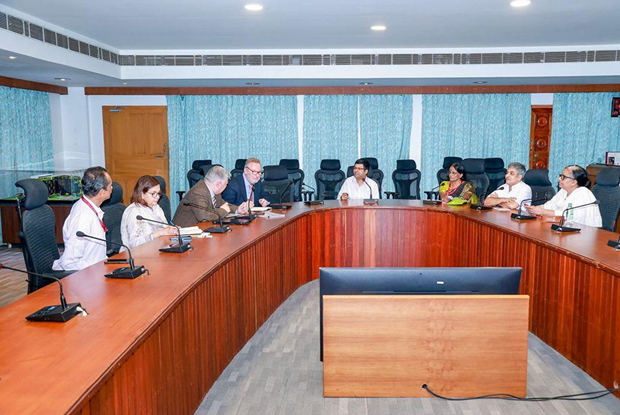
The 2025 collaboration built upon earlier Amrita–Durham joint research projects addressing clean water challenges in rural India. These initiatives provided an existing foundation for international research cooperation and the exchange of approaches to water accessibility and sustainable resource management. By connecting research expertise from India and the United Kingdom, the partnership created opportunities to examine different technological and community-based approaches, share implementation experiences, and identify practices that could inform sustainable water-management initiatives in diverse geographical contexts.
A major focus of the renewed partnership was the exploration of collaborative research opportunities in energy resilience, decarbonisation, and sustainable infrastructure. These areas are increasingly important for addressing climate change, improving energy security, and supporting the transition towards low-carbon development. Through international research cooperation, the universities sought to combine their complementary scientific capabilities to investigate emerging challenges, compare technological approaches, and explore innovative solutions suited to different environmental and socioeconomic conditions.
The collaboration also emphasised the importance of reviewing comparative approaches and sharing international best practices for tackling the SDGs. By encouraging interdisciplinary research and institutional knowledge exchange, the partnership provided opportunities to examine sustainable energy technologies, resource-efficiency strategies, climate-responsive infrastructure, and approaches to strengthening community resilience. Such comparative learning can help researchers identify promising interventions and assess their potential applicability across different regions.
The discussions held in July 2025 established a foundation for further institutional cooperation. This engagement subsequently progressed to the signing of a Memorandum of Understanding in early 2026 to establish an International Joint Centre of Excellence for Energy Resilience and Decarbonisation. The proposed centre represents a significant direction for the partnership, bringing together international research capabilities to advance knowledge and innovation in sustainable energy systems, climate resilience, and decarbonisation. While the formal agreement was concluded in 2026, the 2025 delegation visit and collaborative discussions were important steps in developing this international research initiative.
The partnership contributes to SDG 6 (Clean Water and Sanitation) through its earlier collaborative research on rural water challenges; SDG 7 (Affordable and Clean Energy) through planned cooperation in energy resilience and sustainable energy systems; SDG 13 (Climate Action) through research directions focused on decarbonisation and climate-responsive development; and SDG 17 (Partnerships for the Goals) through international academic cooperation, knowledge exchange, and joint research planning. Through its engagement with Durham University in 2025, Amrita Vishwa Vidyapeetham reinforced its commitment to international collaboration, comparative research, and the exchange of sustainable development practices. By building upon existing joint research and identifying new areas for cooperation, the partnership strengthened opportunities for developing research-informed approaches to water sustainability, energy resilience, and climate action, contributing to the broader advancement of international best practices for addressing the United Nations Sustainable Development Goals.
Amrita Vishwa Vidyapeetham strengthened its international academic engagement in gender equality, artificial intelligence (AI), and science, technology, engineering, and mathematics (STEM) education through collaborative research discussions and knowledge-sharing initiatives undertaken in April and June 2025. Led by Dr. Bhavani Rao, UNESCO Chair on Gender Equality and Women’s Empowerment at Amrita, these engagements provided opportunities to exchange research findings, review comparative approaches, and promote international best practices for addressing gender disparities in education, technological innovation, and scientific participation. In April 2025, Dr. Bhavani Rao participated in the UNESCO-backed International Conference on Technical and Vocational Education and Training (TVET) and Skills Development, held in Pune, India. During a panel chaired by UNESCO, she presented research examining the structural and sociocultural barriers affecting women’s participation and advancement in STEM fields in India. Her contribution drew upon the UNESCO publication A Braided River: The Universe of Indian Women in Science, which she co-authored, highlighting the complex relationship between educational opportunities, institutional environments, social expectations, and women’s professional experiences in scientific disciplines
The international conference provided a platform for comparative learning and the exchange of research-informed approaches to improving gender equity in technical education, vocational training, and STEM careers. Through engagement with international education specialists, researchers, and development practitioners, the discussions created opportunities to examine barriers to women’s participation, consider institutional responses, and share strategies for strengthening inclusive education and skills development. These exchanges supported broader dialogue on identifying transferable practices that could improve women’s access to scientific education and employment opportunities across different socioeconomic contexts.
In June 2025, Dr. Bhavani Rao further strengthened Amrita’s international research engagement through an academic visit to Université de Nantes, France, where she met with the university’s President and Vice-President for International Affairs. The visit included a presentation on women’s empowerment and artificial intelligence, hosted by Prof. Colin de la Higuera, UNESCO Chair on Open Educational Resources and AI. This engagement connected Amrita’s community-based research experience with international academic perspectives on inclusive technology, gender-responsive innovation, and the responsible development of artificial intelligence.
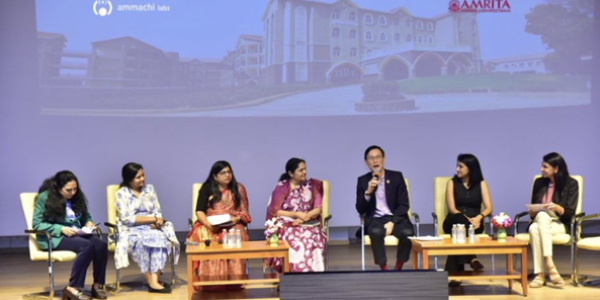
During the visit, Dr. Bhavani Rao shared insights from Amrita’s grassroots initiatives involving women and underserved communities, highlighting approaches that integrate experiential learning, community participation, and technological innovation to address social inequalities. The discussions explored the importance of incorporating gender perspectives into STEM education and AI research, recognising that technological advancement must be accompanied by equitable participation, accessibility, and sensitivity to diverse social contexts.
The engagement with Université de Nantes created opportunities for reviewing comparative approaches to gender inclusion in AI and STEM, particularly by connecting Amrita’s community-centred research practices with international perspectives on educational technologies and artificial intelligence. Through academic dialogue and knowledge exchange, participating researchers could examine how different institutional and community-based approaches address gender disparities and explore practices that may be adapted across educational and cultural environments.
Together, the April and June engagements reinforced the value of international collaboration and comparative research in identifying effective approaches to gender equality and inclusive technological development. By sharing research on structural barriers, discussing community-based interventions, and exchanging perspectives on gender-responsive AI, Amrita contributed to international dialogue on strengthening women’s participation in science, education, and emerging technologies.
These initiatives also highlighted the importance of connecting academic research with practical social interventions. Amrita’s experience in working with underserved communities offered perspectives on how participatory approaches and locally grounded research can inform international discussions on inclusive innovation. At the same time, engagement with UNESCO-associated academic networks provided opportunities to learn from international experiences and explore research-informed practices relevant to different institutional and national settings.
The activities contributed particularly to SDG 4 (Quality Education) through inclusive STEM education and skills development; SDG 5 (Gender Equality) through research on women’s empowerment and barriers to scientific participation; SDG 9 (Industry, Innovation and Infrastructure) through gender-responsive technological innovation; SDG 10 (Reduced Inequalities) through attention to underserved communities and equitable opportunities; and SDG 17 (Partnerships for the Goals) through international academic collaboration and knowledge exchange.
Through these international engagements in 2025, Amrita Vishwa Vidyapeetham strengthened its contribution to reviewing comparative approaches, exchanging research findings, and advancing international best practices for tackling the United Nations Sustainable Development Goals. By connecting research on gender inequalities in STEM with global discussions on ethical AI and inclusive education, the university supported continued international cooperation toward equitable scientific participation, responsible technological development, and sustainable social transformation.
Amrita Vishwa Vidyapeetham strengthened its international engagement in disaster risk reduction, geohazard monitoring, climate resilience, and community-based disaster preparedness through research collaborations, international knowledge-sharing initiatives, and scientific contributions undertaken throughout 2025. Building upon its experience in landslide early-warning systems, environmental monitoring, and community resilience, the university participated in international platforms that facilitated the exchange of scientific expertise, review of comparative approaches, and advancement of best practices for addressing disaster-related challenges under the United Nations Sustainable Development Goals (SDGs).
In April 2025, Amrita participated in the International Workshop on Women’s Role in Disaster Risk Reduction, organised by India’s National Disaster Management Authority (NDMA) in collaboration with UN Women. The workshop brought together representatives from leading international organisations, including the World Food Programme (WFP), European Commission, Global Facility for Disaster Reduction and Recovery (GFDRR)–World Bank, and Coalition for Disaster Resilient Infrastructure (CDRI). This international engagement provided an opportunity to examine different approaches to disaster preparedness, climate adaptation, community resilience, and women’s participation in disaster risk governance.
During the workshop, Amrita shared its experience in community-based resilience and water sustainability initiatives, including efforts to train women across more than 5,000 communities. These initiatives highlighted the importance of women’s participation in strengthening local capacities, promoting sustainable resource management, and improving community preparedness for environmental challenges. By exchanging experiences with international development organisations and disaster management specialists, Amrita contributed practical perspectives on integrating gender inclusion, community participation, and locally relevant knowledge into disaster risk reduction strategies.
The workshop encouraged comparative learning on international disaster risk reduction practices, particularly approaches that recognise women as active contributors to resilience-building and sustainable community development. Discussions provided opportunities to examine institutional strategies, participatory disaster management models, and approaches to strengthening the capabilities of vulnerable communities. Such exchanges supported the identification of potentially transferable practices for improving disaster preparedness, reducing vulnerability, and strengthening community resilience across different geographical and socioeconomic contexts.

In November 2025, Amrita further expanded its international research cooperation by signing a Memorandum of Understanding with the National Research Council of Italy’s Institute for Geo-Hydrological Protection (CNR-IRPI). The partnership established a framework for joint research in geohazards, hydrology, and disaster resilience, connecting scientific expertise from India and Italy to address complex environmental and disaster-related challenges. This collaboration created opportunities for comparative research on geohazard assessment, hydrological processes, environmental monitoring, and approaches to reducing risks associated with natural hazards.
The Amrita–CNR-IRPI partnership also provides a foundation for reviewing comparative scientific methodologies and advancing international best practices in disaster risk reduction. Through planned joint investigations and research exchange, the collaborating institutions can examine different approaches to hazard monitoring, risk assessment, and resilience planning. The partnership supports opportunities to explore how research findings and technological approaches developed in different environmental contexts may inform disaster preparedness and sustainable infrastructure planning.
Amrita’s international scientific engagement was further strengthened in December 2025 when Dr. Maneesha V. Ramesh, Pro Vice-Chancellor of Amrita Vishwa Vidyapeetham, was appointed an editor of the international journal Natural Hazards and Earth System Sciences. This appointment recognised her involvement in the field of natural hazards and disaster-related research and provided an additional avenue for engagement with the international scientific community. Editorial participation supports the scholarly review and dissemination of research addressing natural hazards, earth systems, risk assessment, and disaster resilience.
Collectively, these initiatives demonstrate Amrita’s continuing commitment to international collaboration, comparative research, and knowledge exchange in disaster risk reduction. The university’s participation in international policy discussions, establishment of research partnerships, and engagement in scientific publishing connect community-based experience with global research perspectives. Together, these activities create opportunities to examine different disaster management approaches, share practical knowledge, and advance research-informed strategies for strengthening resilience.
The initiatives contribute particularly to SDG 1 (No Poverty) by addressing disaster-related vulnerabilities affecting communities and livelihoods; SDG 5 (Gender Equality) through women’s participation in disaster preparedness and resilience-building; SDG 11 (Sustainable Cities and Communities) through disaster risk reduction and community resilience; SDG 13 (Climate Action) through climate adaptation, hazard monitoring, and preparedness; and SDG 17 (Partnerships for the Goals) through international research collaboration and multistakeholder knowledge exchange. Through its international engagements in 2025, Amrita Vishwa Vidyapeetham reinforced its commitment to reviewing comparative approaches and advancing international best practices for tackling the Sustainable Development Goals. By connecting grassroots resilience initiatives, scientific research partnerships, and international academic expertise, the university supported continued cooperation toward more inclusive, research-informed, and sustainable approaches to disaster risk reduction