

This talk presents an engineering-based view of how humans perform remarkably complex movements every day—such as playing a musical note, catching a falling cup, or shifting gaze—often without conscious effort. These abilities rely on the brain’s capacity to control movement reliably, even when the environment is unpredictable and the system itself is “noisy.” In many ways, the motor system functions like an elegant engineered system, and using engineering tools to study movement helps reveal the principles behind this control. Movement noise and variability have traditionally been treated as unwanted errors.
The research discussed in this talk treats noise not as a nuisance but as a key feature of the motor system—one that can be modelled, measured, and even used to guide diagnosis and rehabilitation in movement disorders. The focus is on saccadic eye movements, rapid gaze shifts that occur several times a second and are among the most precisely controlled actions humans make. By combining computational models, detailed behavioural analysis, and brain-network methods, the work shows how people control movements differently and how changes in this variability can sensitively indicate dysfunction in Parkinson’s disease.This engineering-driven perspective opens new ways to understand human behaviour, neural computation, and allowing clinical translation of these insights.

The Department of Electronics and Communication Engineering, Amrita School of Engineering, Coimbatore, is organizing an expert talk on “Engineering Approaches to Decoding Human Movement Control” on December 16, 2025 (Tuesday), from 11:00 AM to 12:30 PM IST.
Third-year and final-year UG students, PG students, and research scholars interested in this domain are encouraged to attend the seminar.
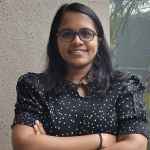
Dr. Varsha Vasudevan
Research Consultant
About the Speaker
Dr. Varsha Vasudevan is a biomedical engineer with expertise in computational neuroscience, neurophysiology, and human movement behavior. She completed her undergraduate studies in Model Engineering College, earning a B.Tech. in Electronics and Biomedical Engineering, followed by an M.Tech. in Biomedical Engineering from SRM University. She then pursued a Master’s-cum-Ph.D. in Bioengineering at the Indian Institute of Science.
Dr. Vasudevan has experience in both academic and industrial research. She worked with neuroprosthetics startup Grasp Bionics and served as a project consultant at Alien Technology Transfer before undertaking a postdoctoral fellowship at the Paris Brain Institute. She also served as an Institute Postdoctoral Fellow at the Indian Institute of Technology Bombay. Currently, she is an independent research consultant collaborating with multiple institutes through her own startup venture, Neurocom.
0422-2685734
Email: eceseminars@cb.amrita.edu