



30/Dec/2025
Amrita Vishwa Vidyapeetham has a target that at least 10% of each year’s new undergraduate students come from the bottom 20% of household incomes in India, rising to 15% by academic year 2030–31. The target applies to all 10 campuses and every undergraduate programme.
Amrita defines the bottom quintile more tightly than the national Economically Weaker Section (EWS) category, which covers families earning up to ₹8 lakh a year. Amrita’s target counts only students from families earning ₹1.2 lakh a year or less (for a family of four), a limit based on MoSPI’s national household survey. The target supports SDG 1 (No Poverty), SDG 4 (Quality Education) and SDG 10 (Reduced Inequalities).
A student counts towards the target if their family’s total annual income from all sources is ₹1.2 lakh or less, for a household of up to four people. For larger households, the limit is ₹30,000 per household member per year (₹2,500 per person per month). The next section shows why this limit sits at or below the bottom 20% of Indian households.
At admission, students show one of these documents:
| Proof accepted | Issued by |
| Income certificate showing annual family income of ₹1.2 lakh or less (or ₹30,000 per member for households of more than four), dated within the last 12 months | Tahsildar or other state revenue authority |
| Antyodaya Anna Yojana (AAY) ration card | State food and civil supplies department |
| Below Poverty Line (BPL) card or priority household ration card | State government |
The Admissions Office checks every document before the student is counted. Students who do not have these documents can apply through a means assessment by the Scholarship Committee, which reviews family income, assets and circumstances.
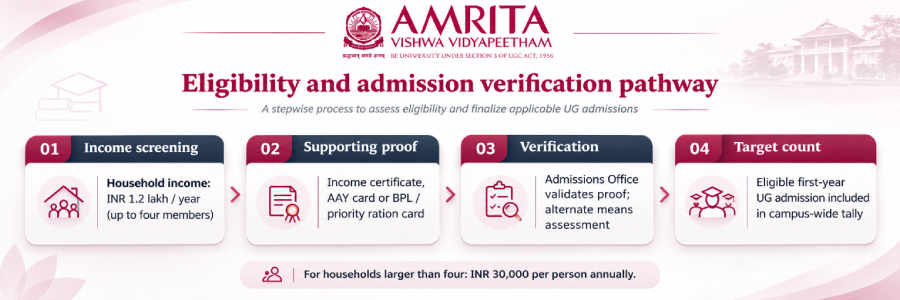
Amrita Vishwa Vidyapeetham’s Eligibility and Admission Verification Pathway, illustrating household income screening, supporting documentation, institutional verification, and the inclusion of eligible first-year undergraduate students from the bottom financial quintile in university-wide admission targets.
The threshold is set from India’s official national survey of household living standards, the Household Consumption Expenditure Survey (HCES) 2023–24 by the Ministry of Statistics and Programme Implementation (MoSPI). India publishes no official national distribution of household income, so MoSPI’s consumption survey is the standard national measure for ranking households by economic status.
HCES 2023–24 ranks people by monthly per-person consumption (MPCE). The 20th percentile, the upper edge of the bottom 20%, falls between the average of the 10–20% class and the average of the 20–30% class:
| Area | Average MPCE, 10–20% class | Average MPCE, 20–30% class | Bottom-20% line lies between |
| Rural India | ₹2,473 | ₹2,833 | ₹2,473 and ₹2,833 per person per month |
| Urban India | ₹3,687 | ₹4,353 | ₹3,687 and ₹4,353 per person per month |
Amrita’s limit of ₹2,500 per person per month (₹1.2 lakh a year for a family of four) is at the low end of the rural range and well below the urban range. This means:
The threshold is reviewed when MoSPI publishes a new HCES, and at least every three years.
The share of first-year undergraduate students from the bottom quintile will rise from 10% to 15% over five years.
| Academic year | Target share of new undergraduate students from the bottom 20% |
| 2026–27 | At least 10% |
| 2028–29 | At least 12% |
| 2030–31 | At least 15% |
The target is measured on each year’s total first-year undergraduate intake across all campuses. Each campus also tracks its own share, so that no campus falls far behind the university target.
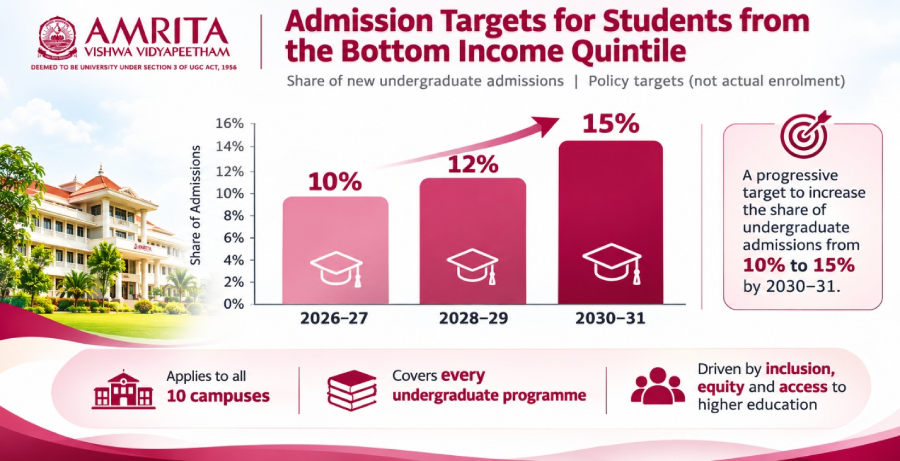
Amrita Vishwa Vidyapeetham’s Progressive Admission Targets for the Bottom Financial Quintile (2026–2031), illustrating the university’s commitment to increasing the proportion of newly admitted undergraduate students from economically disadvantaged households from 10% in 2026–27 to 12% in 2028–29 and 15% by 2030–31, across all 10 campuses and undergraduate programmes, promoting equitable access to higher education.
The target sits alongside, and does not replace, the national reservations Amrita follows in admissions: 15% for Scheduled Castes, 7.5% for Scheduled Tribes, 27% for Other Backward Classes (non-creamy layer) and 10% for EWS.
Students admitted under the target receive financial and practical support so that cost is not a barrier to joining or finishing their degree. 87% of Amrita students already receive some form of scholarship or fee concession.
| Support | What it covers |
| CATALYST Scholarship (with ELGi Equipments Ltd.) | Full tuition, hostel, meals and materials for 20 economically disadvantaged B.Tech Mechanical Engineering students at Coimbatore, with placement opportunities at ELGi |
| Chancellor’s Scholarship (merit-cum-means) | 100% tuition waiver for 80% and above in Class 12; 50% for 70–79% |
| AEEE entrance scholarships | More than 200 scholarships a year covering 25% to 90% of B.Tech tuition |
| Rekha Eipe Memorial Scholarship | Full tuition and residential costs for economically disadvantaged women |
| Meals and welfare | Subsidised meals, emergency food help, ration kits and meal vouchers |
| Loans and transport | Help with education loans from partner banks; subsidised campus buses |
| Wellbeing | Free 24/7 counselling and free legal aid |
To reach the target, Amrita also runs outreach in low-income areas: Amrita SeRVe works in 101 villages, ATL Sarthi mentors 67 government schools in Coimbatore, and AmritaCREATE and the STI Hubs reached over 4,000 people directly in 2024. These programmes guide students from these communities on how to apply and which scholarships they can get.
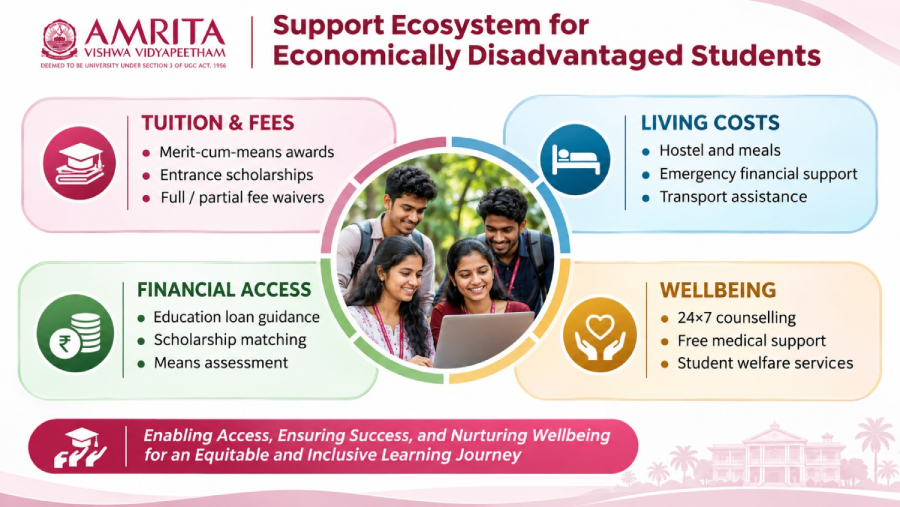
Amrita Vishwa Vidyapeetham’s Comprehensive Support Ecosystem for Economically Disadvantaged Students, highlighting financial assistance, scholarships, living-cost support, educational access, counselling, and student welfare initiatives to promote equitable access, retention, and successful degree completion.
The Academic Council approves the target, and the Director of Admissions is responsible for meeting it.
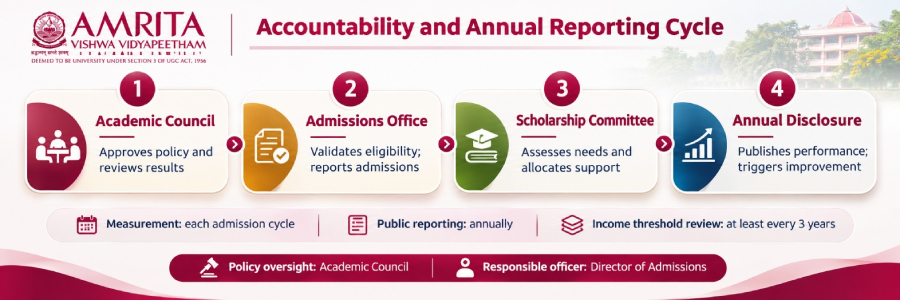
Figure: Amrita Vishwa Vidyapeetham’s Accountability and Annual Reporting Cycle, illustrating the four-stage governance framework for policy oversight, admission eligibility verification, scholarship allocation, and annual performance disclosure to ensure transparency, accountability, and continuous improvement in equitable access to higher education.
| Item | Details |
| Policy title | Bottom Financial Quintile Admission Target |
| Policy reference no. | AVV/ACAD/POL/2388/2025 |
| Approving body | Academic Council, Amrita Vishwa Vidyapeetham |
| Meeting no. and date | AVV2901, 1/6/2025 |
| Resolution no. | 4498 |
| Effective from | Admissions for academic year 2026–27 |
| Policy owner | Director of Admissions |
| Next review | 1/6/2028, three years after approval |
Resolution. Resolved that the Academic Council approves the Bottom Financial Quintile Admission Target: that at least 10% of first-year undergraduate students admitted in 2026–27, at least 12% in 2028–29 and at least 15% in 2030–31 shall come from households with annual income of ₹1.2 lakh or less (or ₹30,000 per member for households of more than four), as set out in this document; and that the Director of Admissions shall report progress to the Council after each admission cycle.
| Signed | Name | Date |
| Vice Chancellor | Dr. Venkat Rangan | 1/6/2025 |
| Registrar (Secretary, Academic Council) | Dr. Bipin Nair | 1/6/2025 |
| Director of Admissions | Shri Maheshwar Chaitanya | 1/6/2025 |