


Last Updated: November 30th, 2025

At Amrita Vishwa Vidyapeetham, water management is approached through an integrated framework that combines consumption monitoring, efficient water use, wastewater treatment and reuse, rainwater harvesting, and responsible water-resource management.
In alignment with United Nations Sustainable Development Goal 6 – Clean Water and Sanitation, Amrita continuously works towards improving water-use efficiency, reducing dependence on freshwater resources, and strengthening sustainable water-management practices across its campuses.
The university’s approach integrates technology-enabled monitoring, water-efficient infrastructure, treatment and reuse systems, and institutional sustainability initiatives to support responsible water stewardship.
During 2025, Amrita Vishwa Vidyapeetham recorded a total water consumption of 239,726 m³ across its campuses, serving a reported campus population of more than 39000. The university’s water-management approach involved monitoring potable and utility water consumption alongside the treatment and reuse of wastewater for suitable non-potable applications.
| Drinking water consumption | 51,508 m³ |
| Utility water consumption | 83,259 m³ |
| Total freshwater input (drinking + utility) | 134,767 m³ |
| Treated/reused wastewater | 104,958 m³ |
| Total reported water consumption, including reuse | 239,725 m³ |
| Wastewater treatment and reuse ratio | 78% |
| Total reported water use per person | 6 m³/person/year |
| Freshwater input per person | 3.4 m³/person/year |
A major achievement of Amrita’s integrated water-management programme in 2025 was the treatment and reuse of approximately 78% of the water input from drinking and utility water sources. The treated water is utilised for suitable non-potable purposes, including irrigation (70%) and remaining 30 % is used for toilet flushing and other utility applications. This approach helps recover water resources, reduce dependence on additional freshwater supplies, and promote more circular water management across campus operations.
Despite serving a campus population of more than 39,000, Amrita Vishwa Vidyapeetham maintained an average reported water consumption of approximately 6 m³ per person per year in 2025, equivalent to around 16.4 litres per person per day. This relatively low per-person consumption reflects the university’s emphasis on water-use efficiency, systematic monitoring, and integrated water management. For context, the Government of India’s Swachh Campus guidance indicates indicative water-use levels of 30 litres per day for day scholars and 100 litres per day for hostellers.
Amrita uses IoT-enabled smart meters, water tank automation unit, sub-meters, and digital dashboards to monitor water consumption and support resource management across its campuses. These systems facilitate the tracking of water-use patterns, identification of unusual consumption, detection of potential leakages, and timely management interventions. Continuous monitoring provides a data-driven foundation for improving water-use efficiency and strengthening institutional water governance.
The university’s Sustainable Campus Policy, updated in December 2025, incorporates measures to reduce freshwater demand and improve water-use efficiency. These include low-flow taps, dual-flush toilets, sprinkler and drip-irrigation systems for landscaped areas, and automated water-monitoring systems. Together, these interventions support more efficient water use across campus buildings, residential facilities, and landscaped spaces.
Amrita’s water-management framework also incorporates rainwater harvesting, wastewater treatment, water reuse, and sustainable water infrastructure. These measures contribute to reducing freshwater dependency, improving water availability, and strengthening campus resilience to water-related challenges.
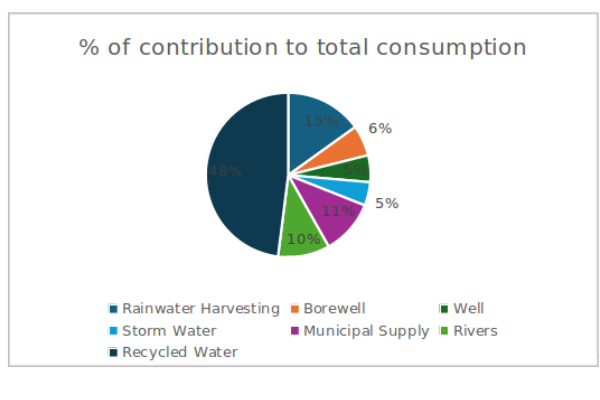
Amrita Vishwa Vidyapeetham adopts a diversified water-resource management approach by utilising multiple sources to meet the water requirements of its campuses. These include recycled wastewater, rainwater harvesting, municipal water supply, rivers, borewells, open wells and stormwater. The source-wise distribution of water consumption indicates that recycled water accounts for the largest share (48%) of the total water consumed across the reported institutional water-use profile. Rainwater harvesting contributes a further 15%, highlighting the role of rainwater collection and storage infrastructure in supporting campus water requirements.
Other sources include municipal water supply (11%), river water (10%), borewell water (6%), well water (5%) and stormwater (5%). The contribution from these sources demonstrates the institution’s reliance on a combination of conventional water sources and alternative water resources.
The substantial contribution from recycled water reflects the importance of wastewater treatment and reuse within the university’s integrated water-management approach. Treated wastewater is reused for appropriate non-potable applications, including landscape irrigation and toilet flushing, thereby reducing dependence on freshwater sources.This diversified sourcing strategy supports water conservation, promotes the efficient utilisation of available water resources and contributes to the institution’s broader commitment to sustainable water management under SDG 6.
Amrita’s water-consumption records demonstrate the development of its integrated water-management programme over the five-year period from 2021 to 2025. The data show an increase in campus population, overall water input, and the volume of treated/reused water.
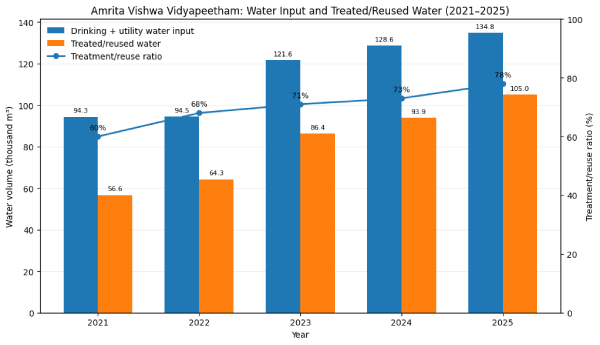
The volume of treated/reused water increased from 56,608 m³ in 2021 to 104,958 m³ in 2025, representing an increase of approximately 85%. Over the same period, the treatment and reuse ratio increased from approximately 60% to 78%.
Amrita Vishwa Vidyapeetham operates sewage treatment plants (STPs) with a combined treatment capacity of approximately 1,400 m³/day across its campuses to manage wastewater generated from residential, academic and other campus activities. The treated wastewater is recovered and reused for non-potable applications, reducing dependence on freshwater resources. During 2025, the university reported approximately 104,958 m³ of treated/reused wastewater. Of the reused water, approximately 70% is utilised for landscape irrigation, while the remaining 30% is used for toilet flushing and other utility applications. The university’s wastewater management infrastructure includes treatment units and associated processes such as filtration and ultrafiltration to support wastewater treatment and reuse.
Amrita implements rainwater harvesting and groundwater recharge measures to improve campus water availability and reduce dependence on external freshwater sources. Approximately 65,000 m² of rooftop area is connected to rainwater harvesting systems, with an estimated annual rainwater collection potential of 60,000 m³. The harvested rainwater is channelled into 16 storage tanks with a combined capacity of approximately 24,000 m³. In addition, the university has established 16 check dams to support rainwater retention and groundwater recharge. Three remotely managed borewells form part of the campus water-resource infrastructure, supporting groundwater resource management.
Amrita promotes water-efficient landscaping through the use of drip and sprinkler irrigation systems, along with the reuse of treated wastewater for maintaining campus green spaces. Approximately 70% of the treated/reused wastewater is allocated to landscape irrigation, reducing the requirement for freshwater in maintaining landscaped areas. Water-efficient irrigation practices are implemented across the landscaped areas, with emphasis on optimising water application and minimising wastage. The university also incorporates water-conscious planting practices and appropriate plant selection to support sustainable landscape management and reduce irrigation demand.
Amrita’s water-management programme incorporates water-quality monitoring to support the safety of drinking water supplies and the appropriate reuse of treated wastewater. Water-quality assessment includes monitoring key physicochemical parameters such as pH, turbidity, total dissolved solids (TDS), total hardness, calcium, magnesium, chloride, alkalinity and residual free chlorine. The university’s water-testing infrastructure includes multiparameter water-quality monitoring equipment and ion chromatography facilities for the assessment of selected water-quality parameters. Such monitoring supports the assessment of water quality, identification of potential contamination and informed management of water resources. Treated wastewater is intended for designated non-potable applications, with appropriate attention to treatment performance and reuse suitability.
Amrita continues to strengthen its water-management approach through technology-enabled monitoring, efficient infrastructure, wastewater treatment and reuse, and rainwater-management practices. Regular assessment of water input, wastewater treatment and reuse performance, and water-quality indicators provides a basis for identifying further opportunities for conservation.
Through these integrated efforts, Amrita Vishwa Vidyapeetham seeks to promote responsible water use, strengthen campus water resilience, and contribute to the objectives of SDG 6 – Clean Water and Sanitation.
