


Last updated: November 4th, 2025

In 2025, Amrita Vishwa Vidyapeetham reinforced its commitment to the United Nations Sustainable Development Goal 6 (SDG 6), ‘Ensure availability and sustainable management of water and sanitation for all,’ through a comprehensive approach to water-conscious planting and landscaping across its campuses. As part of its commitment to responsible water management and environmental stewardship, the university reports that 80% of its plant species are drought tolerant. This selection helps reduce irrigation requirements while maintaining green, attractive, and biodiverse campus environments.
Across Amrita’s campuses, vegetation covers 35% of non-built areas, with drought-tolerant species accounting for nearly 28% of these areas. The university incorporates water-efficient drip irrigation and uses recycled water exclusively to maintain its gardens and plantations. Together, these practices support an ecosystem-based approach to sustainable landscaping by reducing dependence on freshwater, improving irrigation efficiency, and strengthening the resilience of campus green infrastructure in line with SDG 6.
Selection of drought-tolerant plants
Plant selection is an important part of water-conscious landscaping. Species that can tolerate periods of limited water after establishment may help reduce irrigation demand, although actual requirements depend on species, soil, plant age, season, shade and local weather.
Efficient irrigation and recycled water
Across the campuses drip irrigation and the use of recycled water for gardens and plantations. These measures can support more efficient water use when correctly designed and maintained. For strong evidence, the university should document the locations served, the source and treatment status of recycled water, the irrigation method, and any available records of water use. Avoid describing a practice as universal unless records confirm that it applies across all campuses in the reporting scope.
Soil-moisture retention and landscape maintenance
Landscape maintenance can include mulching, soil improvement, appropriate plant spacing and irrigation scheduling. These practices can help retain soil moisture and reduce unnecessary watering when applied appropriately.
The following are examples of plant species identified across the campuses that support water conservation and effective drought management.
Scientific name: Bougainvillea glabra
An ornamental plant that, once established, can tolerate relatively dry conditions. It can provide colour along boundaries and in landscaped areas with comparatively modest irrigation needs.
Scientific name: Aloe vera
A succulent adapted to warm, dry conditions and limited water availability. It may be suitable for planting beds where drainage and sunlight are appropriate.
Scientific name: Ficus elastica
The source report describes this plant as able to tolerate irregular watering. Prolonged drought can still cause stress, so placement and irrigation should reflect local growing conditions.
Scientific name: Dracaena trifasciata (formerly Sansevieria trifasciata)
A hardy plant that can tolerate infrequent watering in suitable conditions. The updated scientific name should be verified against the campus inventory.
Scientific name: Manilkara zapota
A fruit-bearing tree that may be suitable for productive campus landscapes. Water needs vary with establishment, climate and fruit-production goals
Scientific name: Ananas comosus
A crop that can tolerate some dry periods but needs suitable moisture for healthy growth and fruit development. Irrigation should be adjusted to local conditions.
Scientific name: Carica papaya
A fruit crop that can tolerate some short periods of reduced soil moisture, but regular water management is important for growth and fruit production.
Scientific name: Artocarpus heterophyllus
A locally important fruit tree that contributes to productive campus greenery. Young trees and trees during dry periods may require supplementary watering.
Scientific name: Anacardium occidentale
An established cashew tree can tolerate some dry conditions and can contribute to productive planting. Water needs vary with plant age, soil and season.
Scientific name: Bambusa spp. (species to be confirmed)
Some bamboo species tolerate periods of reduced water availability, but requirements differ by species and growing conditions. The campus species should be identified before making a specific drought-tolerance claim.
Scientific name: Punica granatum
A fruit-bearing shrub or small tree that can tolerate relatively dry conditions once established, although water is important for healthy growth and fruit development.
Scientific name: Psidium guajava
A fruit tree adaptable to a range of growing conditions. Water requirements depend on plant age, soil, season and the desired fruit yield.
Scientific name: Phoenix dactylifera (identification to be confirmed)
The source report includes a date palm photograph. The species and cultivar should be confirmed, and its inclusion as drought-tolerant should be assessed in the context of local growing conditions.
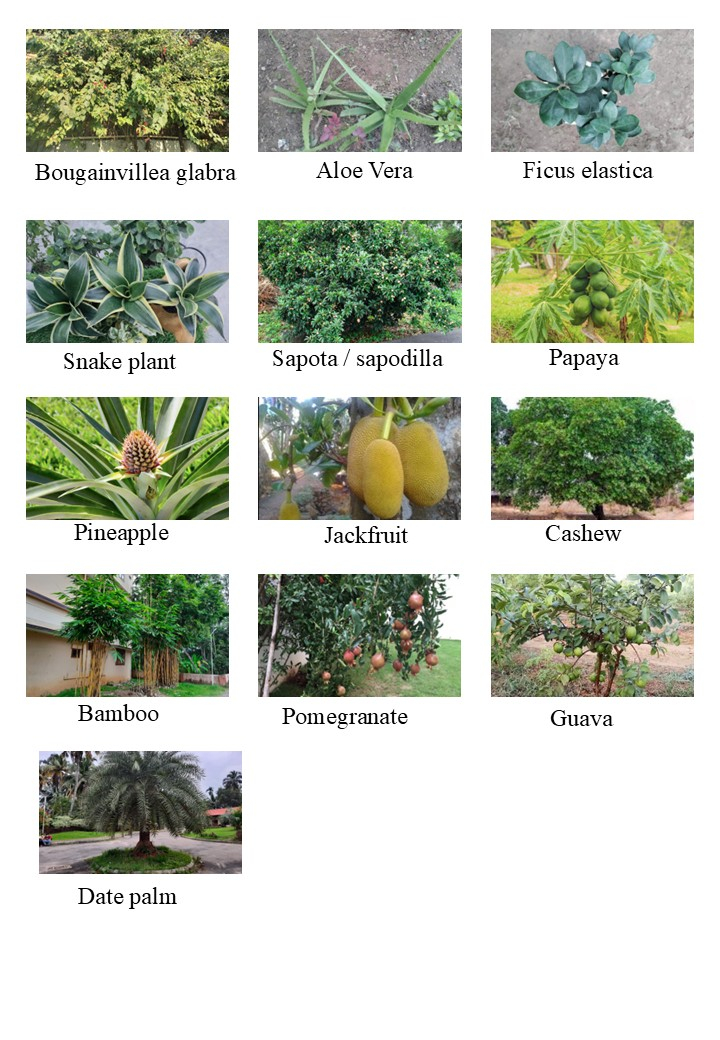
List of Water tolerant plants identified across the campus
Amrita’s School of Ayurveda maintains an herbal garden dedicated to medicinal-plant diversity, learning and research. The garden as covering approximately five acres and containing around 500 rare medicinal-plant species. The Department of Dravyaguna Vijnyana has a key role in the garden’s conception and maintenance. The garden also supports teaching, particularly for students studying Dravyaguna Vijnayana, and a portion is earmarked for herbs required by the hospital’s research division.
The garden includes medicinal plants such as Jambu (Syzygium cumini), Jyotishmati (Celastrus paniculatus), Madhūka (Madhuca longifolia), Nirgundi (Vitex negundo) and other species listed. Its inclusion in this report broadens the account of campus planting beyond ornamental and fruit-bearing plants to include medicinal-plant cultivation with educational and research value.
Campus lawns are maintained using buffalo grass, selected for its ability to remain viable with relatively low water inputs. Choosing a grass species with modest irrigation needs helps preserve functional, visually appealing lawns and recreational green spaces. This approach enables the university to maintain the benefits of landscaped open areas while supporting its broader commitment to conserving water.
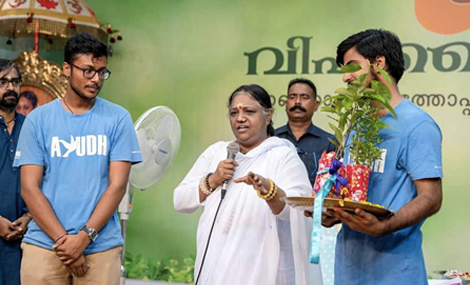
The Chancellor of Amrita Vishwa Vidyapeetham encourages students to plant and nurture drought-tolerant trees and other vegetation across campus. This emphasis on hands-on participation extends the university’s sustainability efforts beyond formal policy and into everyday student engagement. Such initiatives promote environmental awareness and responsible resource use while helping students gain practical experience in water-conscious planting and landscape management. The knowledge developed through these activities can also inform sustainable choices beyond the campus.
The following figures illustrate the relatively low annual water requirements reported for selected drought-tolerant plant species. They provide a quantitative reference for understanding how appropriate species selection can support water-conscious planting and help reduce landscape irrigation demand at Amrita:
Agave americana (Century plant) requires approximately 18 gallons of water annually, while Aloe vera needs about 4 inches of water per year. Artemisia californica (California sagebrush) requires approximately 12 inches annually, and Ceanothus species (California lilac) need around 20 inches. Dudleya species (Liveforever) require about 6 inches of water each year, while Encelia californica (California encelia) needs approximately 12 inches. Eriogonum fasciculatum (California buckwheat) requires around 10 inches annually. Hesperaloe parviflora (Red yucca) needs approximately 15 gallons of water per year. Lavandula angustifolia (English lavender) requires about 20 inches annually, while Leucophyllum frutescens (Texas ranger) needs around 15 inches. Opuntia species (Prickly pear) require approximately 10 inches of water per year, and Yucca schidigera (Mojave yucca) needs about 12 inches annually.
Amrita Vishwa Vidyapeetham’s water-conscious planting practices demonstrate how environmental responsibility can be integrated with attractive and functional campus landscapes. By selecting drought-tolerant species and combining them with efficient irrigation and recycled water, the university seeks to limit freshwater consumption while maintaining diverse green spaces. Its approach also connects landscape management with student learning, fruit production, biodiversity, and local cultural practices. Taken together, these measures reflect an integrated commitment to sustainable campus development and the objectives of SDG 6.