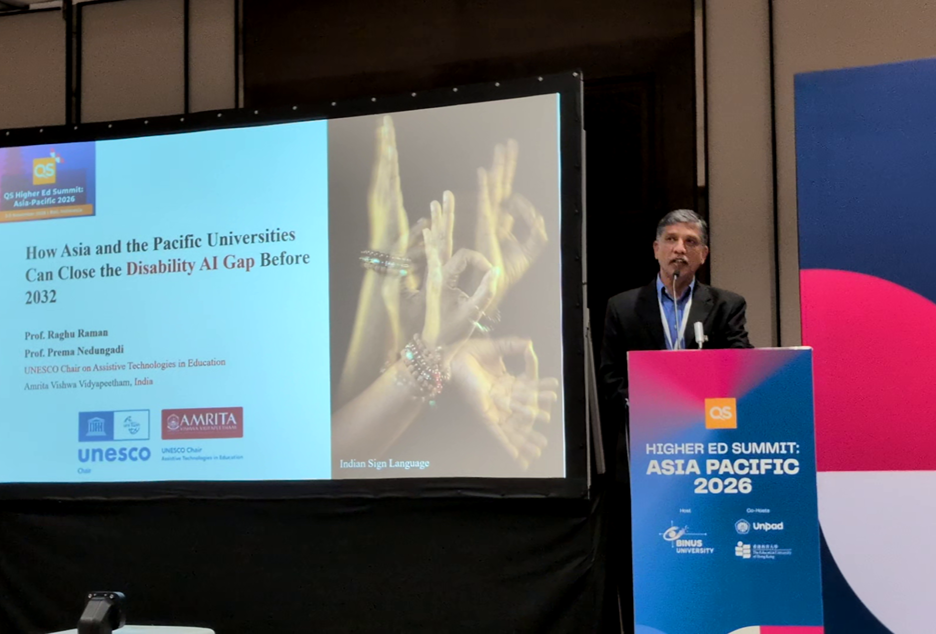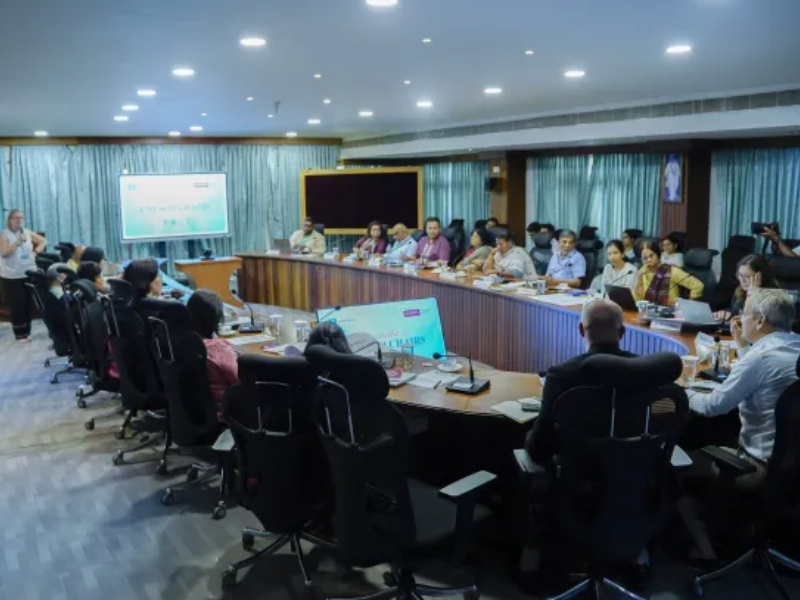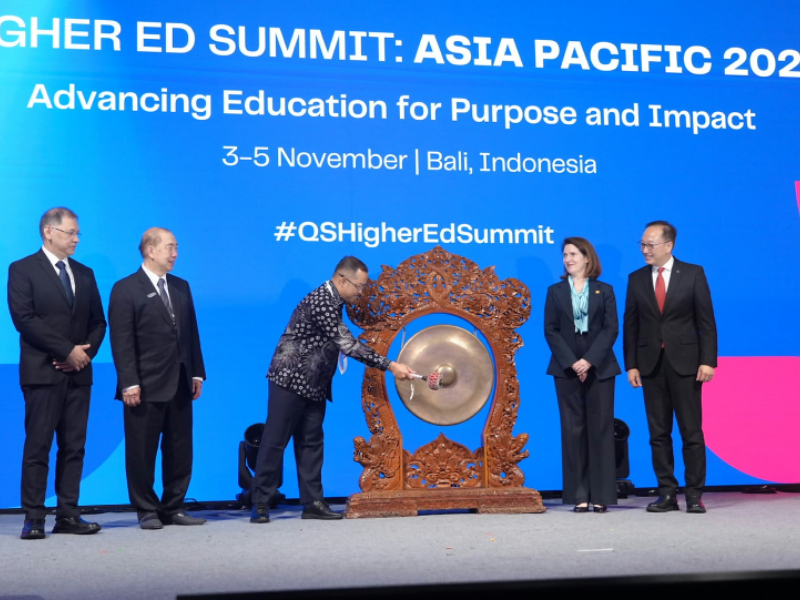
As artificial intelligence becomes increasingly part of education and public services, an important question remains: Are these technologies accessible to everyone? This was the question Prof. Raghu Raman, UNESCO Chair on Assistive Technologies in Education at Amrita Vishwa Vidyapeetham, brought to the discussion at the QS Higher Ed Summit: Asia Pacific 2026, held in Bali, Indonesia, from 3–5 November.
Speaking on “How Asia and the Pacific Universities Can Close the Disability AI Gap Before 2032,” Prof. Raman urged universities to take a more active role in ensuring that advances in AI do not leave persons with disabilities behind.
Compassion as the starting point
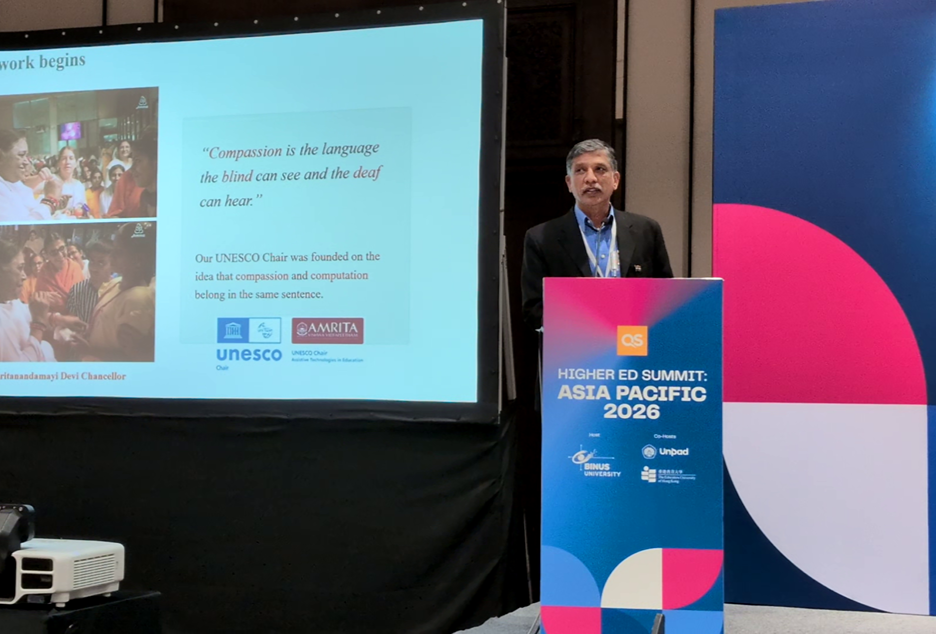
At the beginning of his presentation, Prof. Raman recalled the words of Amrita’s Chancellor, Mata Amritanandamayi Devi (Amma): “Compassion is the language the blind can see and the deaf can hear.”
He connected this thought to the founding idea of the UNESCO Chair: that compassion and computation belong together. The development of technology, he argued, must begin with an understanding of people’s needs and the barriers they face.
This is an urgent concern across Asia and the Pacific, where an estimated 700 million people live with disabilities. Prof. Raman pointed out that many AI tools are trained on datasets that do not adequately represent low-resource languages and sign languages. As a result, tools that can describe images, caption lectures or recognise sign language may work well for some communities but remain inaccessible to others.
Work underway at Amrita
Prof. Raman shared examples of how the UNESCO Chair and Amrita CREATE are addressing some of these gaps.
One initiative is the development of Indian Sign Language (ISL) access to Online Labs (OLabs), a virtual platform offering more than 500 curriculum-aligned science experiments. The work involves ISLRTC, Deaf educators and sign linguists, with the aim of making science learning more accessible to Deaf students.
He also spoke about an ISL-enabled interface for UMANG, India’s national digital government services platform, through which Deaf users can access services using sign language. The service is already live.
Another project, ChalaChitra Vachana, uses AI to generate audio descriptions of visual content for blind and low-vision learners in several Indian languages.
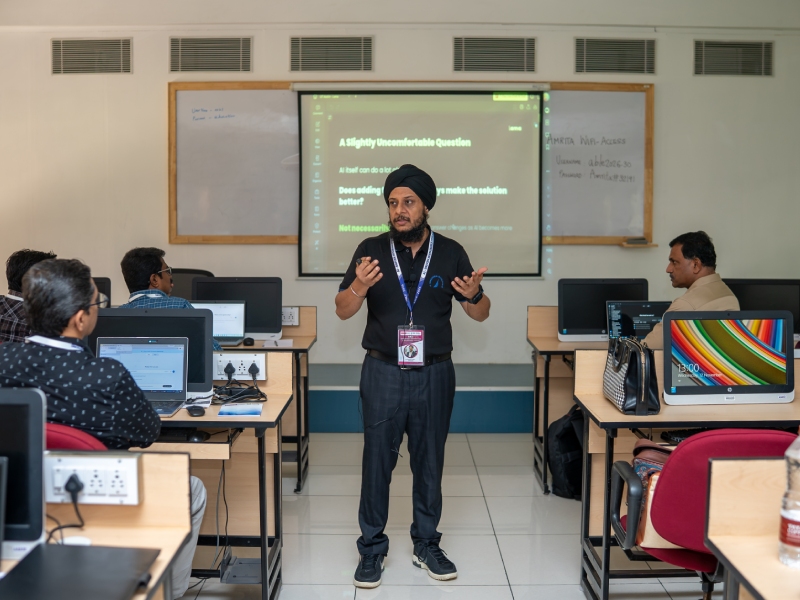
These projects reflect the Chair’s approach to assistive technology: working with the people who will use the solutions, and testing them in the settings where they are needed. Prof. Raman referred to workshops at Happy Hands School for the Deaf in Odisha and Amrita Speech and Hearing Improvement School in Thrissur, where Deaf students and teachers worked alongside researchers on accessible learning resources.
What universities can do
For Prof. Raman, universities have a responsibility that goes beyond developing new technologies. They can help build the datasets that AI systems need, test tools in actual classrooms, prepare students to design with accessibility in mind, and produce research that helps governments measure progress.
He also stressed that persons with disabilities must be involved in the work from the beginning, as researchers and co-creators, rather than brought in only to test a finished product. Building trust, obtaining informed consent and creating research structures that last beyond individual funding cycles are equally important.
With the Asian and Pacific Decade of Persons with Disabilities (2023–2032) now at its midpoint, Prof. Raman called on universities to contribute more actively to the region’s efforts towards inclusion.
He closed with a question that went to the heart of his presentation:
“The question is not how do we adopt AI. That decision has already been made for us. It is who does our AI include.”
The presentation brought the work of the UNESCO Chair to a wider higher education audience and opened up an important conversation about the role universities must play in making technological progress more inclusive.