Our research over the past several years has focused on understanding how Artificial Intelligence (AI), particularly Large Language Models (LLMs), is changing the landscape of online exploitation and how AI can also be used to protect potential victims. This work has resulted in three complementary research studies that examine the problem from different perspectives.
“Love, Lies, and Language Models : Investigating AI’s Role in Romance-Baiting Scams” (USENIX Security ’26), investigates how criminal organizations are already using LLMs to support large-scale scam operations. Drawing on interviews with trafficking survivors and individuals who worked inside scam compounds, the research shows that AI tools are routinely used to translate conversations, generate convincing messages, and build trust with victims. The study also demonstrates that AI-generated conversations can be more persuasive than those created by trained human operators, while existing content moderation systems struggle to detect these scams because the conversations appear natural until the final stage of exploitation.
Another study, “Exploiting LLMs for Scam Automation : A Looming Threat,” examines how LLMs can automate different stages of online scams. The research highlights how AI enables scammers to generate personalized conversations at scale, significantly increasing the speed, efficiency, and reach of fraudulent operations. It also emphasizes the growing need for proactive AI-based defenses that can identify suspicious behavioral patterns rather than relying solely on message content.
“The Industrialization of Messaging Scams in the LLM Era,” explores how modern scam operations have evolved into highly organized enterprises with specialized roles, standardized workflows, and AI-assisted communication. The research argues that future detection systems must move beyond identifying individual suspicious messages and instead analyze long-term behavioral patterns, recruitment strategies, and trust-building activities that occur over time.
Spotting the Red Flags in Online Job Advertisements
Every year, an estimated 27.6 million people worldwide are trapped in forced labor or sexual exploitation. Increasingly, the first point of contact between traffickers and potential victims occurs through seemingly legitimate online job advertisements or social media messages. These recruitment attempts often appear genuine at first glance, making it difficult for individuals to recognize the warning signs of exploitation.
A study presented at the 2025 Gender and Technology Conference (IEEE GTC), Detection of Human Trafficking Risks Using Machine Learning, tackles this at its earliest, most preventable stage- recruitment.
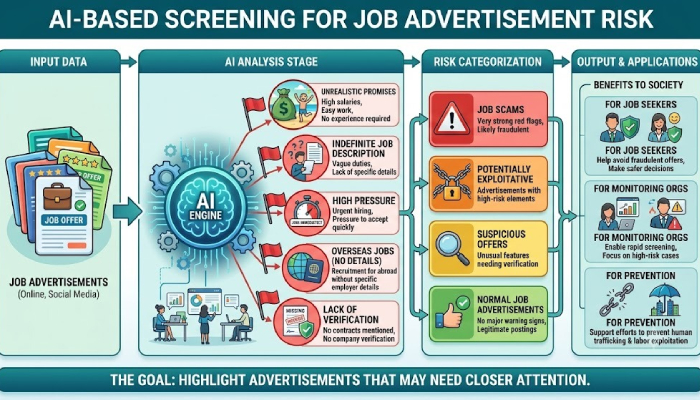
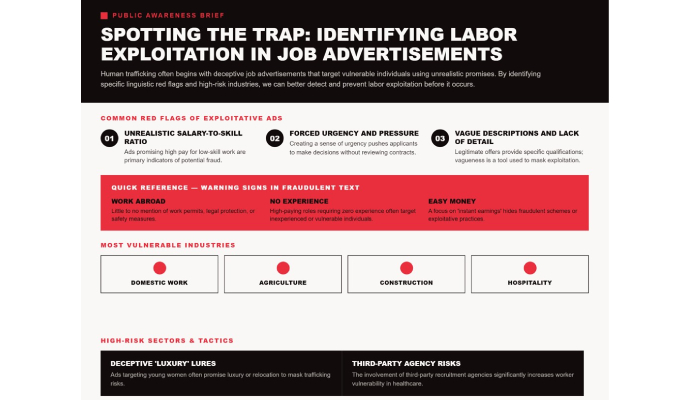
Traffickers pose as recruiters offering high-paying jobs abroad, build fake relationships on dating apps, and use coded, multilingual language to stay ahead of detection. Manual monitoring is difficult to scale, and traditional keyword-based filtering methods often fail to capture the subtle language and context used by traffickers. Furthermore, the lack of a comprehensive labeled dataset has limited the development and training of more effective detection models. The research team developed a multilingual, manually annotated dataset containing job advertisements in English, Hindi, and Bengali to support the detection of potentially exploitative recruitment. The research was further extended to online platforms that are commonly exploited by traffickers, including Telegram, OLX, Craigslist, and dating applications, where deceptive job advertisements and fabricated relationships are frequently used as recruitment and grooming tactics. Applying the same AI-based analysis across these platforms demonstrates the potential of the framework to detect suspicious recruitment activities beyond traditional job portals.The analysis identified several warning signs that frequently appear in potentially exploitative job advertisements. These include unrealistic salaries for low-skill work, vague job descriptions, pressure to apply or join immediately,”no experience required” claims for high-paying jobs, overseas employment opportunities without information about legal protections, and promises of easy money.