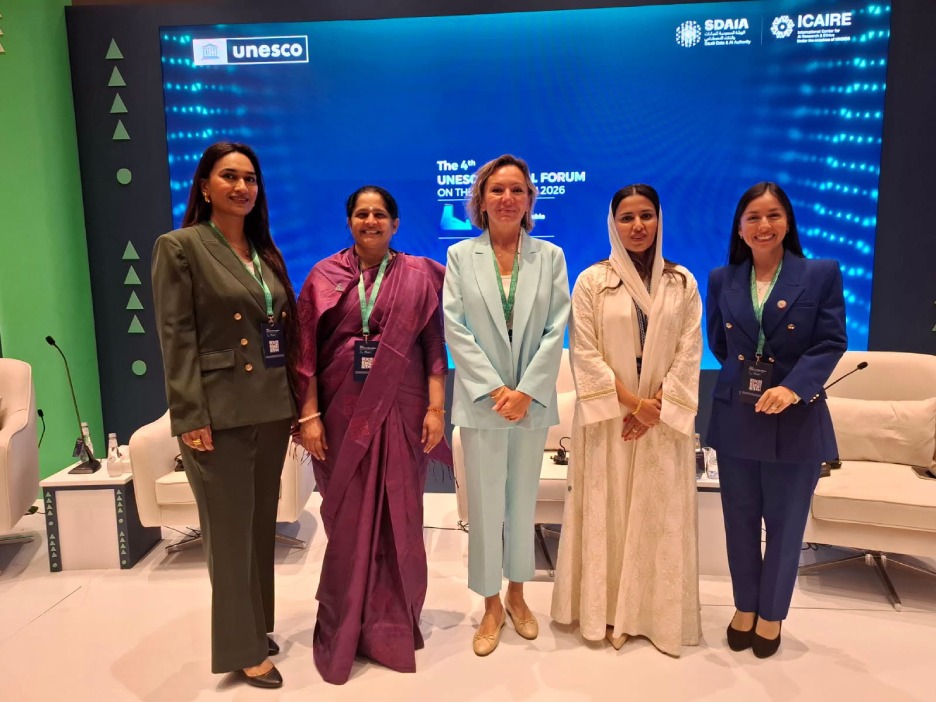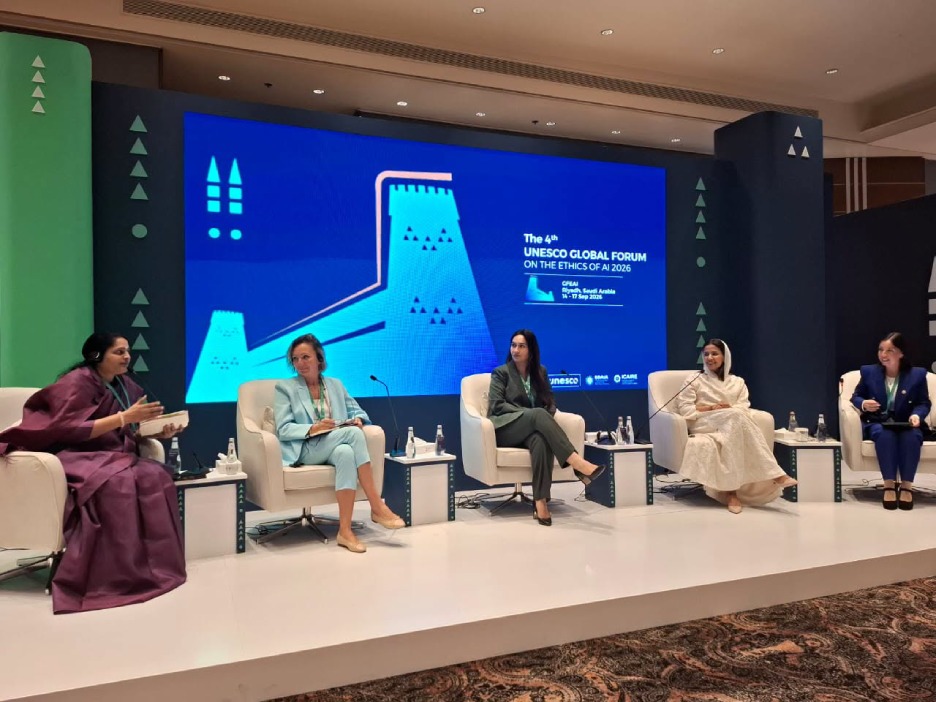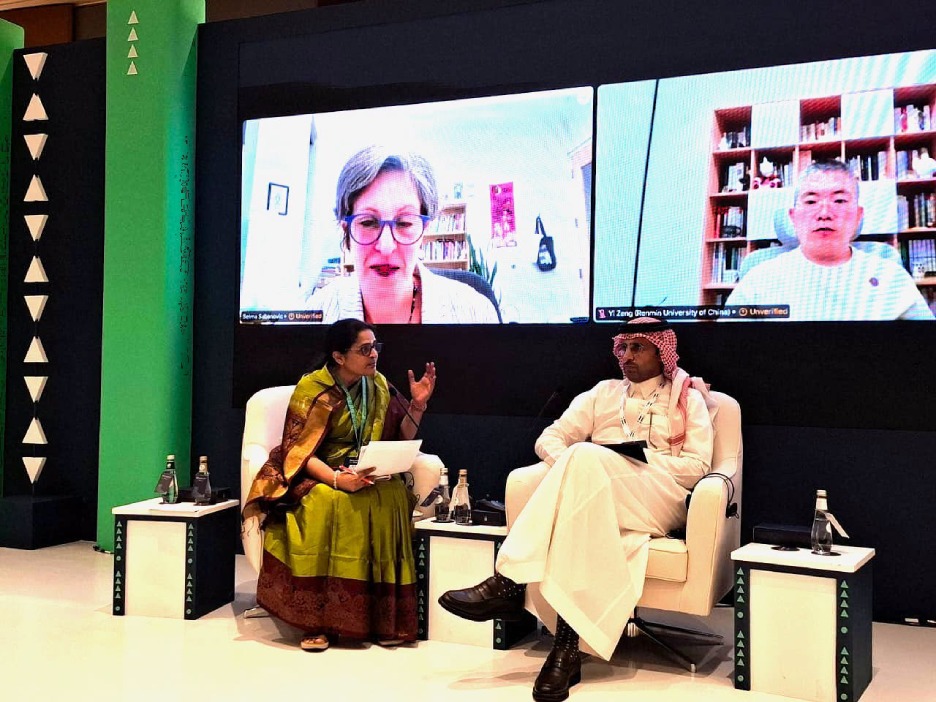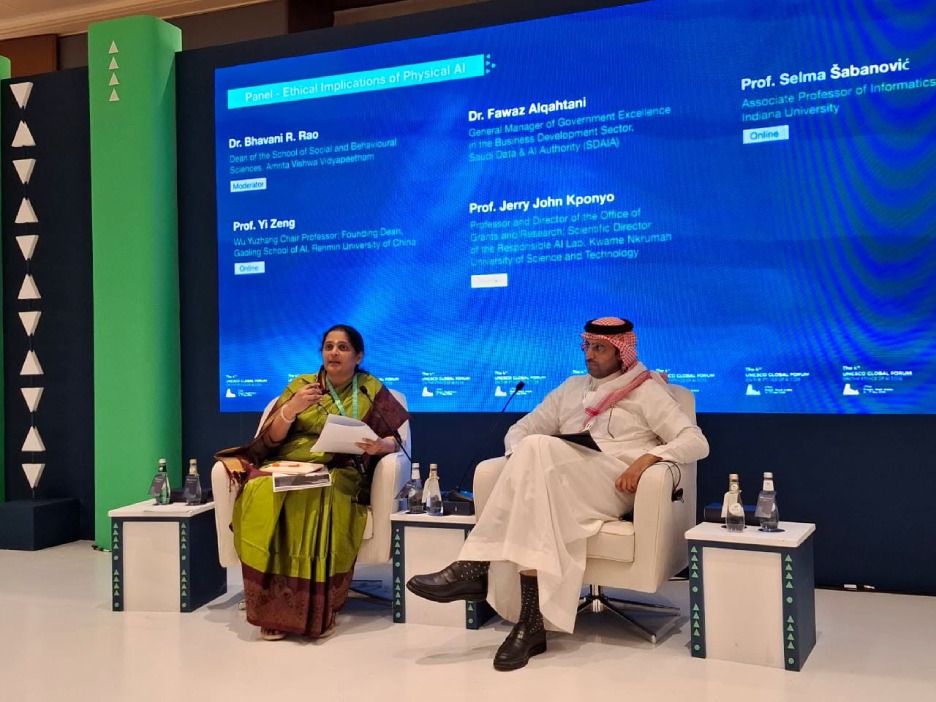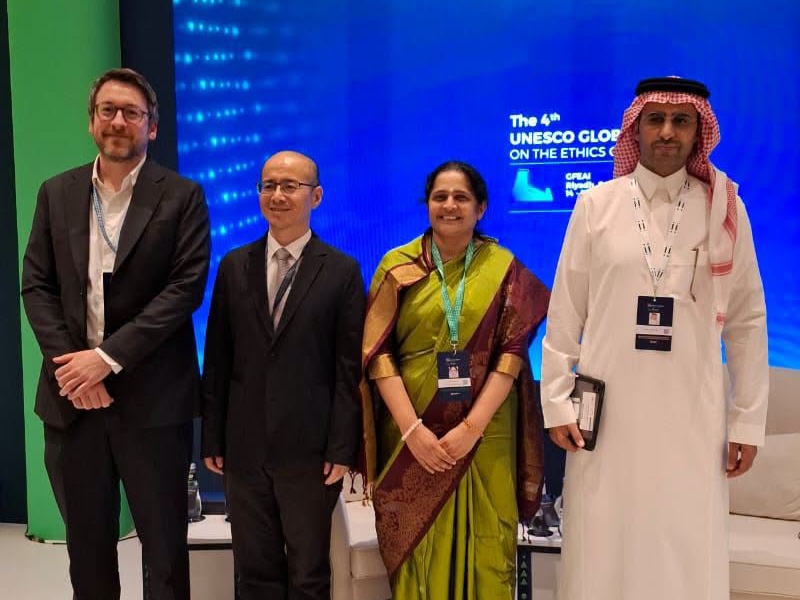
Amrita Vishwa Vidyapeetham joined policymakers, researchers and technology leaders from across the world at the 4th UNESCO Global Forum on the Ethics of Artificial Intelligence, held in Riyadh from September 14 to 17, 2026.
Representing Amrita, Dr. Bhavani Rao R., Dean of the Amrita School of Social and Behavioural Sciences and UNESCO Chair on Gender Equality and Women’s Empowerment, spoke in two sessions and brought the Global South perspective to discussions on how AI should be governed as it enters every sphere of life.
Amrita at the Forum
Co-hosted by UNESCO and the Kingdom of Saudi Arabia through the Saudi Data & AI Authority (SDAIA) and the International Centre for AI Research and Ethics (ICAIRE), the Forum was held under the theme “Transforming Global Cooperation for Ethical AI Governance.” It was the first edition to be held in the Gulf region and coincided with Saudi Arabia’s Year of Artificial Intelligence. Earlier editions took place in Prague, Kranj and Bangkok.
The Forum’s central task was to turn UNESCO’s Recommendation on the Ethics of Artificial Intelligence, adopted by all 194 Member States in 2021, into working policy, institutions and safeguards.
Dr. Bhavani Rao took part in two sessions:
She spoke in her capacity as Chair of the Women for Ethical AI (W4EAI) South Asia Chapter, launched at Amritapuri on January 19, 2025, during the International Conference on Gender and Technology organised by Amrita in collaboration with UNESCO and IEEE. Co-chaired by Amrita and UNESCO’s Regional Office for South Asia, the Chapter has grown into one of the most active regional chapters of UNESCO’s global W4EAI platform, which is headquartered in Paris and tracks implementation of the gender chapter of the Recommendation.
In July 2026, the Chapter published the Outlook Study on Artificial Intelligence and Gender in South Asia, the first regional assessment of women’s participation in AI across Bangladesh, Bhutan, India, Maldives, Nepal and Sri Lanka. The study maps how barriers accumulate along the AI pipeline, from education to entrepreneurship, and limit women’s access to leadership in the field.
At the Intersection of Gender and Technology
Dr. Bhavani Rao’s presence at the Forum rests on a long record of research that places women and vulnerable communities at the centre of technology design. Besides her role as Dean, she directs AMMACHI Labs and the Centre for Women’s Empowerment and Gender Equality at Amrita, the University’s home for the UNESCO Chair on Gender Equality and Women’s Empowerment.
Her work focuses on empowering women and girls in rural areas across India and Africa, combining research, development and field implementation of technology, including AI, augmented and virtual reality, robotics and haptics, for capacity building and skill development. Her programmes also deliberately engage men and boys as partners in gender equality and social change.
At the policy level, Dr. Rao led the Civil20 Gender Equality Working Group during India’s G20 Presidency, shaping recommendations on inclusive technology and gender-responsive digital transformation. UNESCO lists her among its AI Ethics Experts Without Borders, with recognised expertise in four policy areas of the Recommendation: gender; education and research; economy and labour; and health and social well-being.
At the launch of the W4EAI South Asia Chapter in 2025, Dr. Rao framed the stakes plainly: given how deeply AI will touch South Asia’s population, it is imperative that AI does not deepen existing inequalities and vulnerabilities. At the Outlook Study launch in July 2026, she called for AI and research education from the school level, greater visibility for women leaders in AI, and research that weighs social, cultural, ethical and environmental impact alongside technical excellence.
Bringing the Global South to the Table
Amrita’s participation in Riyadh ensured that the realities of South Asia and the wider Global South, where AI is reaching large, young and often underserved populations, informed a conversation that is frequently shaped by the priorities of advanced economies. Through the UNESCO Chair, AMMACHI Labs and the W4EAI South Asia Chapter, Amrita continues to work for AI that is ethical, inclusive and human-centred, in keeping with Chancellor Amma’s vision of education and technology in service of society.