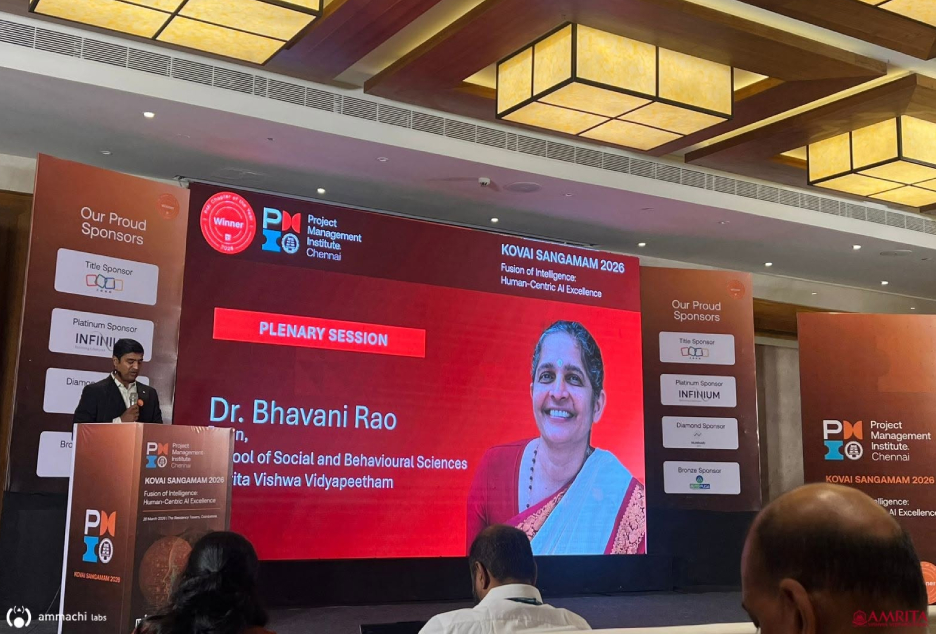
At Kovai Sangamam 2026, Dr. Bhavani Rao R., UNESCO Chair and Dean of the Amrita School of Social and Behavioural Sciences, delivered a thought-provoking session titled “AI, Data, and Ethics: Designing for Inclusion.” The session explored the growing influence of Artificial Intelligence (AI) on society and emphasized the urgent need to ensure that AI systems are developed with fairness, accountability, and inclusivity at their core.
Addressing a diverse audience of academics, policymakers, technology professionals, and students, Dr. Rao underscored a critical reality: AI is only as ethical as the data on which it is built. As AI increasingly shapes decision-making processes across sectors, the quality, representativeness, and responsible use of data have become central to ensuring equitable outcomes.
Drawing from her extensive fieldwork and research across rural and tribal communities in India, Dr. Rao highlighted persistent challenges such as the digital divide, gender disparities, and the underrepresentation of marginalized populations in technology design. She cautioned that unless these systemic inequities are addressed, AI technologies risk reinforcing and amplifying existing social inequalities.
During the session, Dr. Rao outlined several key priorities for developing more inclusive AI systems, including:
“Technology is an amplifier,” Dr. Rao noted, emphasizing that it has the potential to scale both inclusion and inequality. She stressed the importance of embedding ethics, compassion, and accountability into every stage of the design and development process.
The session also called for a broader shift from efficiency-driven innovation toward human-centric AI, guided by empathy, fairness, and social responsibility. According to Dr. Rao, the future of AI must be shaped not only by technological advancement but also by a commitment to human dignity and social justice. Her insights strongly resonated with the overarching theme of Kovai Sangamam 2026, reinforcing the need for collaborative efforts to create AI systems that serve society equitably, sustainably, and responsibly.
As discussions on AI governance and ethical technology continue to gain momentum worldwide, Dr. Rao’s address served as a timely reminder that the true measure of innovation lies in its ability to empower all sections of society and leave no one behind. During the session, Dr. Rao outlined several key priorities for developing more inclusive AI systems.