

Inclusive Education in Practise – the second webinar in the quarterly webinar series “Voices of Persons with Disabilities”, conducted by UNESCO Chair on Assistive Technologies in Education, began with one question – Inclusion usually means asking someone with a disability to fit into a system built without them. What if we questioned the system instead?
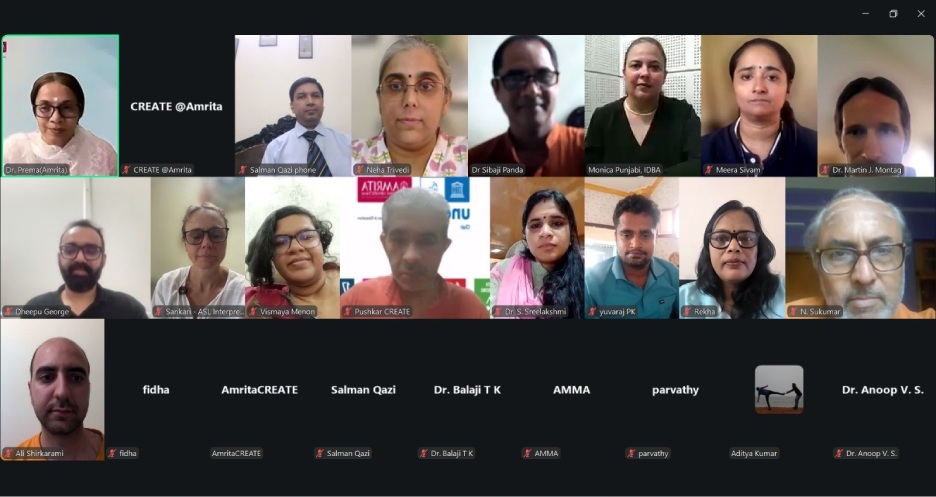
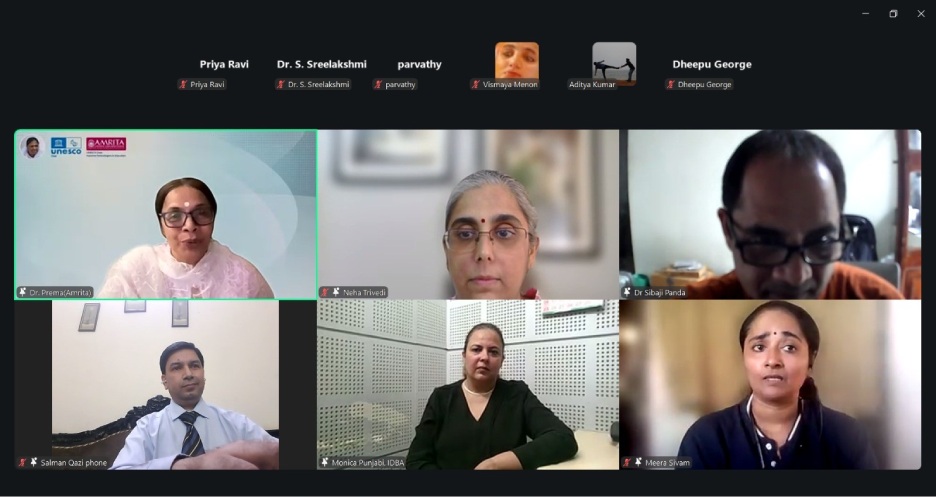
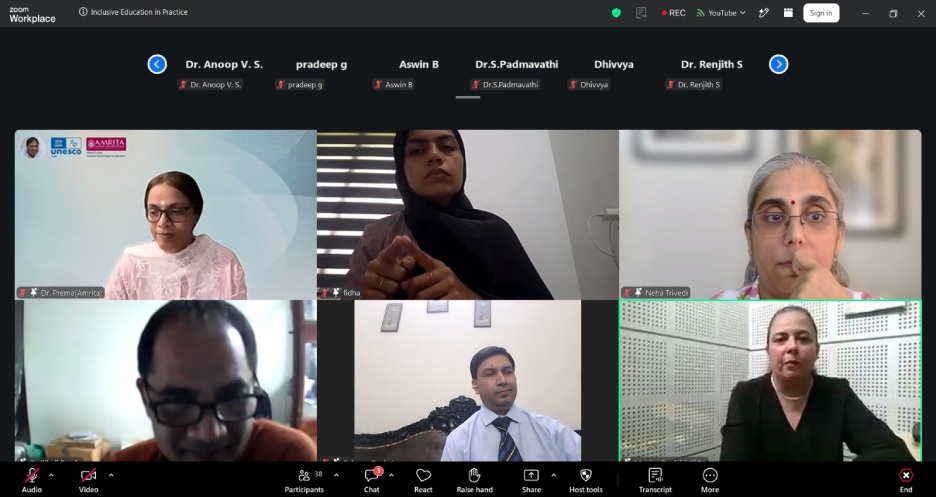
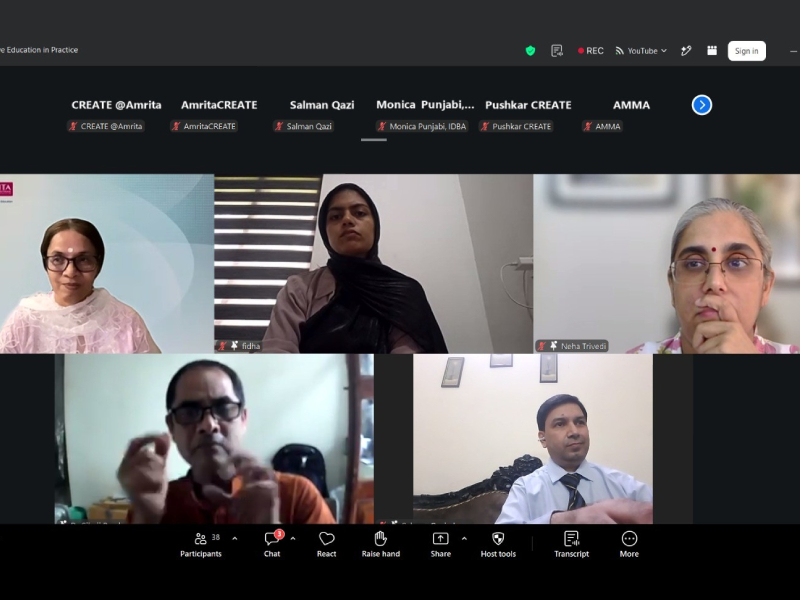
That single theme ran through everything that followed. Five panellists — with Indian Sign Language (ISL) interpretation live throughout — brought perspectives from a Deaf bilingual school, a mainstream classroom, a deafblind student’s own experience, a Deaf-led institution, and the world of accessibility design.
The session opened with an introduction about Amma’s initiatives in inclusion and empowerment, followed by a video showing the launch of Amrita’s UNESCO Chair on Assistive Technologies in Education. This was proceeded by a short video giving the bios of the panellists.
Dr. Prema Nedungadi, the chairholder, then moderated the entire session. She began by giving a brief overview of the various works being done by the Chair on accessible technologies, and then proceeded to move the discussion towards individual panellists.
The first panellist was Ms. Monica Punjabi, the director of the Indore Deaf Bilingual Academy (IDBA) — India’s first bilingual school for the Deaf, founded by a Deaf couple, Usha and Rajkumar Punjabi, back when ISL wasn’t even formally recognised. The idea was simple but radical for its time: teach every subject in ISL first, and treat Hindi and English as additional languages, not the default.
Ms. Punjabi has worked with NCERT and NIOS on the standardization and translation of educational materials into ISL and feels that even though translated textbooks exist now, their quality is patchy, and most curricula are still built for hearing students, not restructured for Deaf ones. She encouraged more pathways for skilled Deaf adults to become certified subject teachers — because right now, there just aren’t enough.
The next panellist was a blind educator, Mr. Salman Ali Qazi, who uses the latest assistive technologies to empower visually impaired students at Christ Church College in Lucknow, with the aim of integrating them with the mainstream students in the school. One of his students, Sara Moin, is deafblind and scored 98.75% in her Class 12 boards — with a laptop and a refreshable Braille display as her main tools. Mr. Qazi framed disability as substantially a product of environment: “disability is nothing… it is the environment which is responsible for making any child able or disabled.”
Speaking through Mr. Qazi, Saara Moin identified the Orbit Reader (refreshable Braille display) as the single assistive technology that most changed her education, enabling independent use of a laptop and the internet. She said opportunities for multiply disabled students to study STEM subjects — including access to diagrams and mathematical notation — remain reasonably adequate up to Class 10 but drop off sharply afterward, and called for this to be addressed. Outside academics, she shared interests in fiction writing (published in her school magazine), cricket, chess, and travel, and stated her ambition to become a university professor of English literature.
The next panellist was a pioneer in Deaf education, Dr. Sibaji Panda. Dr. Panda grew up as a deaf child in a remote village of Odisha and experienced first-hand the difficulties of studying in an education system not equipped to meet the needs of a Deaf child. Consequently, he became one of the first persons in India to document the Indian Sign Language, and also became a founding member of the Indian Sign Language Interpreters Association. He later founded a free, residential school led by and for Deaf students. During the webinar, he spoke through Indian Sign Language, which was interpreted. Dr. Panda acknowledged that although awareness of ISL has grown over the past 25 years — the system underneath hasn’t changed nearly enough. Deaf people, he said, are still expected to squeeze into a hearing-built system rather than the system itself being restructured for equal inclusion. Echoing Ms. Punjabi, he mentioned that bilingual education — with ISL as the foundation and Deaf teachers present — is essential, since oral-only instruction in Hindi or another spoken language effectively excludes Deaf learners.
The fourth panellist, accessibility consultant Ms. Neha Trivedi, pushed back on a framing she hears constantly — that accessibility is worth doing because it is charitable, or because it’s mandatory for compliance. That framing, she argued, is itself a symptom of a non-inclusive starting point. Her alternative: treat it as a fundamental rights issue. Diversity isn’t a special case that needs a business justification — it’s just how human populations are. And until leaders adopt this mindset, inclusion will never really become a part of universal design.
Ms. Trivedi proposed a unique viewpoint in which disability is looked at as just another diversity – like caste, race, gender, language etc. True inclusion, according to her, would mean that everybody engages with each other at the level of individual, rather than at the level of ability and disability. If a Marathi speaker wanted to speak to a Tamil speaker, wouldn’t they employ the use of a translator or some technology or some common language? Then why can’t the same solutions be used when communicating with a deaf person?
The last part of the webinar was reserved for audience questions. Out of several questions, one stood out – With so much new technology being developed to assist the disabled, what should research focus on next? Ms. Trivedi’s answer was refreshingly unglamorous — the need of the hour is deployment and sustained adoption of existing assistive technologies rather than building new ones.
The session closed with Dr. Prema Nedungadi thanking all panellists for sharing their time and knowledge.