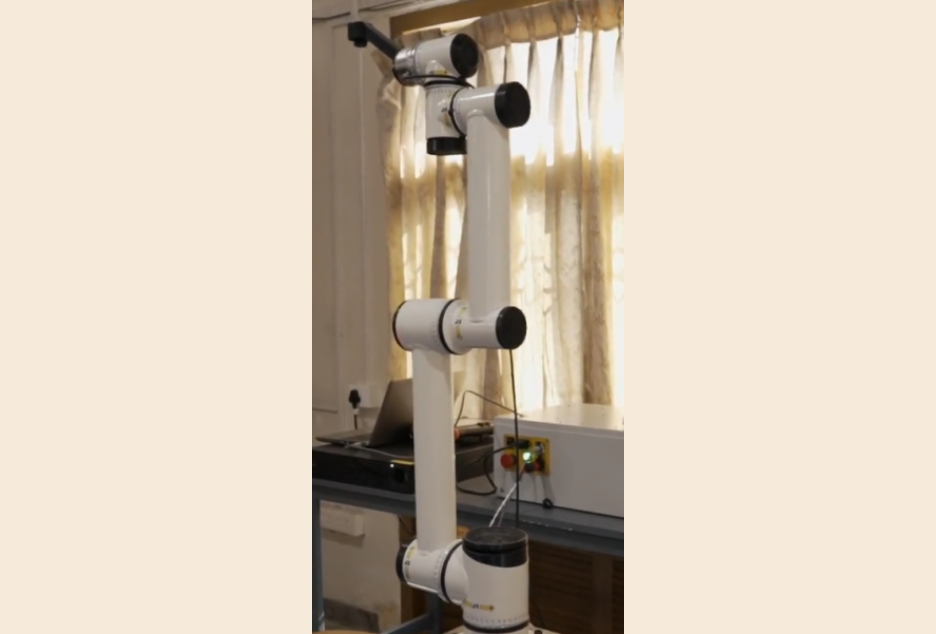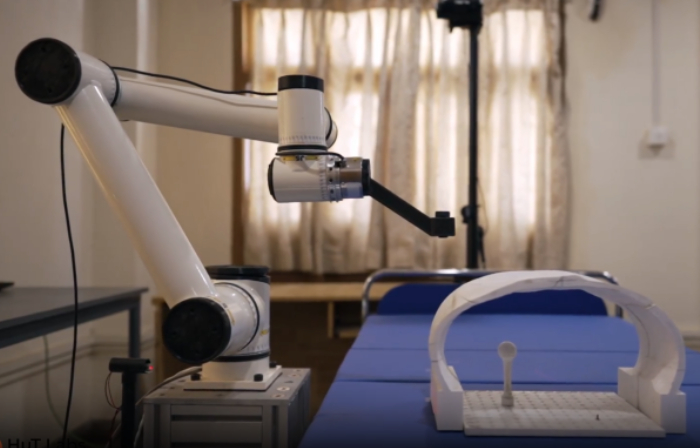
The robotic ultrasound hyperthermia system is a precision therapy that uses a six-axis robotic arm fitted with an ultrasound transducer to gently heat tumour tissue before radiation treatment. The patient is first carefully positioned and aligned using laser guidance to match prior imaging, ensuring accurate targeting. The robot then attaches the ultrasound probe, which is configured based on the tumour’s depth and treatment plan, with a gel pad used to ensure proper contact and energy transmission. During treatment, the robotic arm maintains steady contact using force feedback while delivering controlled ultrasound energy to raise the tumour temperature to about 43–45 °C for 45–60 minutes, improving its sensitivity to radiation. Safety systems continuously monitor force and temperature, automatically stopping the procedure if limits are exceeded, after which the probe is withdrawn.
The 6-DOF articulated robotic arm is used to support brachytherapy procedures by enabling precise positioning and orientation of catheter insertion tools based on image-guided planning. Integrated with CT imaging and DICOM-based treatment data, the robotic arm utilises registered tumour coordinates and clinician-defined entry points to align its end-effector along planned insertion trajectories while respecting anatomical constraints and predefined no-go zones. Leveraging its full kinematic flexibility, it positions itself at the skin entry location. It guides catheter insertion with high accuracy, executing stepwise motion commands via the GUI under supervised or semi-autonomous control. This targeted integration enhances the accuracy, repeatability, and reliability of catheter placement, which is critical for effective localised radiation delivery in brachytherapy.